

Travel Bag Manufacturer: A Sourcing Guide by Category
“Travel bag” is one of the broadest terms in the industry. It covers soft duffels, weekender bags, backpacks, garment bags, toiletry kits, and wheeled hardside suitcases — products so different that no single factory makes all of them well. A travel bag manufacturer that excels at sewn soft goods is the wrong supplier for a wheeled aluminum suitcase, and vice versa. This is the first thing to understand before you contact anyone: “travel bag manufacturer” is not one supplier type, it is several.
Choosing the right one starts with knowing which category your product falls into, because the category determines the factory type, the materials, the MOQ, and the entire production process. A soft-goods factory works in cut-and-sew textile construction; a hardside luggage factory works in injection molding or metal forming. Sending your project to the wrong type means a worse product, a higher price, or both.
This guide maps the travel bag categories to the right factory type, explains how MOQ and materials differ across them, and shows how to source each well. It is written for brands and buyers developing a travel product, from the buyer’s side. At Aluvox, we are a hardside travel bag manufacturer — wheeled luggage in aluminum, polycarbonate, ABS, PP, and titanium — so we will be clear about where our category fits and where a different supplier serves you better.
The Travel Bag Categories — And Why They Need Different Factories
A travel bag manufacturer designs and produces products across a spectrum, but the spectrum divides into two fundamentally different construction families, each requiring a different factory.
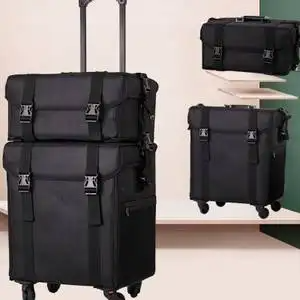
Soft-goods travel bags (cut-and-sew construction). This family includes duffels, weekender bags, backpacks, garment bags, toiletry kits, and packing organizers. They are built by cutting and sewing textiles — nylon, polyester, canvas, leather — with the factory’s expertise in fabric selection, pattern-making, stitching, and textile treatments. Soft-goods factories typically work with materials like 600D or 1680D nylon and YKK zippers, and their MOQs can be relatively flexible because there is no hard tooling — often in the range of 50 to 500 pieces, sometimes higher for fully custom work.
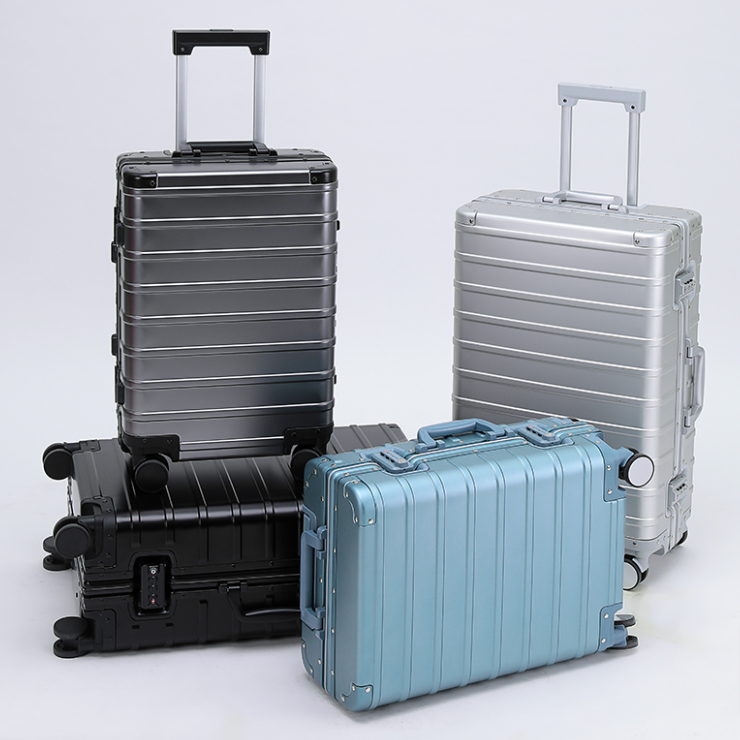
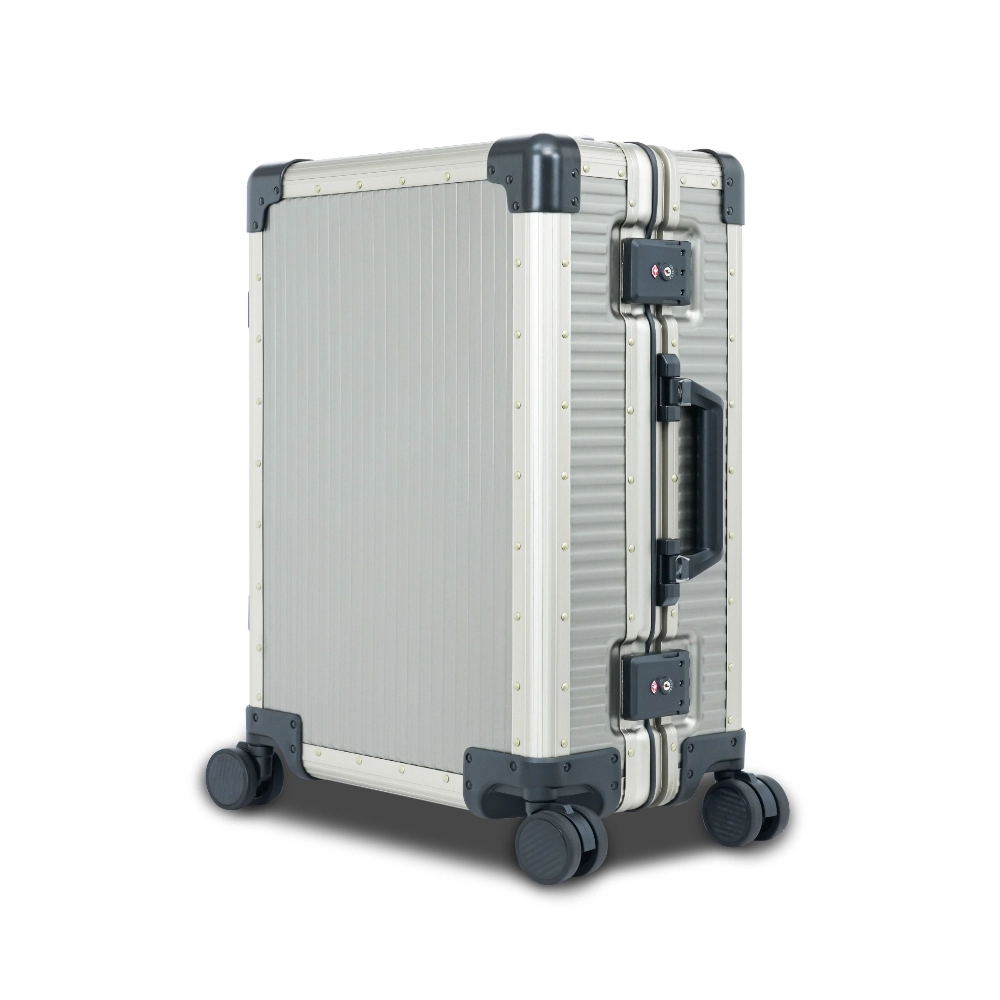
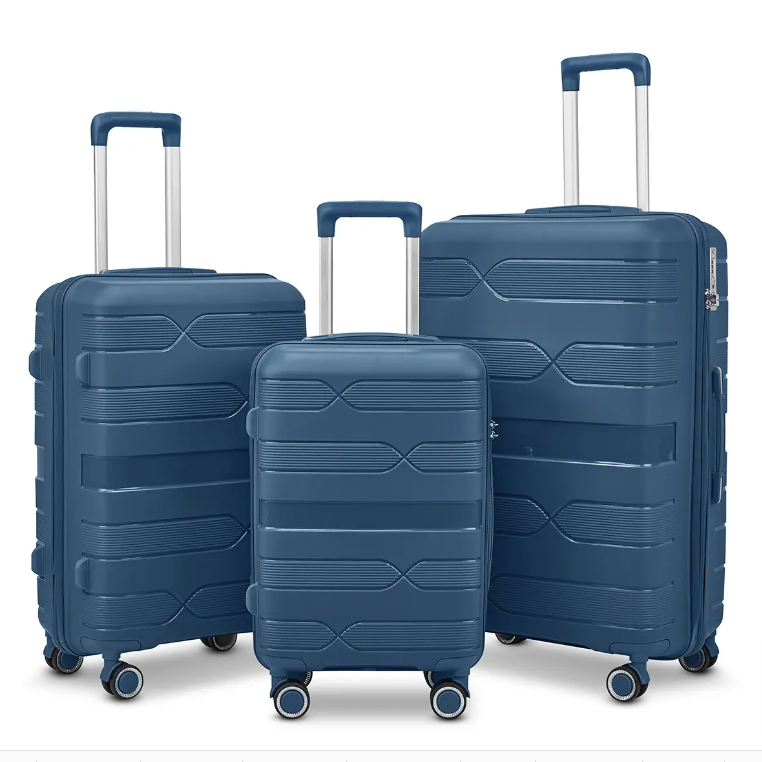
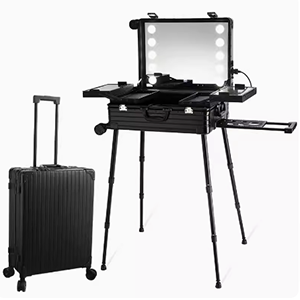
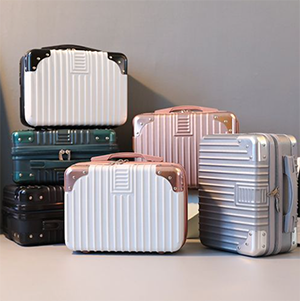
Hardside travel bags (molded or formed construction). This family is wheeled hardside luggage — spinners and carry-ons in polycarbonate, ABS, aluminum, or titanium. They are built by injection molding (for PC/ABS) or metal forming (for aluminum and aluminum-frame cases), with the factory’s expertise in mold development, shell structure, and the wheel, handle, and closure systems that rolling luggage requires. Hardside MOQs are typically higher than soft goods because of tooling and material-run economics, and the production process is entirely different — closer to manufacturing a molded product than sewing a textile one.
Why the distinction matters. These are not two product lines within one factory; they are usually two different factories with different equipment, different skills, and different supply chains. Some large full-service manufacturers do both, but most specialize. The single most common mistake in sourcing travel bags is approaching the wrong family — asking a cut-and-sew duffel factory to produce a wheeled aluminum suitcase, or expecting a hardside molder to deliver a soft leather weekender. Knowing your family first is what makes everything after it work. For the broader manufacturer evaluation framework, see: Suitcase Manufacturers: A Buyer’s Evaluation Guide →
Matching Your Product to the Right Factory Type
Once you know the two families, matching your specific product to the right factory type is straightforward. Here is how the common travel bag products map.
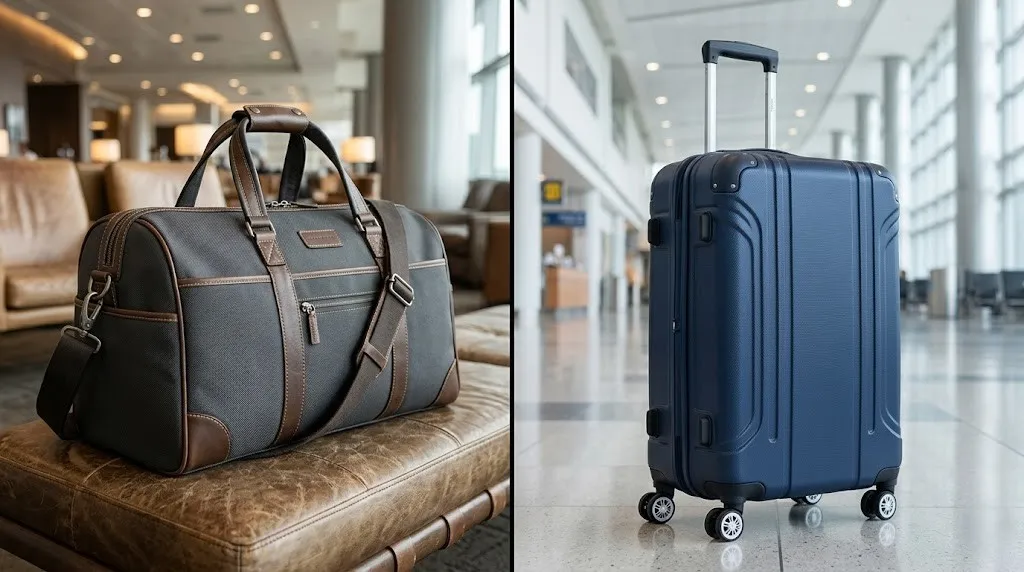
If your product is a duffel, weekender, backpack, or garment bag — a soft, sewn product — you need a cut-and-sew soft-goods factory. Look for textile expertise, a strong fabric and hardware supply chain, and experience with the specific construction (a structured weekender is different from a packable duffel). These factories often support lower MOQs and faster sampling because there is no tooling.
If your product is a wheeled hardside suitcase — a spinner, carry-on, or check-in in PC, ABS, or aluminum — you need a hardside luggage manufacturer. Look for in-house mold capability (for PC/ABS) or metal-forming expertise (for aluminum), wheel and handle testing, and drop-test documentation. This is a molding or forming operation, not a sewing one.
If your product is a hybrid — a wheeled duffel, or a backpack with a trolley sleeve — you need a factory comfortable with both soft and structured elements, or a full-service manufacturer that integrates them. These products combine cut-and-sew bodies with structural components and require a supplier that handles the integration.
If you are launching a multi-category travel line — say a hardside suitcase plus a matching duffel and toiletry kit — you have two options: a full-service manufacturer that produces across families, or separate specialist factories for each. The full-service route simplifies coordination; the specialist route can deliver a better product in each category. The right choice depends on whether coordination or category excellence matters more to your brand.
The principle throughout: match the factory to the construction, not just to the word “travel bag.” A factory’s core competence is in either textiles or molding, rarely equally in both. For how the OEM cost mechanics differ once you have the right factory, see: OEM Luggage Manufacturer Selection & Cost Guide →
How MOQ and Materials Differ Across Categories
A practical consequence of the soft/hard divide is that MOQ and material decisions work very differently in each family. Understanding this helps you plan volume and budget realistically.
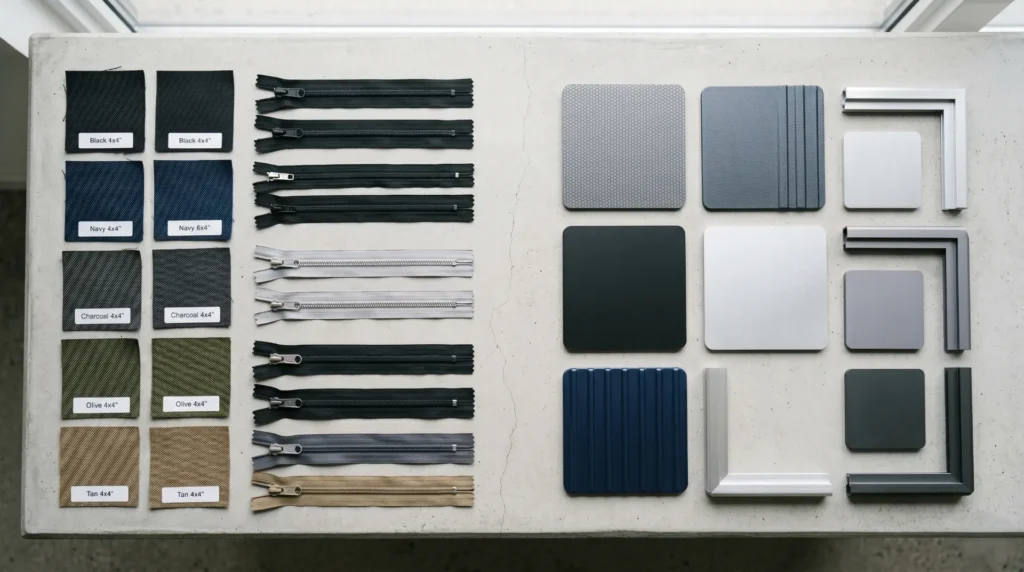
Soft-goods MOQ and materials. Because soft goods have no hard tooling, MOQs can start lower — some factories accept 50 to 300 pieces, with 200 to 500 common for custom work. The MOQ driver is fabric: many fabrics and colors must be purchased in minimum quantities, so the fabric order, not the tooling, sets the floor. A smart way to manage this is sharing materials across SKUs — using the same nylon across a backpack, duffel, and sling bag consolidates the fabric order while diversifying the product range. Using standard stock fabric colors and establishing brand identity through low-MOQ components (woven labels, custom zipper pulls, distinct linings) also keeps minimums down.
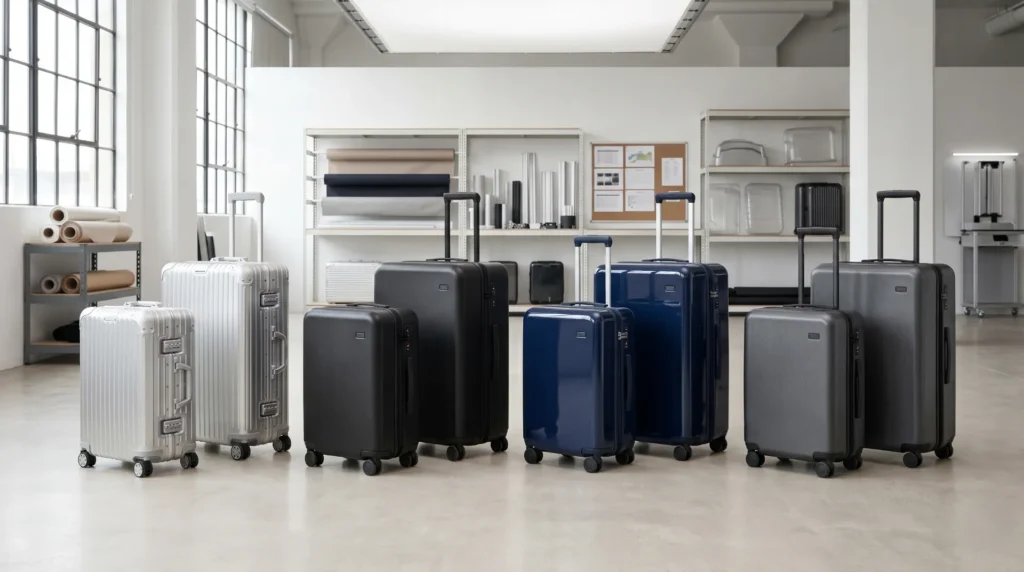
Hardside MOQ and materials. Hardside luggage carries higher MOQs because tooling and material-run economics demand volume to be efficient. A custom shell requires a mold, and that fixed cost is recovered across the order. The MOQ driver here is tooling and production-run efficiency, not fabric. The way to manage hardside MOQ is to start on an existing shell with surface customization (color, logo, hardware) rather than new tooling, and to use color splitting — multiple colors within one minimum — to launch a varied line at a manageable total commitment.
The gradient-order strategy works for both. Across both families, a proven approach is the gradient order: a smaller initial run to test the market — for example 300 units — with a commitment to scale to higher volume once sell-through is proven. This manages risk while still accessing reasonable pricing, and most flexible factories will work with it. For the full minimum-order structure, see: Custom Luggage MOQ Guide →
How to Source a Travel Bag Manufacturer Well
Whichever category you are in, a set of sourcing practices separates a smooth project from a costly one. These apply to soft and hardside alike.
Prepare a tech pack before you contact factories. Define your product clearly — materials, dimensions, functional requirements, target FOB price, and any certifications needed. A clear tech pack gets accurate, comparable quotes; a vague brief gets vague quotes you cannot evaluate. This single preparation step reduces communication errors and speeds development more than anything else.
Confirm certifications for your market. Travel bags sold internationally face market-specific compliance — ISO 9001 for quality systems, REACH for the EU, Prop 65 for California, and for soft goods, textile and chemical standards like OEKO-TEX. For eco-positioned brands, GRS and recycled-content certifications matter. Confirm the factory holds what your market requires, and ask for factory-wide audits rather than fabric-level certificates alone.
Always sample before bulk. Request a pre-production sample and approve it before mass production. For soft goods, this confirms construction and materials; for hardside, it confirms shell, color, hardware, and dimensions. A pilot order of 100 to 200 units is also a proven way to test real defect rates and QC execution before a large commitment.
Run a measurable QC standard. Quality cannot be judged subjectively. Professional buyers apply the Acceptable Quality Limit (AQL) standard to inspection, with AQL 2.5 a common benchmark. Confirm the factory inspects against a defined standard and will provide inspection reports.
Model the full landed cost. The FOB quote is the start, not the total. Add freight, duties, and inland transport for your true per-unit cost, and remember that material choices drive cost — premium nylon and YKK zippers, or aircraft-grade aluminum, cost more than basic alternatives. Compare suppliers on landed cost, not the headline quote.
Sourcing a wheeled or hardside travel bag? Request a quote — send your product type, target volume, and tech pack, and we will respond with material, MOQ, and lead-time guidance within 2 business days. Request Quote
Aluvox as a Hardside Travel Bag Manufacturer
Aluvox specializes in the hardside family — wheeled travel bags and luggage in molded and metal construction. If your travel bag is a rolling suitcase, this is our category; if it is a soft duffel or backpack, we will tell you a cut-and-sew specialist is the better fit.
What we manufacture:
| Category | Construction |
|---|---|
| Wheeled hardside carry-on / check-in | Polycarbonate or ABS injection-molded shell |
| Aluminum and aluminum-frame suitcases | 5052-H32 aluminum-magnesium alloy |
| Titanium luggage | TC4 / Grade 5 titanium |
| PP-shell luggage | Polypropylene |
Production parameters:
| Parameter | Specification |
|---|---|
| MOQ | 300 pcs / style |
| Color splitting | Supported — total order MOQ across colors |
| Customization | Color, finish, hardware, interior, logo, packaging, full tooling |
| Vertical integration | In-house mold workshop and core component control |
| QC standard | IQC, in-process, pre-shipment inspection (AQL 2.5) |
| Sample lead time (existing tooling) | 20 working days |
| New mold development | 30–45 working days |
| Bulk production | 45 days from deposit |
| Payment terms | 30% deposit + 70% against B/L |
| Export ports | Huangpu, Nansha, Shekou, Yantian |
Honest category guidance: Aluvox provides OEM and ODM for the hardside travel bag family, with in-house tooling, AQL 2.5 QC, and ISTA drop-test documentation. For a multi-category line that pairs a hardside suitcase with soft duffels, we can produce the hardside pieces and advise on coordinating a soft-goods specialist for the rest.
Browse the Aluvox travel luggage collection →
Visit the Aluvox private label luggage manufacturer page →
Match the Factory to the Product
The key to sourcing a travel bag manufacturer is recognizing that “travel bag” is a category spanning two different construction families — soft cut-and-sew goods and hardside molded or formed luggage — each made by a different kind of factory. Identify which family your product belongs to first, and the right supplier type, MOQ logic, and material decisions all follow from there. The most expensive mistake is approaching the wrong family and discovering, after samples and deposits, that the factory’s core competence does not match your product.
Once you have the right factory type, the sourcing discipline is the same across both: prepare a clear tech pack, confirm market certifications, sample before bulk, inspect against AQL 2.5, and model the full landed cost. Done with that discipline, the result is a travel bag that matches your specification at a price that protects your margin.
If your travel bag is a wheeled or hardside product, Aluvox can manufacture it and provide a quote with material, MOQ, and lead-time guidance — and if it is soft goods, we will point you toward the right specialist.
Contact our Sales Team — tell us your travel bag type, target volume, and tech pack. We will provide a quote or, for soft goods, guidance on the right factory type, within 2 business days. Contact Sales Team