

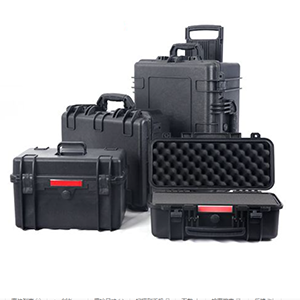
Makeup Case Manufacturer: OEM Sourcing Guide for Beauty Brands
The makeup case market sits at an intersection that most sourcing guides miss: it requires the structural engineering standards of hard-shell luggage and the interior design precision of a professional tool. A factory that does one well does not automatically do the other.
For beauty brands building a product line, and for professional makeup artists sourcing at scale, the evaluation criteria for a makeup case manufacturer are more specific than general luggage sourcing — and the failure modes are more costly, because the end user’s livelihood often depends on the product performing under professional use conditions.
This guide covers what experienced buyers verify before committing to a makeup case OEM partner — material selection, factory capability, customization scope, and the red flags that indicate a factory is not structured for this category.
At Aluvox, we manufacture aluminum, ABS, PVC, and nylon makeup cases from our Dongguan, Guangdong facility, with OEM and ODM programs starting from 300 pieces. The framework below applies to evaluating any makeup case manufacturer, including us.
The Makeup Case Market: What Brand Buyers Are Actually Sourcing
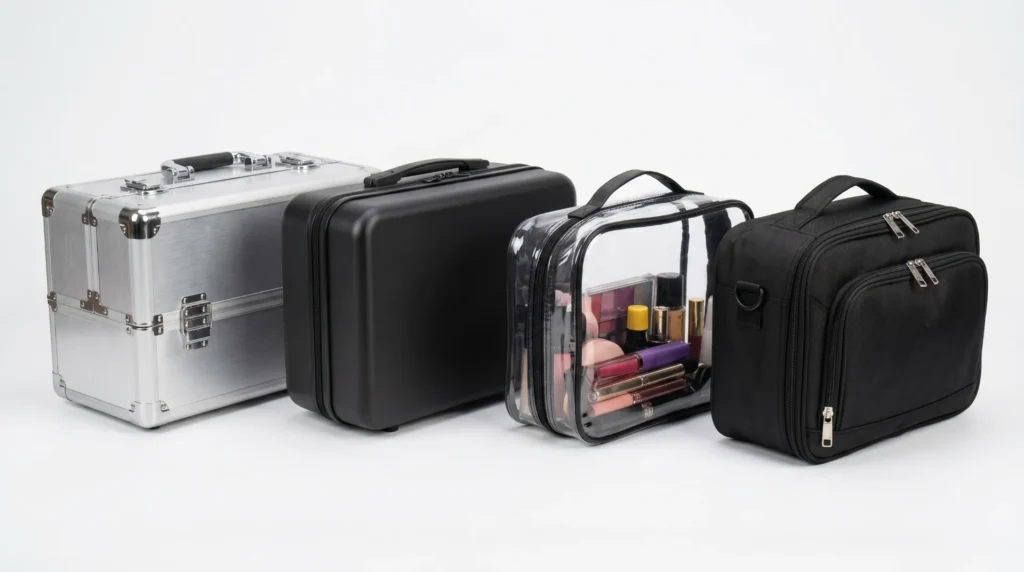
Before evaluating factories, clarifying what you are actually buying matters more in this category than in general luggage. Makeup cases span a wide range of formats, materials, and functional requirements — and not every manufacturer serves every segment.
The four primary formats:
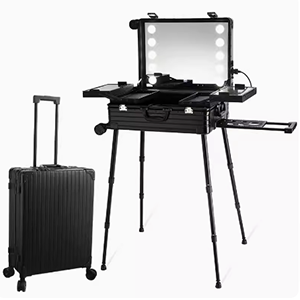
A makeup trolley is a rolling hard-shell case with a telescopic handle, designed for professional use by working makeup artists. The structural requirements are high: the shell needs to withstand daily professional travel, the wheels need to perform under significant load, and the interior needs to be configurable for a working kit.
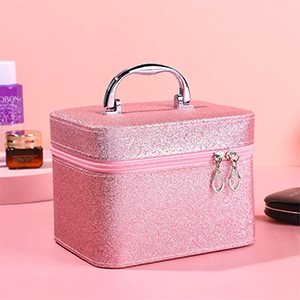
A train case is a compact hard-shell case with a top-opening lid and tiered interior, used for both professional kit organization and brand retail lines. It requires precise interior fitment and reliable latch hardware.
A makeup light case integrates LED lighting into the lid or interior — a specialized format growing in professional and content-creator markets.
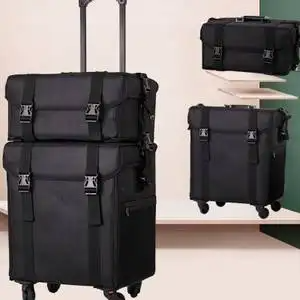
A cosmetic bag or soft case is fabric-based — nylon, PVC, or canvas — and serves entry-level retail and promotional use cases.
Material positioning across the market:
| Material | Retail range | Key advantage | Best for |
|---|---|---|---|
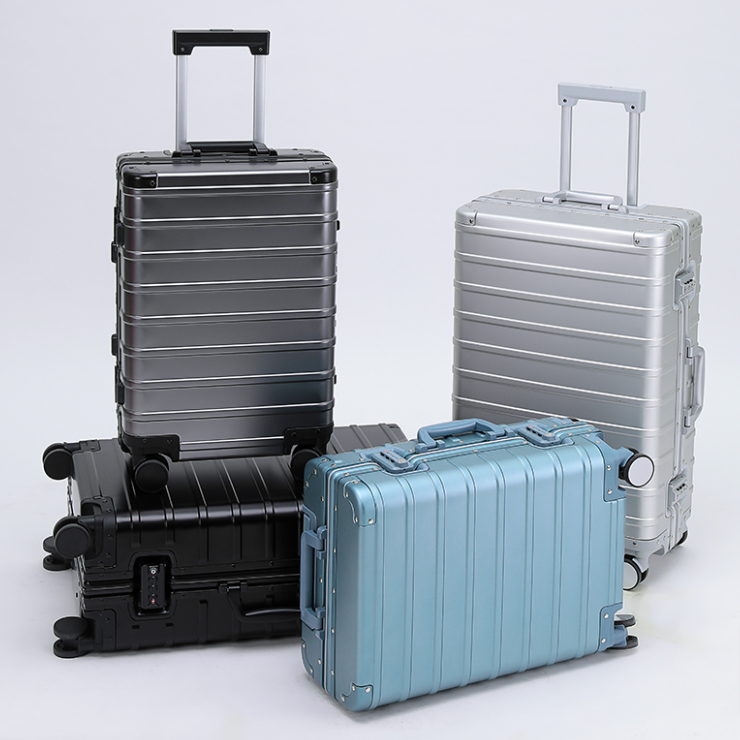
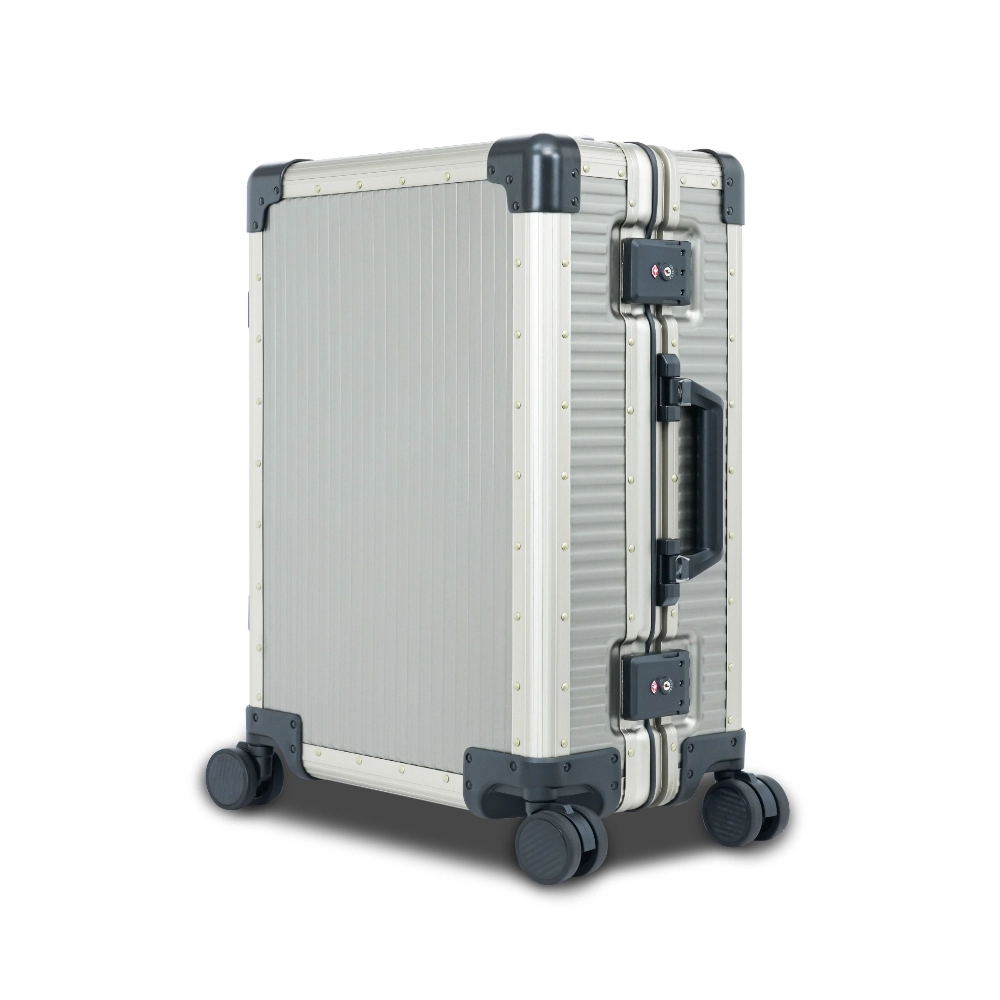
| Aluminum | $150–$400 | Durability, professional credibility | Professional artists, premium brands |
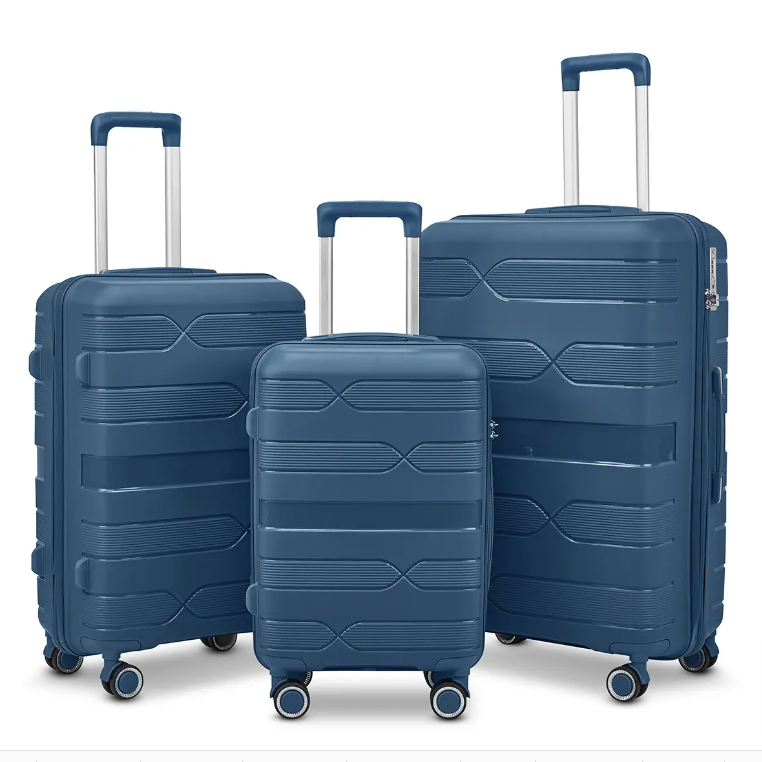
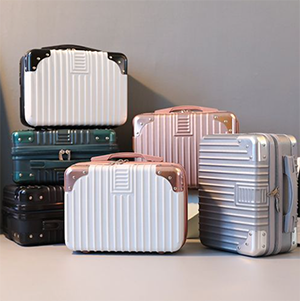
| ABS | $50–$150 | Color range, cost efficiency | Beauty brand retail lines |
| PVC | $30–$100 | Transparency, visual appeal | Fashion-forward, young brands |
| Nylon | $20–$80 | Lightweight, promotional | Entry-level, GWP, promotional |
Most beauty brands launching their first makeup case line start with ABS — lower tooling cost, wider color range, accessible MOQ. Brands targeting the professional market or premium positioning use aluminum. PVC and nylon serve specific retail and promotional use cases rather than the professional segment.
Browse aluminum makeup suitcases and ABS makeup suitcases to see current production examples →
Six Factory Capability Checks for Makeup Case Sourcing
Not every factory that quotes makeup cases has genuine hard-shell manufacturing capability. Many soft bag manufacturers have added makeup cases to their catalog without investing in the equipment or expertise the category requires. These six checks separate capable factories from catalog entries.
1. Hard-Shell Manufacturing Capability
A genuine makeup case manufacturer operates stamping equipment for aluminum production or injection and vacuum thermoforming equipment for ABS and PVC. Soft bag factories — even experienced ones — do not have this equipment. Their makeup cases are typically sourced from a third party and assembled in-house, which means quality control over the shell is indirect at best.
Ask the factory directly: do you produce your hard-shell cases in-house? Request to see the forming equipment during a site visit or via documented video footage. A factory that deflects this question is sourcing shells externally.
2. Interior Structure Customization
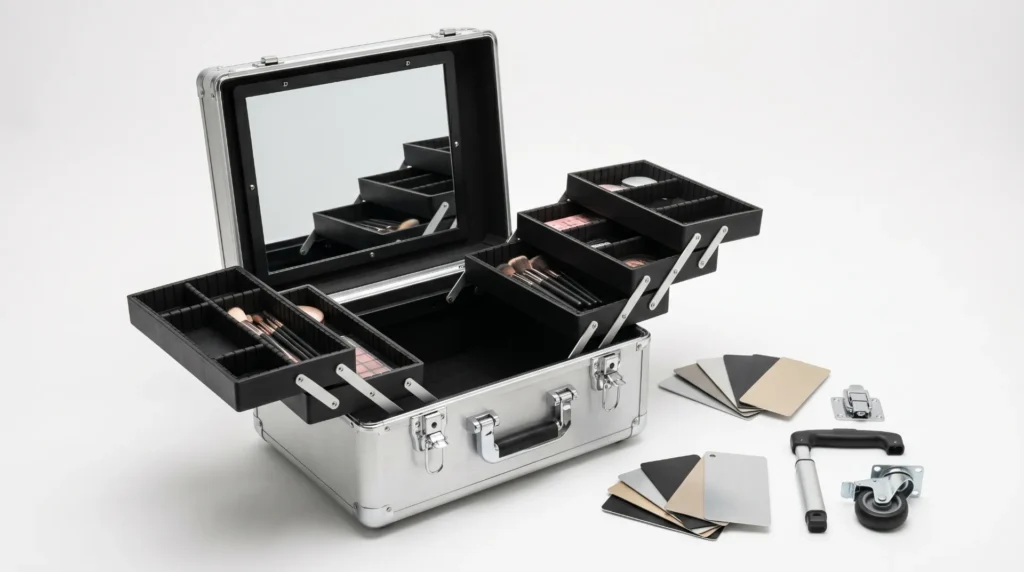
The interior of a professional makeup case is a functional system, not a decorative element. Professional users need configurable compartments, adjustable divider positions, and tray depths that match their specific tools.
Ask specifically: what tray depth options are available? Can dividers be repositioned or removed? Can a mirror be integrated into the lid? What is the minimum and maximum number of tiers available? A factory that can only offer a fixed interior layout has not invested in this category’s tooling requirements.
A professional standard for makeup trolleys is a tray depth of 12cm — sufficient for most professional tools including brushes, palettes, and product bottles. Factories producing shallower trays are typically oriented toward retail aesthetics rather than professional function.
3. Hardware Specification and Testing
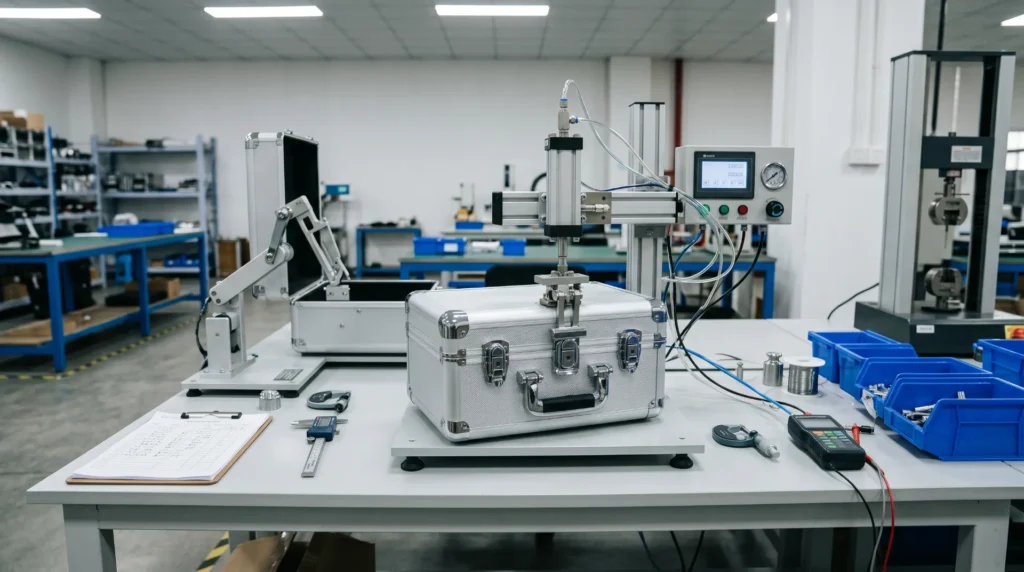
Makeup cases in professional use undergo significantly more open-close cycles than leisure luggage. Latches, hinges, and wheel systems need to be specified to a minimum cycle rating and tested accordingly.
Request hardware specification documentation: latch cycle rating (minimum 3,000 cycles for retail, higher for professional use), wheel load rating and drag distance, handle extension fatigue rating. A credible custom makeup case manufacturer maintains this documentation and provides it on request. Factories that describe hardware quality in subjective terms rather than measurable specifications have not tested to a defined standard.
4. Raw Material Traceability
ABS is the most common material for mid-range makeup cases — and it carries the same blending risk as ABS in luggage production. Some factories blend lower-grade resin into ABS shells to reduce material costs without changing the quoted specification. The result is a shell that looks identical but performs differently under repeated professional use.
Request raw material documentation for ABS cases: the resin brand and grade for each production batch. For aluminum cases, request the alloy mill certificate. Factories with genuine traceability produce this documentation immediately.
5. QC Process and Testing Standards
A credible makeup case manufacturer conducts pre-shipment testing across multiple categories: shell structural integrity, hardware function, interior fitting accuracy, surface finish consistency, and waterproofing. Aluvox conducts 45-day QC testing before bulk goods are released for export.
Ask whether pre-shipment inspection is conducted in-house or by a third-party body. For buyers who cannot physically inspect production, third-party inspection documentation from SGS, Bureau Veritas, or Intertek is the only independent quality verification available.
6. Sample Process and Lead Time
For existing tooling, Aluvox produces makeup case samples within 7–15 working days. Bulk production lead time is 45 days from deposit receipt. MOQ starts at 300 pieces per style.
These parameters allow beauty brands to evaluate actual production quality before committing to full orders — and to plan product launches with realistic timelines rather than catalog estimates.
Material Selection by Brand Tier
Choosing the right shell material for a makeup case is a brand positioning decision before it is a manufacturing decision. The wrong material for your target market creates margin problems at best and brand credibility problems at worst.
Aluminum: Professional and Premium Positioning
Aluminum makeup cases are the professional standard for working makeup artists because the material delivers structural performance that alternatives cannot match under daily professional use. A hard aluminum shell does not deform permanently under load, does not crack at corner impacts, and does not degrade in appearance over time in the way ABS does.
For brands targeting the professional market or the $150 and above retail tier, aluminum communicates the material investment the price point requires. The tradeoff is weight — aluminum cases are heavier than ABS equivalents — which is acceptable in professional use contexts but limits appeal in lightweight-sensitive retail segments.
ABS: The Commercial Center
ABS occupies the largest volume tier in the makeup case market because it balances performance, cost, and commercial flexibility better than any alternative at the $50–$150 retail range.
Color changes require no new tooling — only a resin color adjustment in the production process — which means brands can run seasonal collections, limited editions, and multi-colorway launches without the tooling cost and lead time of aluminum color changes. For beauty brands with frequent collection cycles, this flexibility has significant commercial value.
PVC and Nylon: Specific Use Cases
PVC’s transparency makes it commercially effective for display products — cases where visibility of contents is a feature rather than a limitation. For brands building retail displays or gift-with-purchase programs around visual presentation, PVC offers a format that aluminum and ABS cannot replicate.
Nylon serves the entry-level, promotional, and gift-with-purchase market. Its primary advantages are weight and cost — neither of which translates to professional performance, but both of which matter in volume promotional contexts.
For a detailed comparison of shell materials from a manufacturing perspective, see: Aluminum vs Polycarbonate Luggage: OEM Material Selection Guide →
Customization Scope: What Can and Cannot Be Changed
Understanding what requires new tooling investment and what does not prevents budget surprises and timeline mismatches.
Changes that require no new tooling:
- Shell color and surface finish
- Logo placement and application method (embossing, printing, engraving)
- Interior lining fabric, color, and pattern
- Hardware color and finish (gold, silver, matte black)
- Exterior label and packaging
Changes that require tooling investment:
- Interior tray depth and compartment configuration
- Number of tiers or tray count
- Mirror integration into lid
- Structural modifications to shell geometry
Full custom development:
- New shell shape or dimensions
- Proprietary locking or closure mechanism
- Integrated lighting system
Aluvox’s makeup case private label program supports complete design freedom across all of the above — from color and finish customization at minimal investment to full proprietary design development. The design process is collaborative: brands submit reference images, functional requirements, and target specifications, and Aluvox’s R&D team develops the solution.
Request an Aluvox makeup case sample — confirm interior structure, material quality, and customization options before committing to bulk production. Request Sample
Five Red Flags When Sourcing Makeup Cases
These signals each require a direct question and a satisfactory answer before proceeding.
Factory’s primary business is soft bags
A soft bag manufacturer that also quotes makeup cases is not a makeup case specialist. Their hard-shell cases are almost certainly sourced from a third party, which means quality control over the shell is not in their hands. Ask directly: do you produce your shells in-house? Show me the forming equipment.
Interior layout is fixed with no adjustment options
A fixed interior indicates the factory has not invested in configurable tooling for this category. For professional use cases, a fixed layout is a functional limitation. For retail brands with specific organizational requirements, it is a customization barrier.
No hardware cycle testing documentation
Professional-use hardware — latches, wheels, handles — should be rated and tested to a minimum cycle count. Factories that cannot provide this documentation are either not testing to a defined standard or testing in ways they prefer not to document.
ABS raw material source is unspecified
Unspecified resin sourcing is a flag for potential blending. Request the resin brand and grade for the specific production batch. A factory with nothing to hide answers this question immediately.
Sample and bulk production from different locations
Ask directly: will the production line that made my sample produce my bulk order? If the answer is uncertain or evasive, the factory is likely managing production through subcontractors — meaning your sample quality is not a reliable indicator of bulk quality.
For a comprehensive supplier evaluation framework that applies across makeup cases and luggage, see: How to Vet Industrial Luggage Suppliers →
Choosing a Makeup Case Manufacturer Is a Functional Decision
The professional makeup case category rewards buyers who specify functional requirements precisely and evaluate factories against those specifications systematically. A case that fails a latch, breaks a wheel, or delivers a fixed interior that does not match a professional artist’s kit is not a quality problem with generic consequences — it is a professional tools problem with direct impact on the buyer’s work and the brand’s credibility.
The material, hardware specification, interior configuration, and QC process are not secondary details to be confirmed after the price is agreed. They are the sourcing decision.
If you are building a makeup case line for a beauty brand or sourcing at scale for professional use, Aluvox engineers are available to review your requirements and provide a material recommendation, customization scope, and indicative cost structure within 2 business days.
Contact an Aluvox Engineer — submit your product format, target market, and estimated order volume. We will provide a material recommendation and indicative quote within 2 business days. Contact Engineering Team