

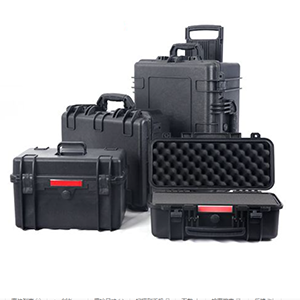
Makeup Luggage Guide: Trolley Cases for Beauty Brands
When buyers search for “makeup luggage,” they are looking for something specific — wheeled, trolley-style cosmetic storage with a telescopic handle and a multi-tier interior. This is a different product category from “makeup cases,” which are stationary, top-opening, hand-carry boxes. The two formats serve different end users, require different manufacturing processes, and command different price points.
The sourcing confusion happens because suppliers, buyers, and marketing copy across the industry use the terms interchangeably. A factory quotes “makeup luggage” and ships a stationary train case. A brand orders “makeup cases” and receives wheeled trolleys. The result is inventory that does not match the buyer’s intended market position — and customer service problems that compound across the product cycle.
This guide covers what makeup luggage actually is in the market today, the three production formats currently driving demand, and what brand buyers should specify when sourcing for retail or professional channels.
At Aluvox, we manufacture both makeup luggage (wheeled trolley formats) and makeup cases (stationary formats) from our Dongguan, Guangdong facility. OEM and ODM programs start from 300 pieces with sample lead times of 7–15 days for makeup category products. The framework below applies to evaluating any makeup luggage supplier, including us.
Makeup Luggage vs Makeup Case: The Format Distinction
Before sourcing, define which format you actually need. The two product categories share materials and surface treatments but differ in structural design, use case, and commercial positioning.
| Category | Format | Primary use | Retail price range |
|---|---|---|---|
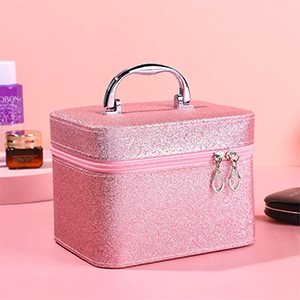
| Makeup case | Top-opening, stationary, hand-carry | Studio, home, fixed location use | $50–$200 |
| Makeup luggage | Wheeled trolley with telescopic handle | Mobile makeup artists, travel | $80–$300 |
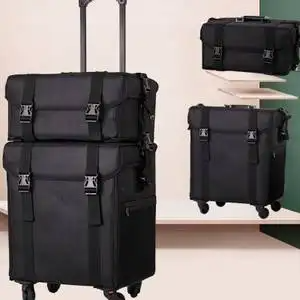
| Makeup trolley | Large wheeled case, professional grade | Wedding makeup artists, film, TV | $150–$400 |
Key structural differences:
Handle system. Makeup luggage includes a multi-position telescopic handle, typically aluminum or hardened plastic, integrated into the back panel. Makeup cases use simple top-mounted carrying handles or shoulder straps.
Wheel configuration. Makeup luggage uses four-wheel 360° spinner wheels for full directional mobility, or two-wheel inline systems for rougher surfaces. Makeup cases either have no wheels or basic fixed inline wheels intended for occasional transport rather than primary mobility.
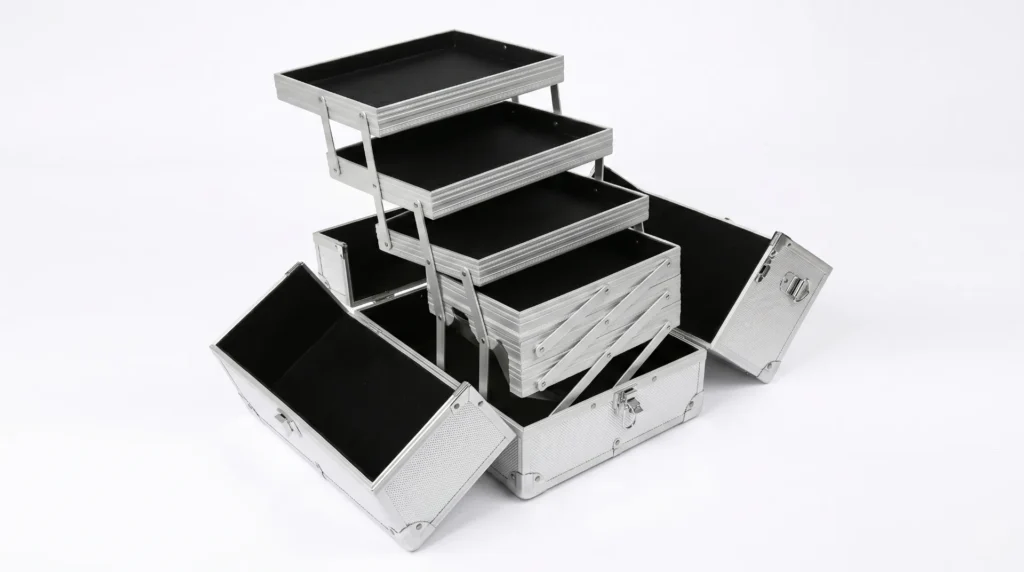
Interior structure. Makeup luggage typically includes multiple stackable tiers, vanity mirror integration, and lockable compartments — features that suit professional working scenarios where the case stays open during use. Makeup cases usually have a single internal tray or two-tier structure, designed for occasional access rather than continuous workflow.
For a deeper look at the stationary makeup case category specifically, see: Makeup Case Manufacturer Guide →
For brands sourcing private label makeup cases at OEM volumes, see: Custom Makeup Case Manufacturer →
Three Makeup Luggage Formats Used in the Market Today
The makeup luggage category subdivides into three production formats, each targeting a different end user segment and price tier.
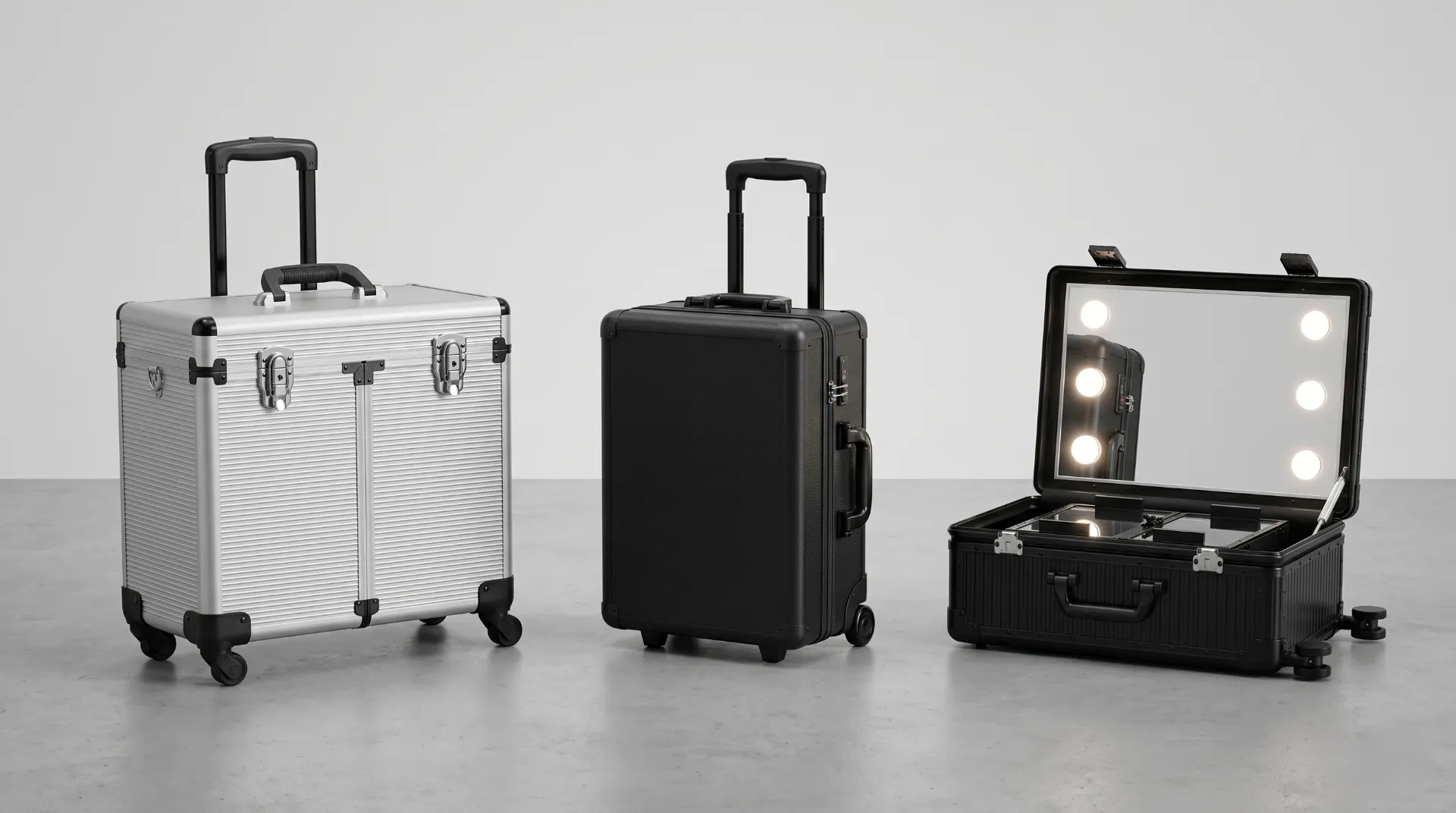
Format 1: Hard-Shell Makeup Trolley
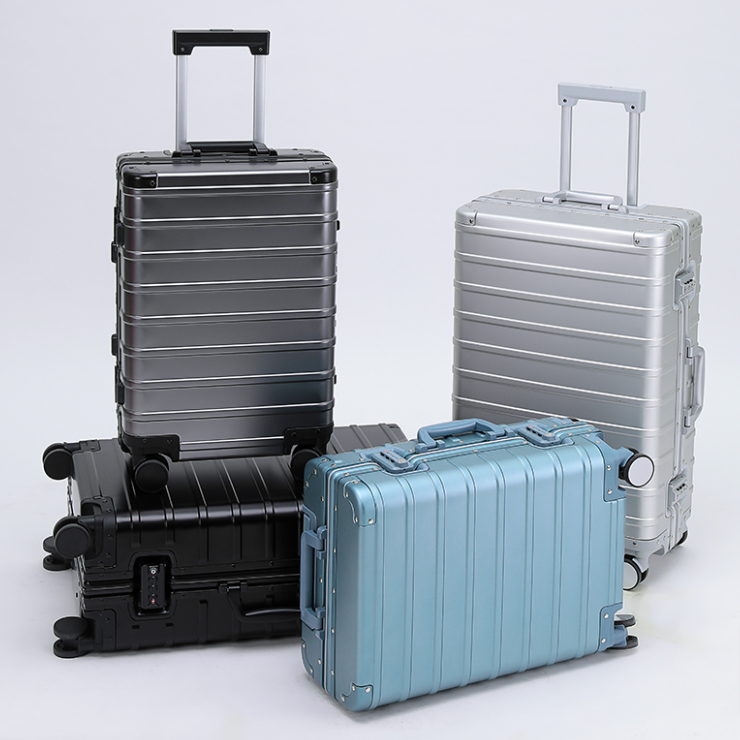
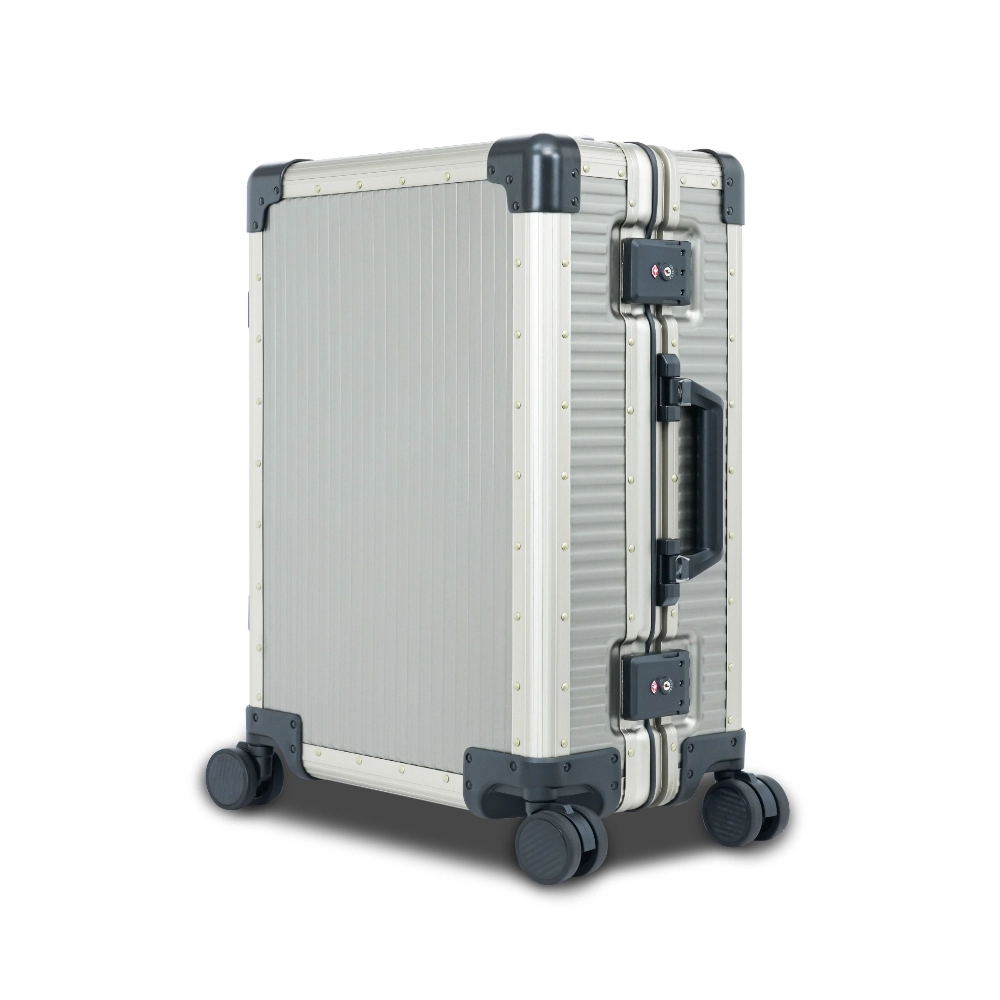
Aluminum or ABS shell with multi-tier interior trays, telescopic handle, and spinner wheels. Closure typically uses butterfly latches with TSA-compatible combination locks. Interior tray depth is industry-standard 12cm for professional applications — sufficient for brushes, palettes, product bottles, and tools.
This is the format most professional makeup artists use. It carries a full working kit, opens to a stable workstation configuration, and survives daily transit between client locations. The aluminum version commands premium pricing; the ABS version serves the entry to mid-range professional market.
Format 2: Wheeled Cosmetic Carry-On
A standard carry-on suitcase format (typically 55 x 35 x 20 cm) with cosmetic-specific interior organization — compartmentalized storage for product bottles, brush rolls, palette holders, and mirror mounting. Shell material is typically polycarbonate or aluminum.
This format serves traveling makeup artists, bridal makeup specialists who work across multiple venues, and beauty content creators who need their product kit airline-ready. The carry-on dimension compliance is the primary technical constraint — internal organization is customized to the brand’s specifications.
Format 3: LED-Integrated Makeup Light Case
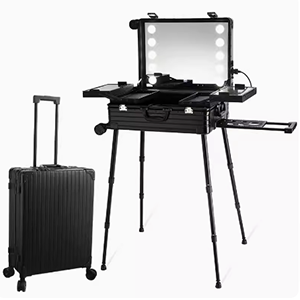
A hard-shell case with integrated LED lighting in the lid or interior, supporting professional makeup application in inconsistent lighting environments. This format is the fastest-growing segment in the makeup luggage category, driven by demand from beauty content creators, social media influencers, and professional makeup artists working in mobile contexts.
The technical complexity is higher than standard makeup luggage — LED integration requires waterproof wiring, battery housing, dimmer controls, and color temperature options. Sourcing this format requires factories with both luggage manufacturing capability and electrical integration expertise.
Material Selection for Makeup Luggage
Material selection determines retail price ceiling, weight, durability, and brand positioning. The makeup luggage category supports four primary materials, each appropriate for specific market segments.
| Material | Weight | Durability | Cost | Best for |
|---|---|---|---|---|
| Aluminum | Heavy | Best | High | Professional flagship, premium retail |
| Polycarbonate | Medium | Good | Medium | Mid-range travel cosmetic carry-on |
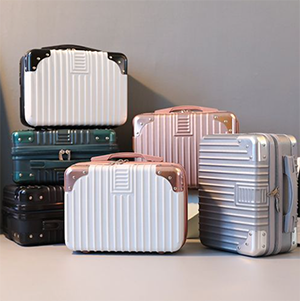
| ABS | Light | Moderate | Low | Entry retail, promotional, beauty brand color lines |
| PVC | Light | Moderate | Low | Display-oriented, transparent showcase products |
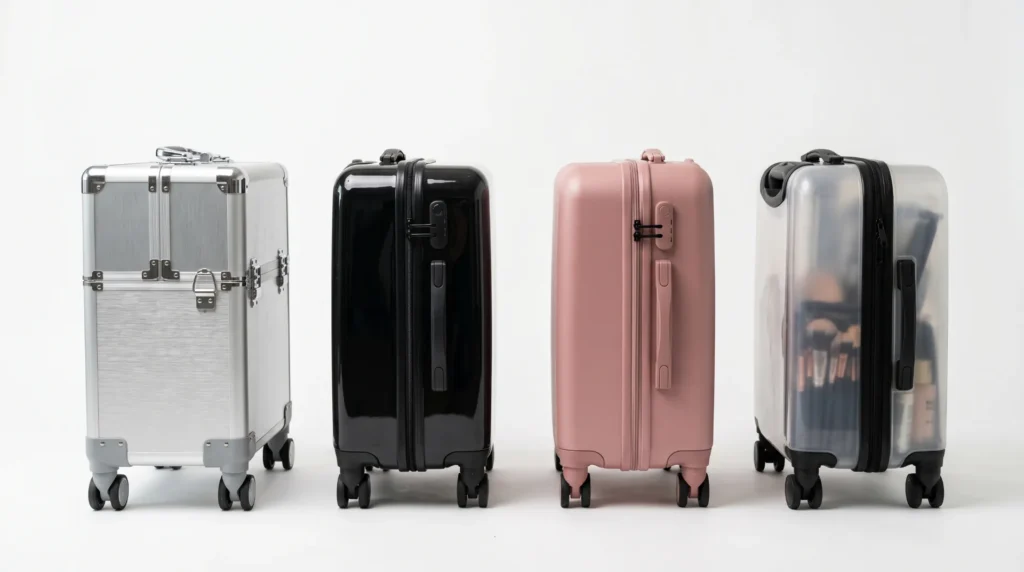
Aluminum: The professional standard. Aluminum makeup luggage signals durability, engineering investment, and professional positioning. The tradeoff is weight — a fully outfitted aluminum makeup trolley can weigh 5–7 kg empty, which limits airline carry-on compliance.
Polycarbonate (PC): The commercial middle ground. PC offers structural performance close to aluminum at meaningfully lower weight, with the color flexibility that beauty brands need for seasonal product launches and limited editions.
ABS: The entry tier. Lowest unit cost, widest color range, accessible MOQ. Appropriate for beauty brand retail product lines targeting the $50–$120 price point and promotional gift-with-purchase applications.
PVC: Specialty applications. PVC’s transparency makes it visually distinctive for retail display products where the contents themselves are part of the marketing.
For a detailed comparison of aluminum versus polycarbonate from a manufacturing perspective, see: Aluminum vs Polycarbonate Luggage →
What Beauty Brands Should Specify When Sourcing
A sample request without specifications produces a sample that may or may not match what your market needs. The following specifications should be defined in writing before any sample is produced.
Tray depth and tier configuration. 12cm tray depth is the professional standard — sufficient for brushes (typically 18-22cm length but stored angled), full-size product bottles, palettes, and tools. Brands targeting professional users should specify 12cm minimum. Brands targeting retail consumers can specify shallower trays (6-8cm) for a more compact product format.
Mirror integration. For professional makeup applications, lid-mounted mirrors are standard. Specify mirror dimensions, mounting method (recessed or surface-mounted), and whether the mirror should be tilt-adjustable. For LED light cases, mirror integration with the lighting system requires additional electrical specification.
Hardware cycle ratings. Makeup luggage hardware sees significantly higher use frequency than general luggage — professionals open and close their kit multiple times per client appointment. Specify minimum cycle ratings: latches and locks tested to 3,000+ open-close cycles, wheels tested under load to a defined drag distance.
Interior lining material. Lining options include PU leather (premium feel, easy to clean), brushed velvet (luxury aesthetic, harder to clean), waterproof nylon (practical, easy maintenance), and dye-cut foam (custom tool slots, professional precision fit). The lining decision affects both perceived quality and end-user practicality.
Lock specification. TSA-compatible combination locks are standard for makeup luggage destined for markets where the product travels through airline security. For non-airline use, latch-only configurations reduce hardware cost and complexity.
Aluvox Makeup Luggage OEM Program
Production parameters:
| Parameter | Specification |
|---|---|
| MOQ | 300 pcs / style |
| Color splitting | Supported — total order MOQ across colors |
| Sample lead time (makeup category) | 7–15 working days |
| Bulk production lead time | 45 days from deposit |
| Materials available | Aluminum, ABS, PC, PVC, Nylon |
| Customization scope | Color, surface finish, hardware, logo, lining, tray configuration |
| Export ports | Huangpu, Nansha, Shekou, Yantian |
Why makeup category sampling is faster (7–15 days): Makeup luggage and case sampling lead times are shorter than general luggage because most customization happens at the surface and interior level rather than at the shell tooling level. Color, logo, lining, and hardware modifications use existing tooling — which compresses the development cycle.
Browse the Aluvox makeup suitcase collection for current production examples →
For private label makeup luggage programs with full brand customization, see: Custom Private Label Makeup Case Manufacturer →
Request an Aluvox makeup luggage sample — verify interior tray depth, hardware quality, and customization options before committing to bulk production. Request Sample
Three Buyer Profiles for Makeup Luggage
The makeup luggage category serves three distinct buyer types, each with different sourcing priorities.
Profile A: Beauty brands building a retail product line
Volume-focused, weight-sensitive, color-flexible. The retail consumer who buys a $80 cosmetic luggage product expects light weight, multiple colorway options, and reasonable durability. ABS or PC shell, simplified interior, brand-customized exterior. MOQ split across 3–5 colorways. Lead time discipline matters because retail launch dates are fixed.
For brands at this stage building toward a full luggage line, see: Private Label Luggage Brand Guide →
Profile B: Professional makeup artist supply channels
Durability-focused, specification-driven, price tolerant. Buyers in this channel — beauty schools, makeup artist associations, professional supply distributors — require documented hardware cycle ratings, professional-standard 12cm tray depth, and durable closure systems. Aluminum is the dominant material. Custom interior configuration is common.
Profile C: Beauty content creator and influencer brand lines
Visual-first, feature-rich, smaller batch sizes. Influencer-brand cosmetic luggage typically includes LED lighting, distinctive surface finishes, and brand-aligned color schemes that match the creator’s content aesthetic. Production volumes are smaller but customization is more extensive. ODM with significant modification is the typical structure.
Choosing the Right Makeup Luggage Format Is a Channel Decision
The makeup luggage format you source is a function of the channel you sell into. A wheeled aluminum trolley designed for professional makeup artists does not work as a retail product at $200 — too heavy, too specialized, too expensive. An ABS cosmetic carry-on designed for retail does not work for professional makeup artists — insufficient durability, inadequate tray depth, hardware not rated for daily professional use.
The sourcing discipline is to match format to channel before negotiating price. The wrong format at the right price is still inventory that does not move.
If you are building a makeup luggage product line for any of the three buyer profiles above, Aluvox engineers are available to review your channel, retail positioning, and target specifications.
Contact an Aluvox Engineer — submit your target channel, retail price point, and estimated order volume. We will provide a makeup luggage format recommendation and indicative production quote within 2 business days. Contact Engineering Team