

Aluminum vs Polycarbonate Luggage: OEM Material Selection Guide for Brand Buyers
When sourcing hard-shell luggage for your brand, the choice between aluminum and polycarbonate is not purely aesthetic. It determines your factory MOQ threshold, your per-unit BOM cost, your return rate exposure, and the retail price ceiling your brand can credibly occupy.
Most material comparison guides are written for travelers. This one is written for brand buyers and sourcing managers evaluating which shell material to build their product line around — and what that decision costs in tooling, lead time, and supplier capability requirements.
At Aluvox, we have manufactured aluminum and polycarbonate luggage since 1995 for international brands across North America, Japan, Singapore, and the Middle East. The breakdown below reflects what we see on the factory floor, not just material data sheets.
Material Fundamentals: What Changes at the Factory Level
The core difference between aluminum and polycarbonate is not strength versus weight. It is manufacturing process — and that process difference drives every cost and lead time variable downstream.
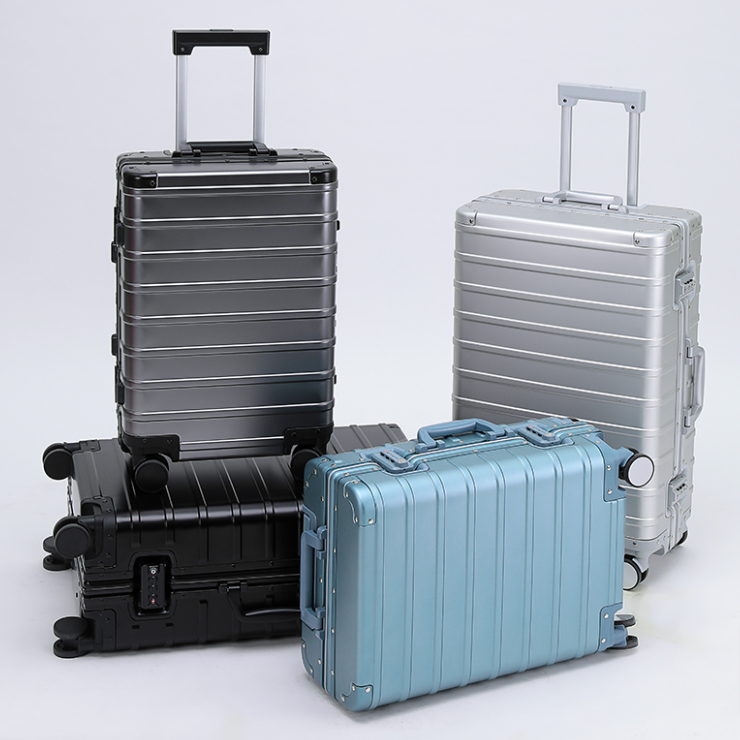
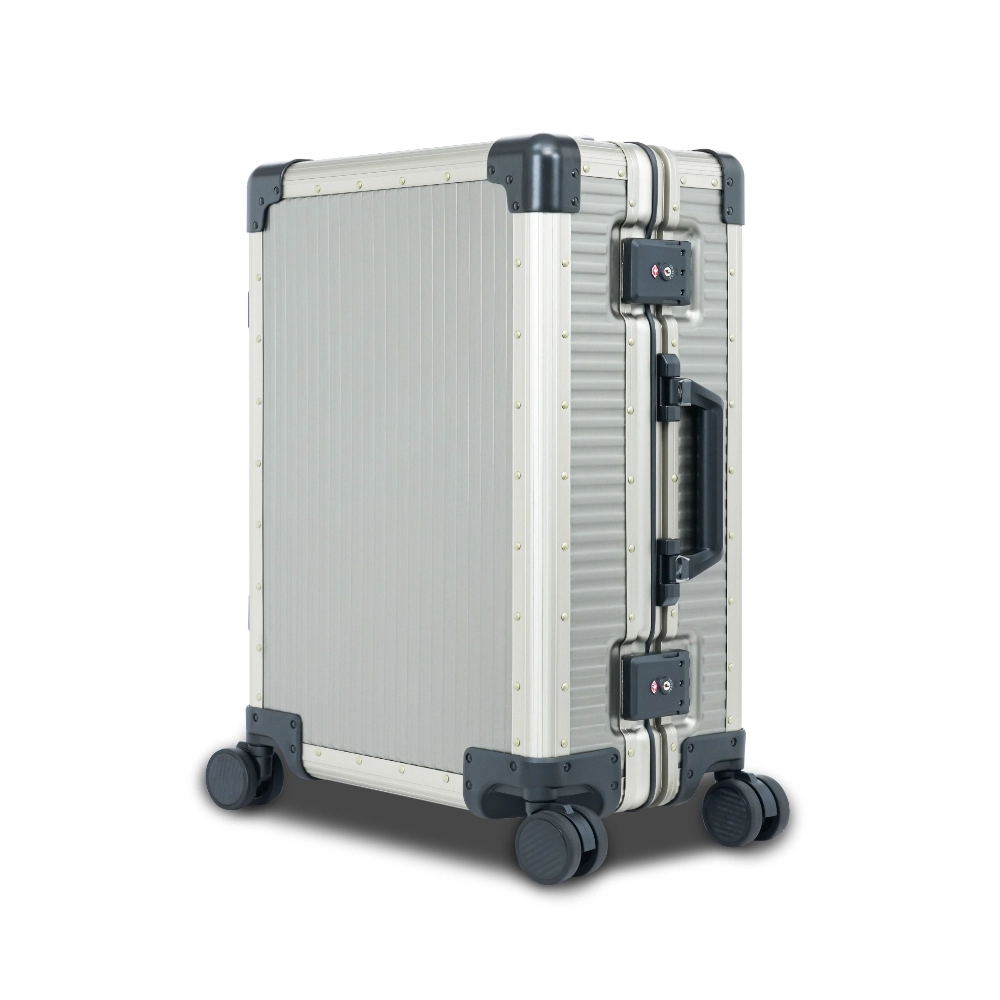
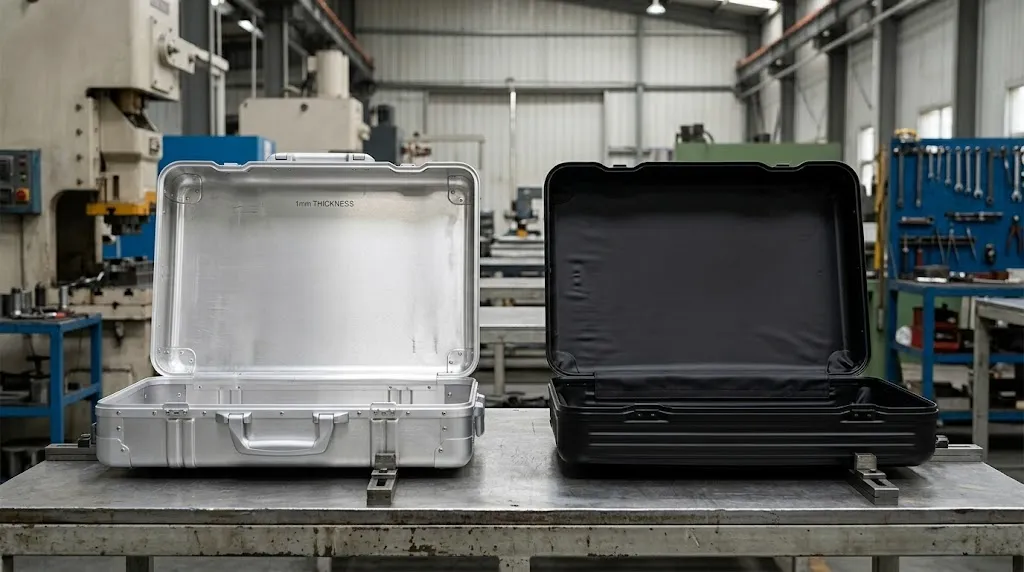
Aluminum luggage at Aluvox is produced from aerospace-grade Series 5 aluminum-magnesium alloy, formed at 1mm shell thickness via stamping. Each shell panel requires a dedicated stamping die. The alloy’s magnesium content improves corrosion resistance and structural integrity without increasing brittleness, which is why Series 5 is the standard for high-end luggage production rather than the lower-cost Series 3 alternatives. Surface finishing options include brushed, sandblasted, and anodized — each requiring a separate post-processing step that affects both lead time and unit cost.
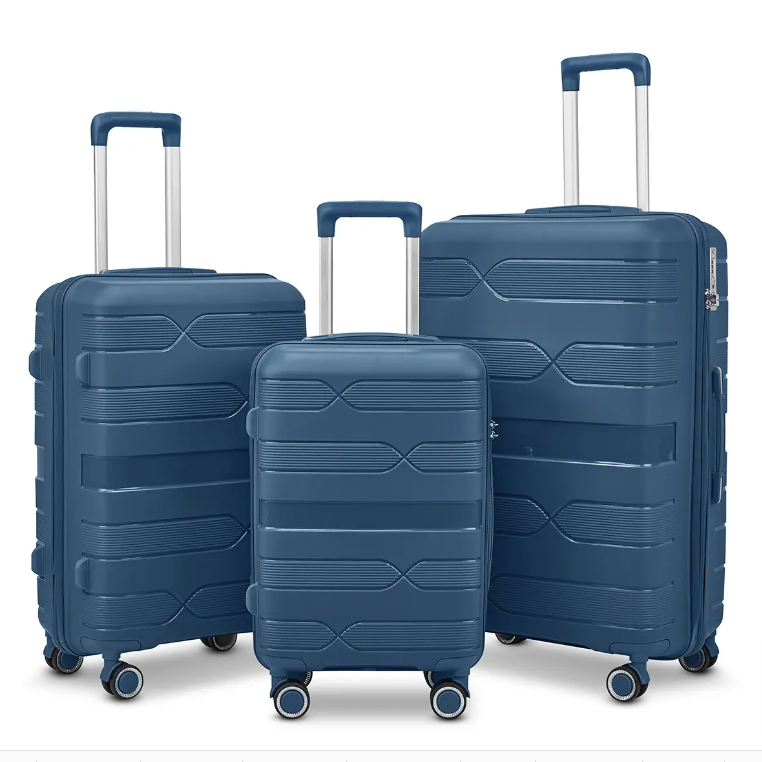
Polycarbonate luggage shells are formed through vacuum thermoforming or injection molding. PC is a thermoplastic, which means tooling development is faster and lower-cost than aluminum stamping dies. Shell thickness for luggage-grade PC typically runs 0.8mm–1.2mm. The material flexes on impact rather than deforming permanently, which changes both its damage profile and its warranty risk profile for brands.
The table below captures the manufacturing-level differences that matter for sourcing decisions:
| Specification | Aluminum (Series 5) | Polycarbonate |
|---|---|---|
| Shell thickness | 1mm | 0.8–1.2mm |
| Shell weight (20″ carry-on) | 1.8–2.2 kg | 0.9–1.3 kg |
| Forming method | Stamping | Vacuum forming / Injection |
| Tooling cost (per SKU) | $8,000–$15,000 | $3,000–$6,000 |
| Surface finish options | Brushed / Sandblasted / Anodized | Matte / Gloss / Texture print |
| Impact response | Permanent deformation (denting) | Elastic recovery (flex without cracking) |
| Corrosion resistance | High (Mg content) | N/A (non-metallic) |
One sourcing implication that buyers frequently underestimate: aluminum stamping dies are material-specific. A die built for Series 5 alloy cannot be directly reused for a different alloy grade without re-qualification. If your supplier switches raw material sources without disclosure, the mechanical properties of your finished product change — and your test certification may no longer be valid.
Testing Standards and Quality Evaluation
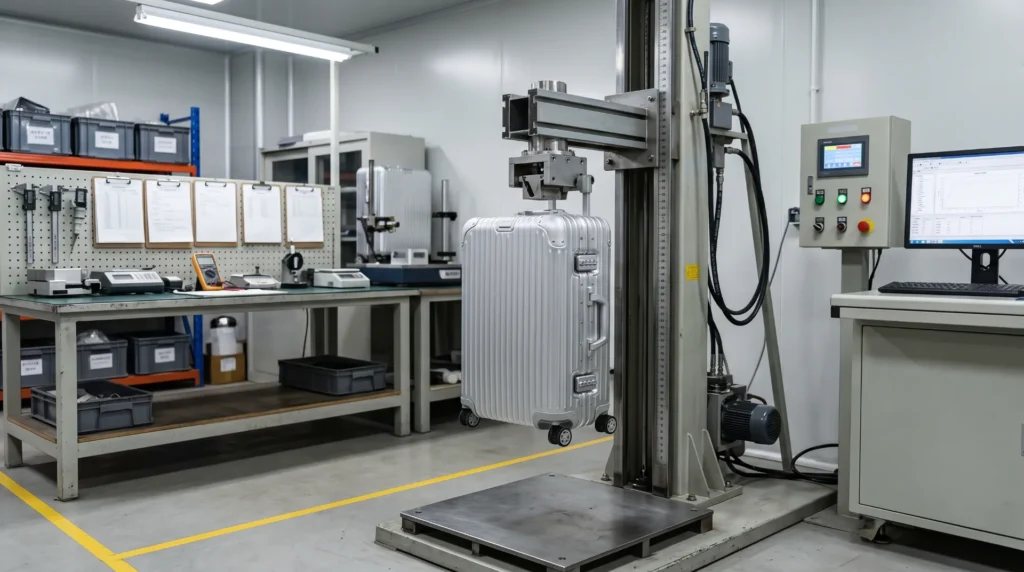
Hard-shell luggage undergoes multiple categories of structural testing before export qualification. The tests differ in what they reveal — and the pass/fail criteria matter differently depending on shell material.
Drop Testing (ISTA 2A / ASTM D5276)
Aluminum shells are evaluated for corner integrity and panel deformation. A compliant aluminum shell will show surface marking at corner impact but maintain structural closure function. Polycarbonate shells are evaluated for crack propagation — a shell that cracks at a corner joint under standard drop conditions indicates insufficient wall thickness or a material blend issue (PC mixed with lower-grade ABS to reduce cost).
Compression Testing
Static load of 100kg+ applied to a closed case evaluates frame and closure integrity. Aluminum performs well here due to rigid frame construction. PC shells with inadequate internal ribbing fail this test by collapsing the lid-to-base junction.
Handle Extension Fatigue Testing
Telescopic handle systems are tested to a minimum of 3,000 extension-retraction cycles. This is independent of shell material but is a common failure point in lower-tier factories that use unqualified handle tube suppliers.
Wheel Drag Testing
Spinner wheel assemblies are tested for rolling resistance and axle integrity under load. Aluvox sources wheels from qualified component suppliers with documented load ratings — not from unspecified open-market suppliers.
Low-Temperature Impact (PC-Specific)
Polycarbonate impact resistance degrades at temperatures below -20°C, with drop test performance declining approximately 25–30% versus room-temperature baseline. This is relevant for brands distributing into Northern Europe, Canada, or high-altitude markets. Specify low-temperature impact testing explicitly when requesting QC documentation.
Procurement note: When requesting test reports from any factory, require documentation issued by a third-party inspection body — SGS, Bureau Veritas, or Intertek. For aluminum products, prioritize corner drop test results. For PC products, request low-temperature impact data specifically. Factory self-inspection reports do not substitute for third-party certification.
Aluvox conducts pre-shipment testing across all seven categories — high temperature, compression, waterproofing, scratch resistance, load-bearing, handle fatigue, and wheel drag — before bulk goods are released for export.
OEM Cost Structure and Procurement Parameters
Understanding the cost structure of each material helps brand buyers set realistic budgets and avoid mid-production surprises.
Aluminum BOM Cost Breakdown (Approximate)
- Raw material (Series 5 alloy sheet): 55–65% of shell BOM
- Stamping and forming labor: 15–20%
- Surface treatment (anodizing / brushing): 10–15%
- Hardware (locks, hinges, handles): 10–15%
Polycarbonate BOM Cost Breakdown (Approximate)
- Raw material (PC resin / sheet): 35–45% of shell BOM
- Thermoforming / injection labor: 20–25%
- Surface treatment (paint / texture): 15–20%
- Hardware: 10–15%
The raw material cost difference is significant: Series 5 aluminum alloy carries a substantially higher commodity price than PC resin, and that gap widens when metal markets are volatile. For brands building margin models, PC offers more cost stability quarter-to-quarter.
Aluvox OEM parameters for both materials:
| Parameter | Aluminum | Polycarbonate |
|---|---|---|
| MOQ | 300 pcs / style | 300 pcs / style |
| Sample lead time (existing tooling) | 20 working days | 20 working days |
| Bulk production lead time | 45 days | 45 days |
| Tooling ownership | Negotiable (buyer buyout available) | Negotiable (buyer buyout available) |
| Customization scope | Shell color, texture, hardware, logo | Shell color, texture, hardware, logo |
| Minimum SKU for first order | 1 style | 1 style |
One parameter that frequently surprises first-time OEM buyers: tooling ownership. Many factories retain ownership of molds developed at a buyer’s expense, creating dependency. Aluvox offers tooling buyout agreements that transfer mold ownership to the brand — protecting your design IP and enabling factory transitions if needed.
Not sure which material fits your brand positioning? Request an Aluvox aluminum vs polycarbonate physical sample comparison kit — including material spec sheets and an engineer’s selection recommendation. → Request Sample Comparison Kit
Brand Positioning Match: Which Material Fits Which Market
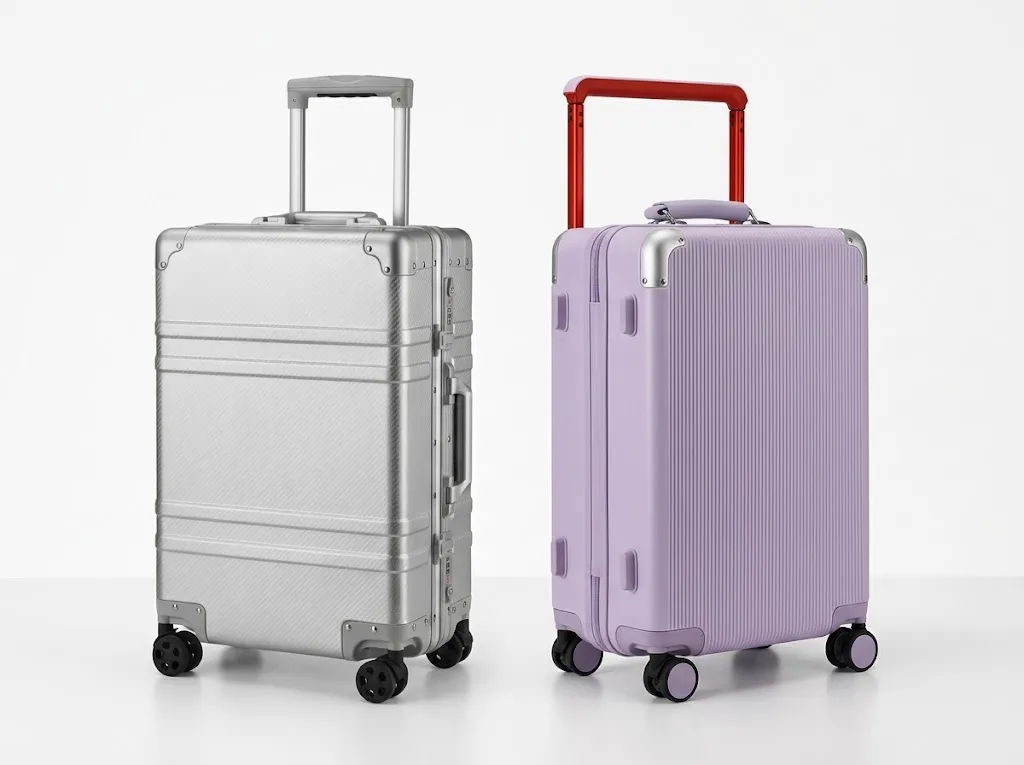
Material selection is a brand architecture decision as much as a manufacturing one. The wrong material for your target retail tier creates margin pressure at best, and brand positioning problems at worst.
When Aluminum Is the Right Choice
- Your target retail price is $280 and above for carry-on, or $380 and above for check-in
- Your brand positioning emphasizes professional, business, or premium travel segments
- Your target customer expects visible hardware (latches, hinges) rather than zipper closure
- Your distribution includes duty-free, department store, or specialty luggage retail channels
- You are building a hero SKU or flagship product to anchor a broader line
Browse Aluvox aluminum luggage collection →
When Polycarbonate Is the Right Choice
- Your target retail price sits between $80–$250
- Your brand requires seasonal color refreshes (PC color changes require no new tooling; aluminum anodizing color changes require process re-qualification)
- Your primary channel is e-commerce or Amazon, where weight-to-price ratio directly affects buyer conversion
- You are launching a new brand and need to manage initial capital exposure while validating market demand
- Your category requires wide SKU variety across multiple colors and finishes simultaneously
Browse Aluvox polycarbonate luggage collection →
A Common Phased Approach
Brands frequently start their product line with polycarbonate to establish market presence and validate demand at accessible MOQs, then introduce an aluminum flagship SKU at the 18–24 month mark to expand brand authority and average order value. Aluvox supports both phases within the same manufacturing relationship, which eliminates the supplier transition risk that comes with scaling.
For more guidance on structuring your supplier relationship, see: How to Vet Industrial Luggage Suppliers →
Supplier Evaluation: Factory Capability Checklist
Not every factory that quotes aluminum luggage has the in-house capability to produce it to specification. The same applies to polycarbonate. Below is the evaluation framework we recommend buyers use when assessing any potential OEM partner.
Evaluating an Aluminum Luggage Manufacturer
- ✅ In-house stamping workshop (outsourced stamping = quality consistency risk)
- ✅ Raw material mill certificates available on request (verifies alloy grade and batch traceability)
- ✅ Anodizing or surface treatment completed in-house or at a qualified, auditable subcontractor
- ✅ Third-party drop test reports available (not factory self-inspection)
- ✅ Tooling buyout or IP protection agreement available in writing
Evaluating a Polycarbonate Luggage Manufacturer
- ✅ PC resin source documented (Covestro and SABIC are industry-standard suppliers; unspecified “imported PC” is a red flag)
- ✅ UL94 V-0 flame rating certification available if distribution includes aviation-regulated markets
- ✅ Mold ownership terms clearly defined before tooling deposit is paid
- ✅ Color consistency process documented (delta-E tolerance specification for production batches)
- ✅ ABS blending disclosed — some factories blend ABS into PC shells to reduce cost without disclosure
Aluvox Factory Capability Summary
Aluvox has operated from its 49,600 m² facility in Hunan Province since 1995, running 10 dedicated production lines with a 250-person specialist team across R&D, tooling, production, and QC. Aluminum stamping, surface treatment, hardware assembly, and pre-shipment testing are all conducted in-house. The facility holds ISO 10012 certification and supplies aluminum and polycarbonate luggage to internationally recognized brands across North America, Japan, Singapore, and the Middle East. Third-party factory audits are supported on request.
For a complete supplier vetting framework, see: How to Vet Industrial Luggage Suppliers →
For guidance on selecting a China manufacturing partner, see: How to Choose a Luggage Manufacturer in China →
Making the Right Material Decision for Your Brand
There is no universally correct answer between aluminum and polycarbonate. The right material is the one that matches your brand’s current retail tier, channel requirements, and capital position — and that can be executed by a factory with verified in-house capability for that specific material.
Mismatching material to market position is one of the most common and costly sourcing errors in the luggage category. It shows up in return rates, in margin erosion, and in brand perception problems that take multiple seasons to correct.
If you are working through this decision for an upcoming product line, Aluvox engineers are available to review your brand positioning parameters and provide a material recommendation with supporting cost and lead time data.
Contact an Aluvox Engineer — Submit your target retail price, distribution channel, and order volume. We will provide a material selection recommendation and indicative quote within 2 business days. → Contact Engineering Team