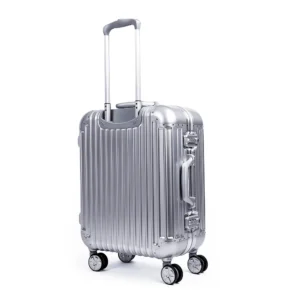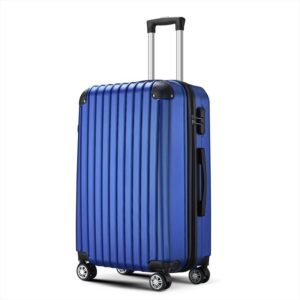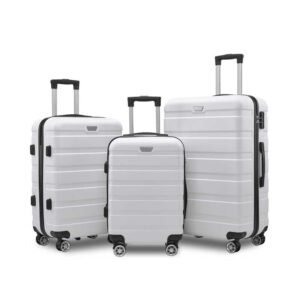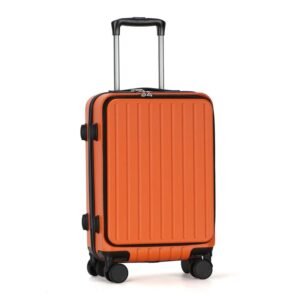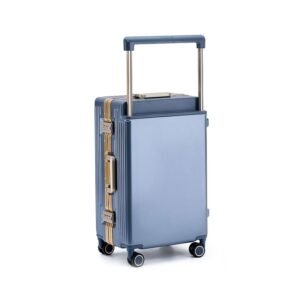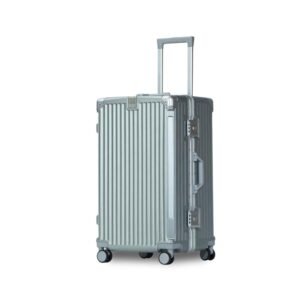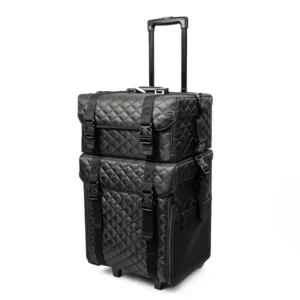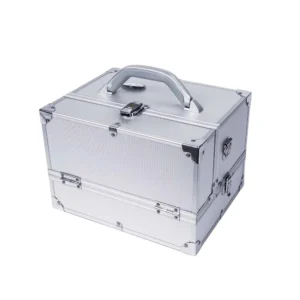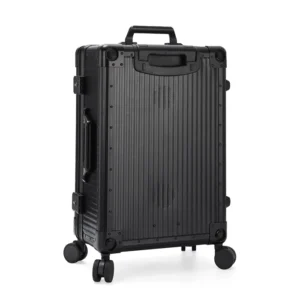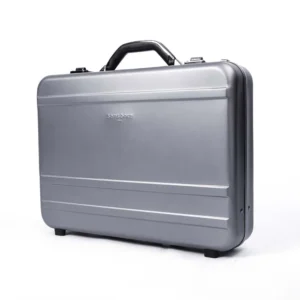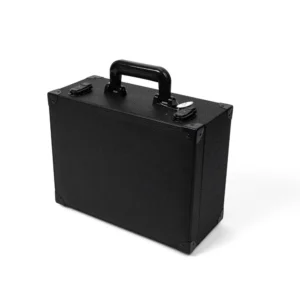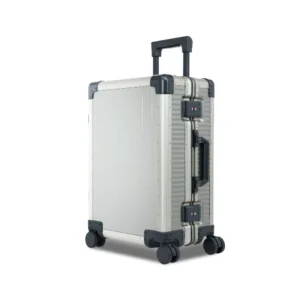

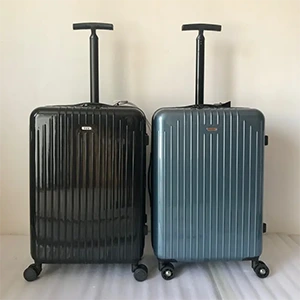
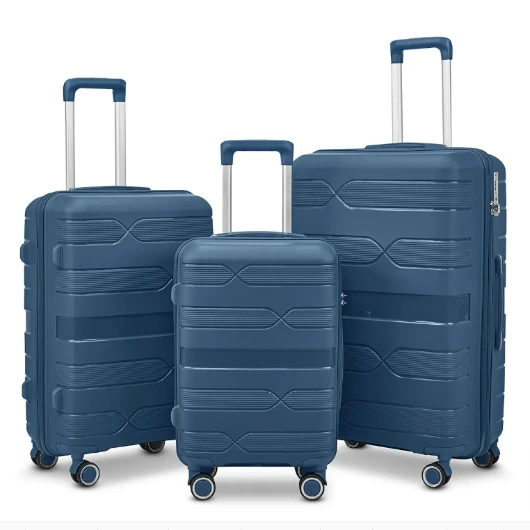
As global consumer expectations for premium travel gear continue to escalate, the hard-shell luggage market has transitioned from basic assembly to a complex battleground of material science and precision engineering. For retail brands building long-term equity in the premium sector, marketing alone no longer sustains profit margins. The real commercial competition has shifted to the factory floor.
Operating as a custom luggage manufacturer since 1993, Aluvox has engineered the physical supply chains behind some of the world’s most aggressive travel brands. We routinely observe brand founders and procurement directors making avoidable global sourcing mistakes — judging a factory based on a glossy B2B directory profile or sorting proposals strictly by the lowest FOB price.
This guide is not a generic sourcing checklist. It is a rigorous, data-driven due diligence framework for retail brands and procurement teams. It covers how to execute deep audits of Chinese suppliers, demand a transparent luggage BOM cost breakdown, and protect gross margins from hidden fulfillment costs.
Luggage Manufacturer vs Supplier: The Systemic Risk of “Lowest Price”
The most common vulnerability buyers expose themselves to when vetting Chinese luggage manufacturers is the “lowest price trap.” In a mature manufacturing ecosystem, a quotation that significantly undercuts the industry average is not a reflection of management efficiency — it is a precursor to hidden material downgrades and process compromises.
The Quality Fade Matrix
In traditional OEM relationships, a pervasive risk known as “Golden Sample Bias” exists. To achieve profitability under the constraint of an artificially low quotation, unscrupulous suppliers implement covert material substitutions during mass production. The first 50 units match the approved golden sample. The next 5,000 do not.
| Core Component | Golden Sample Promise | Mass Production Reality | Financial / Compliance Impact |
|---|---|---|---|
| Outer shell | 100% Covestro virgin polycarbonate | Blended with 30–50% regrind ABS scrap plastic | Shell shatters in sub-zero cargo holds. Triggers US Prop 65 / EU REACH violations, leading to customs seizures and legal fines |
| Aluminum frame | Aerospace-grade 5052-H32 aluminum-magnesium alloy | Downgraded to industrial recycled aluminum with thinner walls | Frame warps under heavy loads; flush-mount locks misalign, causing luggage to burst open during transit |
| Spinner wheels | TPE tread with sealed steel ball bearings | PVC outer tread with rust-prone iron bearings | High friction causes bearings to overheat and seize. Generates noise during use, driving direct 1-star reviews |
| Inner lining | 210D high-density antibacterial peach skin fabric | 150D generic synthetic fiber without color-fasting | Toxic chemical odor in the lining; tears within the first month of use, destroying premium feel |
The end result of Quality Fade is that an expected premium product is reduced to fragile, brand-damaging inventory. The audit framework below is designed to prevent this outcome before it happens.
For material-specific verification frameworks, see: Aluminum Luggage Manufacturer Guide → and PC Luggage Manufacturer Guide →
Demand a Naked BOM (Bill of Materials)
A trustworthy manufacturing partner operates with absolute supply chain transparency. To verify a factory’s claims, require a Naked BOM — a fully itemized Bill of Materials with verifiable cost lines for every component.
Material cost baselines and MOQ strategy:
Aluvox publishes our internal baseline for material costs and our defensive Minimum Order Quantities to set realistic expectations across material categories.
| Core substrate | Physical moat / retail positioning | Estimated OEM BOM cost (20″ carry-on) | MOQ | Mold development |
|---|---|---|---|---|
| 100% Virgin PC | High-end D2C standard. Lightweight flexibility. Target retail: $200–$350 | ~$79.00 | 300 pcs | New mold: 30–45 days |
| 5052-H32 aerospace aluminum | Luxury cornerstone. Cold metallic aesthetic. Target retail: $450–$700 | ~$130.00 | 300 pcs | New mold: 30–45 days (includes 5–8% scrap amortization for metal stamping) |
| TC4 aerospace titanium | Aerospace-grade corrosion resistance. Target retail: $1,500+ | ~$550.00 | 300–500 pcs | Project-dependent (5-axis CNC and vacuum laser welding) |
Building a Rimowa Alternative Supply Chain
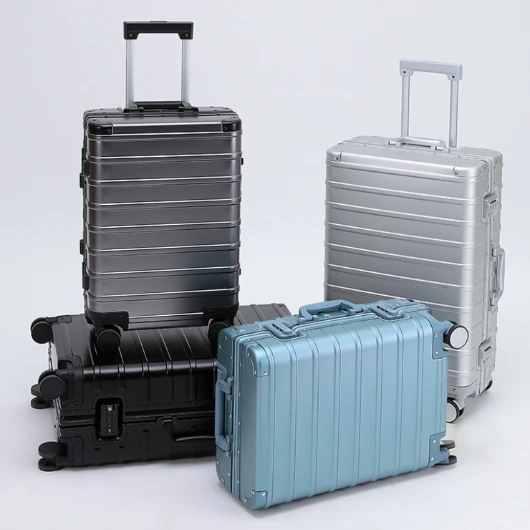
Brands aiming to build a true Rimowa alternative are seeking deep-water metal engineering. Being a premium aluminum luggage supplier requires capital-intensive deep-draw stamping infrastructure to produce premium aluminum shells. If a factory cannot detail the scrap amortization rate of 5-Series aluminum in their Naked BOM, they are outsourcing the metalwork to a subcontractor and adding margin without adding value.
Hardware audit for a zipperless carry-on:
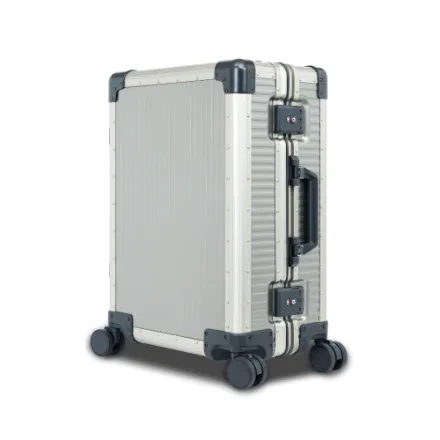
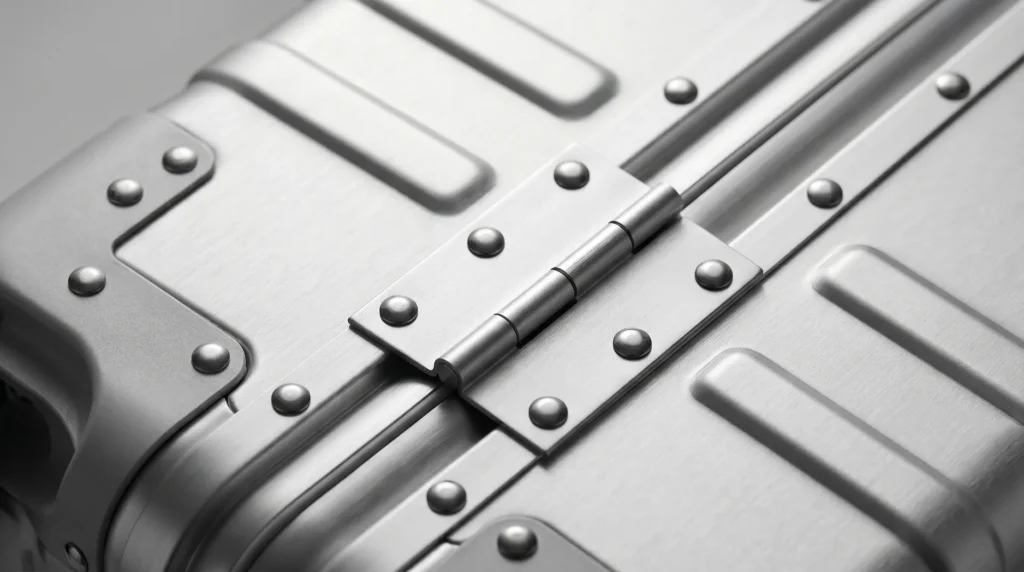
In the premium business travel market, the zipperless carry on suitcase using a high-strength metal frame has become a defining product format. The hardware specifications matter more in zipperless construction than in zippered alternatives — closure quality and durability depend entirely on the frame and latch system.
- Hinomoto spinner wheels. A Japanese supplier whose wheels are used in premium luggage globally. Demand proof of a direct supply chain relationship rather than parallel-import sourcing — the latter is inconsistent in quality and unverifiable in warranty status.
- Flush-mount TSA combination locks. Required for aluminum frame closure systems. Installation requires CNC cutting tolerance of approximately 0.1mm to ensure the lock sits perfectly flat against the frame surface.
For sample lead times: existing tooling samples ship in 20 working days. New mold development extends to 30–45 working days. For the no-zipper format specifically, see: No Zipper Luggage Guide →
Agile MOQs: Defending Cash Flow
The profitability model of mega-factories is built on extreme economies of scale for bulk luggage orders. During the Q4 holiday rush, mega-factories ruthlessly prioritize multinational giants over medium-volume brands — your order shifts down the production queue, and your launch date moves with it.
The 300-unit Custom MOQ with color splitting:
Aluvox maintains a 300-piece custom MOQ across aluminum, PC, and ABS product lines, with color splitting supported — the 300-piece minimum applies to the total order, not to each color. A brand can launch with three colors at 100 pieces each, testing market response across multiple positioning options at the same total capital outlay as a single-color order.
This structure protects founder cash flow during the validation stage of brand development. Rather than committing capital to a single colorway based on assumption, the brand validates with multiple colorways based on actual market data.
For a full breakdown of how MOQ structures work across color splits and order configurations, see: Custom Luggage MOQ Guide →
For brands at the validation stage building toward a full product line, see: Private Label Luggage Brand Guide →
OEM vs ODM: The R&D Engineering Moat
The unstated reality of many industrial luggage suppliers is that they outsource their mold-making. This creates dimensional tolerance issues that compound across production runs — your sample matches the design spec, but bulk production has variance the sample never showed.
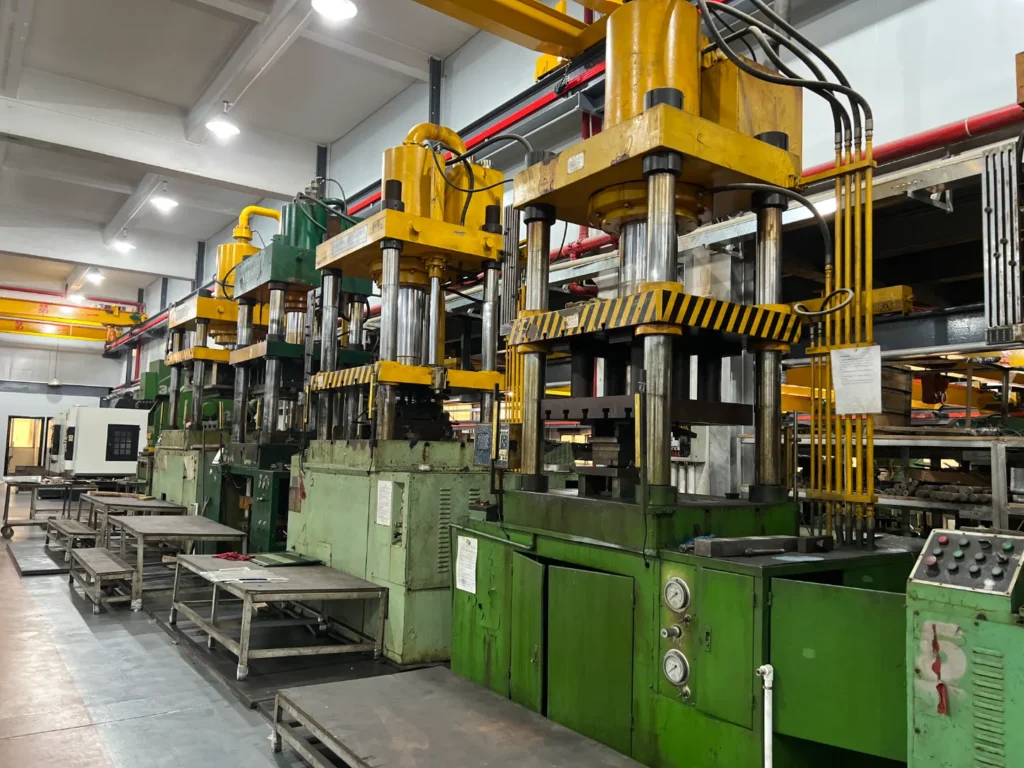
A world-class ODM partner maintains an in-house CNC tooling center, compressing complex 3D mold development cycles to 30–45 working days from CAD-approved rendering to first T0 sample. For existing tooling, samples ship in 20 working days. This timeline discipline is only possible when mold-making, prototyping, and sample production all happen under one roof.
Practical implications for your project:
When evaluating a potential supplier, ask directly: do you operate your own CNC tooling center, or do you outsource mold-making? Request to see the equipment during a site visit. A factory that operates its own mold-making infrastructure can adjust tooling during the sample phase to refine fit and function. A factory outsourcing mold-making cannot — your design is fixed once the mold is cast at the subcontractor.
Hidden Fulfillment Costs: The 3PL Repackaging Tax
To artificially lower freight costs, low-end factories advocate “nested shipping” — putting a 20-inch suitcase inside a 24-inch suitcase, then both inside a 28-inch. The continuous vibration of ocean transit causes the inner wheels to destroy the inner lining of the outer suitcase. The cost savings vanish before the container is unloaded.
Worse, when the container arrives at your US or EU 3PL warehouse, nested shipments trigger a Repackaging Tax that few brands account for in their landed cost calculations.
| 3PL Fulfillment Action | Estimated US/EU Labor Cost | Hidden Risk |
|---|---|---|
| Unpacking and separation | $3.00 – $5.00 / set | High physical force frequently causes deep scratches to shells |
| Local packaging procurement | $4.00 – $7.00 / unit | Purchasing corrugated boxes locally erodes profit margins |
| Repacking and barcoding | $5.00 – $6.00 / unit | Time-consuming process delays e-commerce availability |
| Total hidden margin loss | $12.00 – $18.00 per set | Minor freight savings are eliminated by labor fees |
Aluvox’s solution: Every premium suitcase, including our flagship titanium suitcase, is individually packaged in 5-ply mail-order boxes certified to pass rigorous Amazon ISTA 1A/3A drop tests. Units arrive ready for e-commerce fulfillment — no repackaging, no scratched shells, no margin loss to inbound preparation labor.
For brands selling on Amazon or operating direct-to-consumer e-commerce, this packaging discipline is not optional. It is the difference between a profitable SKU and a margin-burning operational drag.
For broader supplier evaluation framework across industrial and brand luggage categories, see: How to Vet Industrial Luggage Suppliers →
Three Brand Partnerships That Validate the Framework
The audit framework above is not theoretical. The following three client partnerships demonstrate how the principles translate into measurable business outcomes.
MAPPA (Mexico — Retail) MAPPA partnered with Aluvox to scale their retail luggage line in the Mexican market. Through engineering optimization, BOM transparency, and consolidated production with no hidden subcontracting, MAPPA reduced product development costs from 25% of revenue to 10% — a 60% reduction in development overhead — while increasing market share by 220% over the partnership period.
Aucentic (Japan — Online Department Store) Aucentic launched their aluminum alloy luggage line with significant investment but struggled with persistent supplier issues — unstable trolley handles, inadequate wheel smoothness, and suppliers who refused to disclose manufacturing processes. These are precisely the supply chain transparency failures that this audit framework is designed to prevent.
After transitioning to Aluvox, Aucentic’s annual sales exceeded 20,000 units. Revenue grew 180% from their first launch. Aluvox supports Aucentic with rigorous QC across incoming materials, pre-packaging finished product inspection, and post-packaging sampling — plus China-based warehousing services to reduce logistics costs. Aucentic established a significant position in the Japanese online market with a foundation for global expansion.
Italic (Worldwide — Retail) Italic’s brand thesis — that luxury should be defined by product quality rather than logo and price tag — required manufacturing partners willing to operate at lower MOQ thresholds than typical premium factories accept. Most factories supplying major luxury brands refused this MOQ structure.
Aluvox reduced MOQ to half the typical premium-factory threshold for Italic, priced 10% below major brand factory rates, and supported the partnership with consignment terms that eased cash flow pressure during scaling. Result: Italic’s luggage products consistently maintain ratings above 4.9 stars, revenue increased 80%, and five-star ratings increased 50%. All initial inventory sold out within days of launch.
Execute the Audit Before You Commit
Before launching your next global procurement initiative, establishing a strict supplier audit standard is the core mechanism for defending your brand security. The factories that survive this audit are the ones that can sustain quality across production cycles — not just deliver an acceptable golden sample.
The audit framework above covers the four categories where most procurement failures originate: quality fade through material substitution, BOM opacity hiding subcontracted operations, MOQ structures that disadvantage emerging brands, and hidden 3PL costs that erode margins after the FOB price is paid.
If you are preparing to launch a next-generation hard-shell travel case, a precision business carry-on, or a premium aluminum luggage line, Aluvox’s engineering heritage since 1993 stands ready. Bring your industrial design drafts to us for a deep technical alignment. We will generate a transparent Naked BOM cost structure and provide a structured production assessment within 2 business days.
Contact the Aluvox Engineering Team — submit your design specifications, target retail positioning, and estimated order volume. We will provide a transparent BOM cost structure and production assessment within 2 business days. Contact Engineering Team