

Private Label Luggage: How to Build Your Brand from Scratch
Most luggage brand failures happen before the product is made. The decisions that determine whether a brand survives its first two years — material selection, order structure, tooling investment, MOQ commitment — are made at the sourcing stage, often by buyers who have not yet validated whether the market wants what they are building.
Private label luggage manufacturing exists precisely to reduce this risk. It allows brands to enter the market using proven factory tooling, test consumer response at manageable order quantities, and invest in proprietary design only after demand has been established. Used correctly, it is the most capital-efficient path to building a luggage brand. Used incorrectly — treating it as a shortcut rather than a strategy — it produces inventory that does not move and margins that do not work.
This guide covers how to structure a private label luggage brand at each stage of development, what the decisions actually cost, and where the avoidable mistakes are.
At Aluvox, we support private label luggage programs from 300 pieces across aluminum, PC, ABS, and titanium. The framework below reflects what we see working — and what we see failing — across the brands we work with.
The Three Stages of a Luggage Brand
The most useful framework for private label luggage sourcing is not OEM versus ODM — it is brand stage. What you should be doing in manufacturing depends entirely on where your brand is in its development cycle.
Stage 1: Validation (ODM Private Label)
You do not yet have confirmed market demand. Your goal is to test a product in market with minimum capital exposure. The right manufacturing model is ODM — using factory existing tooling, applying your brand identity (color, logo, hardware), and placing the minimum viable order.
At this stage, tooling investment is premature. You do not know which colorways perform, which size mix sells, or whether your target price point converts at the volume you need. Spending $8,000 to $15,000 on custom stamping dies before answering these questions is a common and expensive mistake.
Aluvox’s private label luggage program starts from 300 pieces with multi-color splitting — allowing brands to test three colorways at 100 pieces each rather than committing 300 pieces to a single color. This structure is specifically designed for Stage 1 brands.
Stage 2: Establishment (ODM with Modifications)
You have validated demand. You know which products and colorways work. You are building reorder cadence and starting to differentiate from competitors using the same base tooling. The right model is ODM with selective modifications — hardware changes, interior configuration adjustments, surface treatment variations — that create differentiation without requiring new shell tooling.
At this stage, you are building brand identity within the constraint of existing factory geometry. The modifications that are possible without new tooling are more extensive than most buyers realize: corner guard design, handle grip material, interior lining pattern, zipper pull style, logo application method, and outer packaging can all be customized without a new mold.
Stage 3: Scale (Full OEM)
You have a product market fit, a reorder relationship with a manufacturer, and volume that justifies tooling investment. The right model is full OEM — commissioning a proprietary shell geometry that nobody else can produce or sell. Your design becomes a brand asset with a defensible moat.
The transition from Stage 2 to Stage 3 is a capital decision as much as a design decision. Custom aluminum stamping dies cost $8,000 to $15,000 per style. Custom PC thermoforming tooling costs $3,000 to $6,000. These numbers are manageable when amortized across confirmed reorder volume — and prohibitive when committed before that volume exists.
| Stage | Model | MOQ | Tooling cost | Primary goal |
|---|---|---|---|---|
| Validation | ODM private label | 300 pcs | None | Test market demand |
| Establishment | ODM + modifications | 1,000 pcs+ | Low | Build differentiation |
| Scale | Full OEM | Project-dependent | $3,000–$15,000 | Build design moat |
What You Can Customize at Each Stage
Understanding the customization boundary — what changes without tooling investment and what requires it — prevents budget surprises and timeline mismatches in the sourcing process.
Customization requiring no new tooling:
Shell color and surface finish, logo placement and application method (embossing, heat transfer, engraving), interior lining fabric and color, hardware color and finish (brushed gold, matte black, silver), zipper pull style, outer packaging design and material. These changes cost nothing in tooling and add minimal lead time. They are the customization layer that turns a factory’s existing product into your brand’s product.
Customization requiring modest tooling investment:
Corner guard design modifications, handle grip material changes, interior tray depth adjustments, addition of branded embossing panels, custom zipper garage design. These changes require tooling modifications rather than new molds — typically $500 to $2,000 depending on complexity — and add 10 to 15 working days to the sampling timeline.
Full custom development:
New shell geometry, proprietary closure mechanism, integrated technology features, structural redesign. This is Stage 3 territory — new molds, full tooling investment, longer development timeline. For aluminum, this means new stamping dies. For PC, new thermoforming tooling. The cost and timeline implications are specific to the project.
The practical implication for Stage 1 brands: the customization available without tooling investment is sufficient to establish a distinct brand identity in most market segments. Most consumers cannot identify the difference between two products sharing the same shell geometry when the color, hardware, and packaging are differentiated. Start with no-tooling customization, validate demand, then invest in geometry when the brand position justifies it.
Budgeting Your First Private Label Order
The most common budgeting error in first private label orders is calculating unit price times MOQ and treating that as the total cost. It is not. A realistic first order budget includes five cost components.
Unit price x MOQ: The base production cost. Varies by material, specification, and quantity. Aluminum is significantly higher than ABS or PC; within PC and ABS, unit price decreases as order volume increases.
Sample fee: Varies by factory and project. For existing tooling at Aluvox, samples are produced in 20 working days. Confirm whether sample costs are credited against the bulk order before committing.
Tooling fee (if applicable): For Stage 1 ODM orders using existing tooling, this is zero. For any structural modification, budget the tooling cost separately before calculating your unit economics.
Freight: From port of export to your warehouse. For Aluvox orders, export routes operate through Huangpu, Nansha, Shekou, and Yantian ports on FOB, EXW, or CIF terms. Ocean freight cost varies by destination and season — budget conservatively.
Import duties: Determined by your destination country’s tariff schedule and the product’s HS code classification. Verify with your freight forwarder before finalizing landed cost calculations.
The multi-color splitting advantage:
A single-color order of 300 units ties up capital in one colorway and gives you one data point on consumer color preference. A three-color split of 100 units each tests three market positions simultaneously at the same total capital outlay — and gives you three data points to inform your reorder decision.
For a full breakdown of how MOQ works across color splits and order structures, see: Custom Luggage MOQ Guide →
Standard payment structure:
30% deposit against proforma invoice, 70% payable against bill of lading. This is industry standard for a first order with a new supplier. Any factory requiring 100% prepayment on a first order without an established relationship should be asked to explain the deviation.
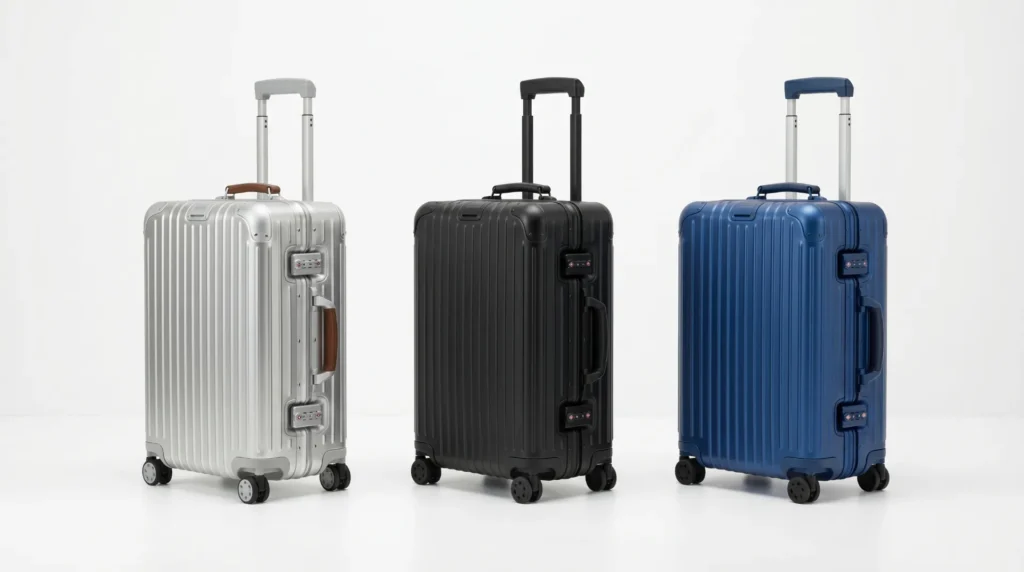
Request an Aluvox private label sample — confirm material quality, customization options, and production consistency before committing to your first bulk order. Request Sample
Choosing Your Material by Brand Tier
Material selection is the most consequential decision in private label luggage sourcing — it determines your retail price ceiling, your production economics, your color strategy, and the manufacturing partner you need.
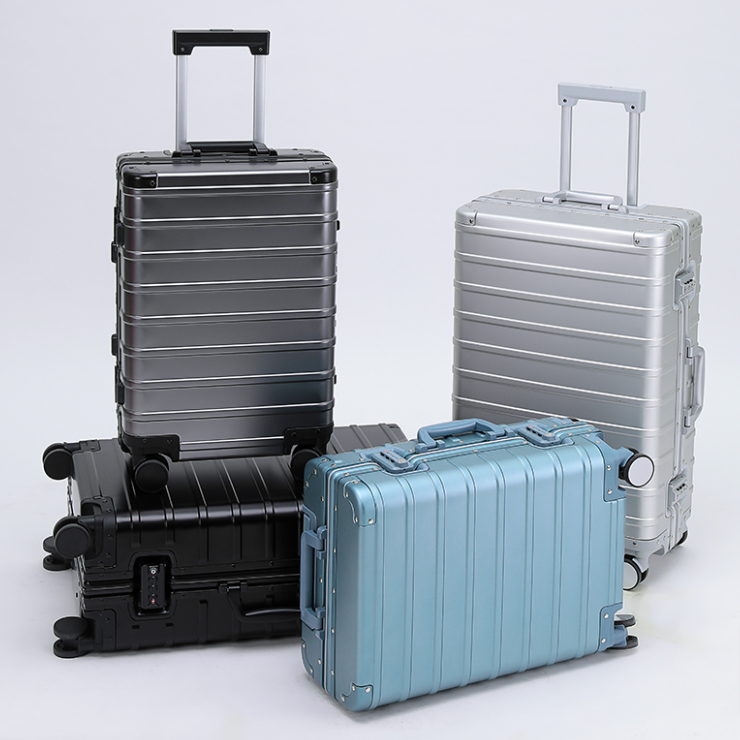
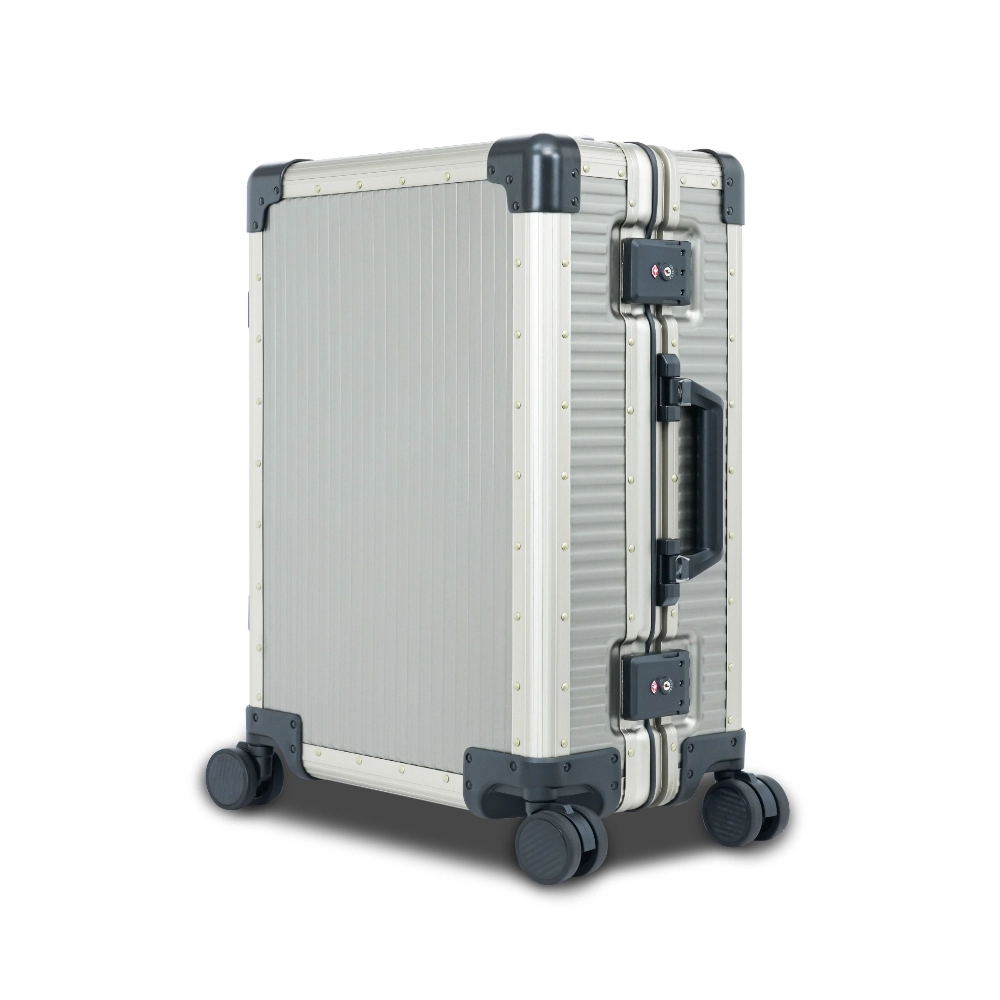
Aluminum: Premium and Professional Positioning
Retail price $280 and above for carry-on. Aluminum communicates durability, engineering investment, and a disregard for fashion cycles that consumers in the premium segment actively value. The surface treatment options — brushed, sandblasted, anodized — produce distinct visual identities from the same alloy.
The commercial constraint: aluminum is heavier than PC or ABS, which limits appeal in lightweight-sensitive segments and e-commerce channels where weight affects conversion.
Browse the Aluvox aluminum luggage collection →
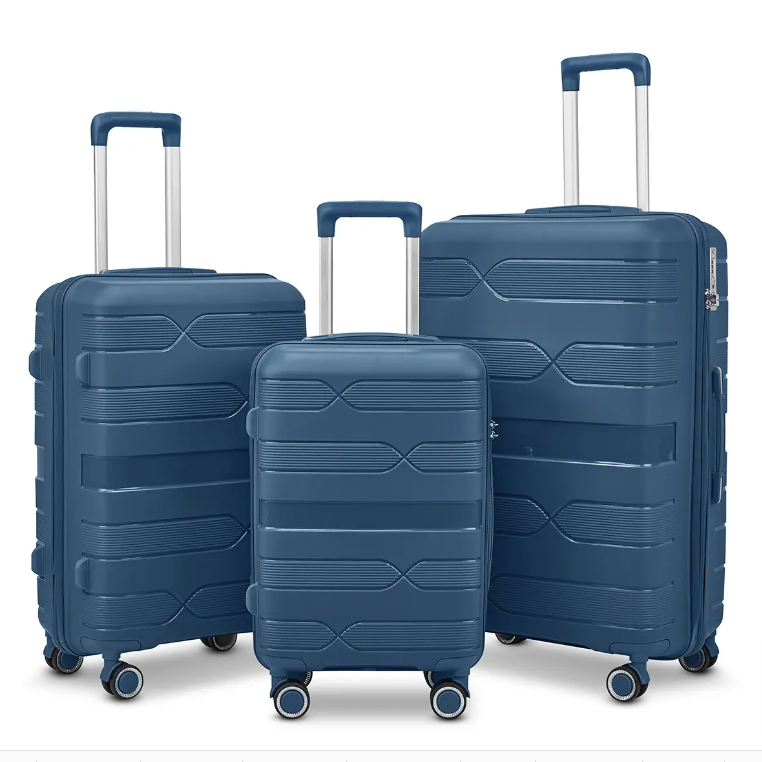
Polycarbonate: The Commercial Center
Retail price $100 to $250. PC dominates the mid-range market because it balances structural performance, color flexibility, and cost efficiency better than any alternative at this price tier. Seasonal color changes require no new tooling — only a resin color adjustment — which suits brands with frequent collection cycles.
ABS: Entry-Level and Promotional
Retail price $50 to $100. ABS provides the widest color range at the lowest tooling and unit cost. The structural limitation — brittleness below -10°C — restricts distribution in cold climate markets. Appropriate for mass retail, promotional programs, and gift-with-purchase applications.
The Scaling Path
Most successful luggage brands follow a material progression: ABS to establish market presence and validate demand at accessible MOQs, PC to build a core range with better structural credibility, aluminum to introduce a premium flagship that expands brand authority and average order value. Aluvox supports all three material lines within a single manufacturing relationship — eliminating the supplier transition risk that typically accompanies brand scaling.
For a detailed material comparison from a manufacturing and brand positioning perspective, see: Aluminum vs Polycarbonate Luggage: OEM Material Selection Guide →
For brands adding travel bags to their luggage line, see: Aluvox private label travel bags →
Four Private Label Brand Mistakes That Kill Margin
These are the sourcing decisions that consistently produce financial losses in private label luggage brands — not because the products are bad, but because the decisions were made at the wrong stage or with incomplete information.
Mistake 1: Tooling investment before demand validation
Paying $8,000 to $15,000 for custom stamping dies before placing a single order is a bet on demand that has not been confirmed. Most brands that do this discover, after the tooling is paid and the first order is in production, that the colorways they chose do not sell, the price point does not convert, or the channel they targeted requires a different product specification. ODM private label exists precisely to avoid this sequence. Validate first. Invest in tooling when reorder volume justifies it.
Mistake 2: Accepting vague quotations
A quotation that does not specify material grade, resin source, alloy series, hardware supplier, or surface treatment method is not a quotation — it is a price. The product that arrives in bulk will be whatever the factory decides those unspecified elements are. Require explicit material specification in writing before any deposit is paid. If the factory will not provide it, they are protecting their ability to substitute.
Mistake 3: Ignoring mold ownership terms
Many factories retain ownership of tooling developed at the buyer’s expense. If you pay for a custom mold and the factory retains ownership, you cannot move production without losing your design. This is a structural dependency that limits your negotiating position permanently. Confirm tooling ownership terms in writing before paying any tooling deposit. Any credible manufacturer will agree to this in writing.
Mistake 4: Single-color first order
Committing your full MOQ to a single colorway is an inventory concentration risk that a split order eliminates. The cost of testing three colors at 100 units each is identical to testing one color at 300 units — but the information value is three times higher. Color preference data from a split first order informs the reorder decision with actual market evidence rather than assumptions.
For guidance on evaluating and selecting an OEM manufacturing partner, see: How to Choose an OEM Luggage Manufacturer in China →
Build the Brand Before You Build the Product
The most durable luggage brands are not built on proprietary shell designs — they are built on the relationship between a brand identity and a customer segment that trusts it. The product is the proof of that relationship, not the source of it.
Private label manufacturing gives brand founders the ability to test that relationship at minimum capital exposure, iterate based on actual market response, and invest in proprietary product development once the relationship is confirmed. It is not a compromise on brand ambition — it is a sequencing discipline that improves the probability of reaching the stage where that ambition is commercially viable.
If you are planning your first private label luggage order, Aluvox engineers are available to review your brand positioning, target market, and capital parameters — and provide a structured recommendation for material, order configuration, and realistic cost expectations.
Contact an Aluvox Engineer — submit your brand tier, target retail price, and estimated order volume. We will provide a private label program recommendation and indicative quote within 2 business days. Contact Engineering Team