

OEM Luggage Manufacturer Selection & Cost Guide
Choosing an OEM luggage manufacturer is where most brands either set up a profitable product or quietly build in a margin problem they won’t see until the goods land. The mistake is almost always the same: comparing factories on the FOB quote alone, as if the per-unit price at the port is the cost of doing business. It is not. The real cost of an OEM project is the FOB price plus tooling, plus the MOQ commitment those tooling costs drive, plus the landed cost that no factory quote shows you.
OEM — where you bring the design and the factory builds to your specification — gives you a product that is exclusively yours. The factory cannot sell your design to anyone else. But that exclusivity comes with cost mechanics that ODM (selecting an existing factory design) does not have: you pay for the tooling, and the tooling cost shapes everything downstream.
This guide explains the cost mechanics of OEM luggage manufacturing, how to read MOQ as a diagnostic signal about the factory you are dealing with, why landed cost matters more than FOB, and the concrete signals that separate a reliable OEM partner from a risky one. It is written to help you evaluate factories, not to describe how one factory presents itself.
At Aluvox, we provide OEM luggage manufacturing from our Dongguan facility, with an in-house mold workshop and transparent cost structure. The framework below applies to evaluating any OEM luggage manufacturer, including us.
What “OEM” Actually Costs You
OEM means you own the design and the intellectual property — and you pay for the tooling that brings your design into production. Understanding this cost is the foundation of an OEM budget.
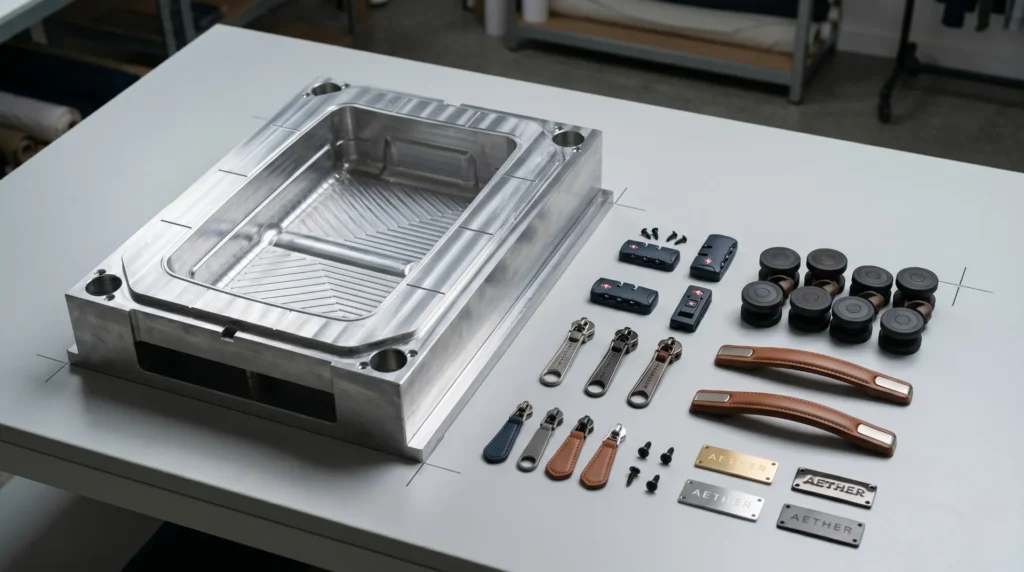
The tooling cost. For a hard-shell luggage design unique to your brand, you pay for the molds — for the shell, and often for custom handles, and sometimes custom wheels. Custom hardware — proprietary zipper pulls, branded buckles, unique metal fittings — requires its own tooling that adds fixed cost, typically in the range of several hundred to a couple thousand dollars per tooled component. The factory recovers this fixed cost through your MOQ, which is why deeper customization drives a higher minimum order.
The way to control it. The most effective way to reduce OEM tooling cost is to use the factory’s existing component catalog wherever your design allows. Using existing wheels, locks, and handles instead of custom-tooled hardware eliminates that tooling cost entirely and lowers the MOQ threshold. The discipline is to review off-the-shelf components before customizing — reserve custom tooling for the elements that genuinely differentiate your product, and use the factory’s proven catalog for the rest. This single decision can save thousands in tooling on a first order.
OEM vs ODM in cost terms. ODM — selecting and branding an existing factory design — carries no new tooling cost because the molds already exist, which is why it is the faster, cheaper path for market testing. OEM carries the tooling investment but delivers a fully exclusive product. The right choice depends on whether your stage justifies the tooling investment. For the full comparison, see: Custom Luggage Manufacturer Sourcing Guide →
MOQ as a Diagnostic Signal
Most buyers treat MOQ as a hurdle — a number to negotiate down. It is more useful read as a diagnostic signal about the type of factory you are dealing with.
What MOQ tells you about a factory. A factory’s MOQ reflects its production model. A factory quoting very high minimums is built for high-volume runs and may not be the right partner for a brand testing a market. A factory offering genuinely flexible low minimums with quality systems intact is built for the brand-building segment. The MOQ is the factory telling you what kind of customer it is set up to serve — read it that way before negotiating it.
Always clarify how MOQ applies. A critical question most first-time buyers forget: does the MOQ apply per style, per color, or per size? A “300-piece MOQ” means something very different if it is 300 per color versus 300 total across colors. Always ask. A factory that allows color splitting — multiple colors within a single MOQ — lets you launch a varied line at a manageable total commitment, while one that requires the minimum per color multiplies your first-order capital.
Negotiating MOQ down. MOQ is negotiable, but the levers are specific: simpler designs, fewer colorways, using existing hardware instead of custom tooling, or accepting a higher unit price in exchange for a lower minimum. A factory that works with you on these levers is showing flexibility; one that refuses any movement is showing you its production model is not built for your scale.
For the full MOQ structure and color-splitting mechanics, see: Custom Luggage MOQ Guide →
Landed Cost vs FOB — The Number That Matters
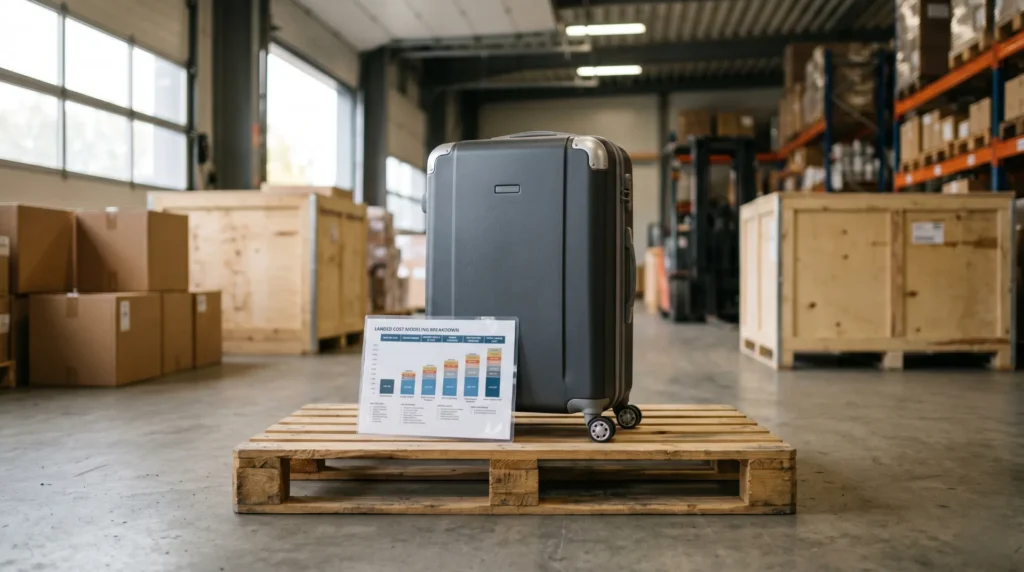
The single most expensive misunderstanding in OEM sourcing is treating the FOB quote as the cost of the product. The FOB price is only the starting number. Your real cost — landed cost, what the product actually costs you at your warehouse — includes everything between the factory port and your door.
What landed cost actually includes:
- FOB price (the factory’s quoted per-unit price at port)
- International freight (sea or air)
- Destination port handling
- Import duties and taxes
- Customs brokerage fees
- Inland freight (port to warehouse)
- Third-party inspection (optional but recommended)
A factory quote that looks lower on FOB can land higher than a competitor’s once all of these are added — which is why comparing factories on FOB alone is misleading. Always model the full landed cost before choosing a supplier on price.
Material cost volatility. A related point most buyers miss: OEM pricing is tied to raw material markets. The cost of virgin polycarbonate and aluminum moves with petroleum and metal prices. A disciplined buyer negotiates material costs and quote validity dates upfront during the quoting phase, locking rates rather than being exposed to mid-project increases. Ask the factory how long the quote is valid and what happens if material prices move.
Volume and unit cost. Unit cost is not static — it drops significantly as you scale from a baseline MOQ toward a full container load. When modeling your economics, model at realistic volume, not just the minimum, because the per-unit cost at scale is what determines your margin once the brand is moving.
For a directory of established factories to compare on these terms, see: Top OEM Luggage Manufacturers in China →
Signals That Identify a Reliable OEM Factory
Beyond cost, the factory’s reliability determines whether the order arrives on spec and on time. These are the concrete signals to evaluate.
Reorder rate. A factory’s reorder rate is one of the most telling quality signals. High reorder rates — above roughly 30% — typically correlate with consistent quality and satisfied buyers. Very low reorder rates warrant deeper due diligence: if buyers are not coming back, find out why before you become the next one-time customer.
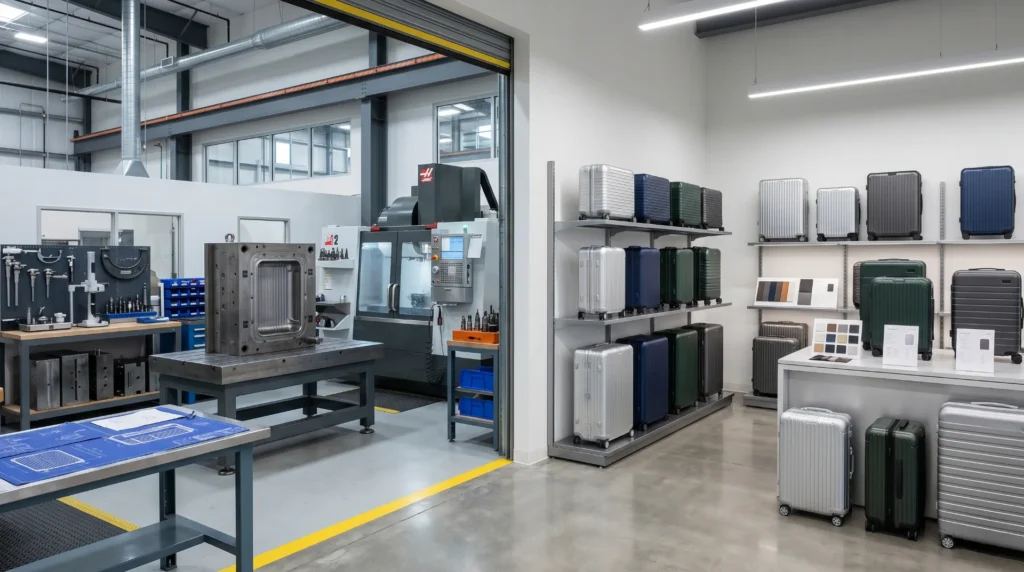
In-house mold workshop. A factory with its own mold workshop controls tooling timelines, protects your design, and accelerates revisions — rather than outsourcing molds and losing control over schedule and confidentiality. For OEM specifically, in-house tooling capability is a meaningful advantage.
Pre-production sample discipline. A reliable factory produces a pre-production (PP) sample for your sign-off before mass production, and quotes bulk lead time from PP sample approval — not from order placement. The standard pattern is bulk delivery 35–45 days after PP sample approval. A factory that wants to skip the PP sample, or cannot commit to this sequence, is a risk.
Quality systems and testing. Look for documented QC and testing — ISTA drop testing for hard shells, wheel and lock function testing, and third-party verification (SGS, Bureau Veritas, Intertek). For brands shipping to Amazon, FBA-specific compliance (FNSKU labeling, carton barcodes, suffocation warnings, DDP routing) signals a factory experienced with the channel.
Response time and communication. Response speed during the quoting phase is a preview of communication during production. Factories with fast, clear response times — and English-language project management — reduce the friction and miscommunication that derail OEM projects. Slow or vague pre-sale communication rarely improves after the deposit.
For the full supplier evaluation framework, see: How to Choose a Luggage Manufacturer in China →
Aluvox OEM Luggage Program
OEM model: Aluvox provides full OEM luggage manufacturing — your design, your specification, your exclusive product — with an in-house mold workshop that controls tooling timelines and protects your design. We also offer ODM for brands wanting a faster, lower-tooling path. Materials span aluminum, PC, ABS, PP, and titanium.
Production parameters:
| Parameter | Specification |
|---|---|
| MOQ | 300 pcs / style |
| Color splitting | Supported — total order MOQ across colors |
| Tooling | In-house mold workshop |
| Sample lead time (existing tooling) | 20 working days |
| New mold development | 30–45 working days |
| Bulk production | 45 days from deposit (after PP sample approval) |
| Materials | Aluminum, PC, ABS, PP, titanium |
| Payment terms | 30% deposit + 70% against B/L |
| Export ports | Huangpu, Nansha, Shekou, Yantian |
| Shipment terms | FOB, EXW, CIF |
Cost transparency: Aluvox quotes the tooling cost, the MOQ structure, and the production cost separately, so you can model your landed cost accurately rather than discovering hidden costs after the deposit. Material costs and quote validity are stated upfront. Pre-production samples are provided for sign-off before mass production, with QC including ISTA drop testing, wheel and lock function testing, and third-party verification available.
Browse the Aluvox aluminum luggage collection →
Visit the Aluvox private label luggage manufacturer page →
Request an OEM quote — submit your design or concept, target volume, and customization scope. We will provide tooling, MOQ, and production cost broken out separately within 2 business days. Request Quote
OEM Engagement Checklist
When you contact an OEM luggage factory, these are the questions that surface the information you need to evaluate and budget the project. Ask them upfront.
On cost and minimums:
- What is your MOQ, and does it apply per style, per color, or per size?
- What is the tooling cost for my design, and which components need custom tooling versus your existing catalog?
- Is the quote FOB, and from which port? Can you help me estimate landed cost?
- How long is the quote valid, and what happens if material prices move?
On samples and timeline:
- What is the sample lead time and sample cost? Is the sample fee credited against production?
- Is bulk lead time quoted from order placement or from PP sample approval?
- Can you send sample photos or video of the finished sample before shipping?
On reliability:
- What is your reorder rate?
- Do you have an in-house mold workshop?
- What QC and testing do you perform, and can you provide third-party verification?
- For Amazon: can you handle FNSKU labeling and DDP routing?
On terms:
- What are your payment terms?
- What is the packaging configuration — units per carton, carton dimensions and weight? (Needed for shipping plans.)
A factory that answers these clearly and in writing is one you can plan and budget around. Vagueness on tooling, MOQ application, or landed cost is the signal to slow down.
OEM Is a Cost Structure, Not Just a Quote
The brands that source OEM luggage well understand that the FOB quote is the smallest part of the decision. The real cost structure is tooling plus MOQ plus landed cost, and the real risk is a factory that looks cheap on FOB and lands expensive — or that skips the PP sample and ships off-spec. Reading MOQ as a diagnostic signal, modeling full landed cost, and evaluating the concrete reliability signals — reorder rate, in-house tooling, sample discipline, testing — is what separates a profitable OEM relationship from a costly one.
OEM delivers an exclusive product that is genuinely yours, and for a brand building something durable, that exclusivity is worth the tooling investment and the diligence. The discipline is to evaluate the full cost structure and the factory’s reliability before the deposit, not after the goods land.
If you are evaluating OEM luggage manufacturers and want a quote with tooling, MOQ, and production cost broken out transparently, Aluvox can provide that breakdown and walk you through the cost structure for your project.
Contact our Sales Team — tell us your design, target volume, and customization scope. We will provide a transparent OEM cost breakdown and project timeline within 2 business days. Contact Sales Team