

Suitcase Manufacturers: A Buyer’s Evaluation Guide
Search “suitcase manufacturers” and you get directories, listicles, and factory homepages that all describe themselves in nearly identical language — vertically integrated, quality-focused, OEM and ODM, trusted by global brands. The descriptions are interchangeable. What a buyer actually needs is a way to tell them apart.
This guide is that framework. It does not list “the top 10 manufacturers” — those lists exist everywhere and rank by nothing you can verify. Instead it gives you the four supplier types so you know which kind you actually need, the metrics that genuinely signal reliability, the quality systems that separate a real factory from a trading company, and the specific items to confirm before committing a first order. At the end is a scorecard to compare suppliers side by side.
It is written from the buyer’s side of the table. At Aluvox, we are a suitcase manufacturer ourselves, supplying private-label travel brands from our Dongguan facility — so the framework below is one you can apply to us as readily as to any other supplier.
The Four Types of Suitcase Manufacturers
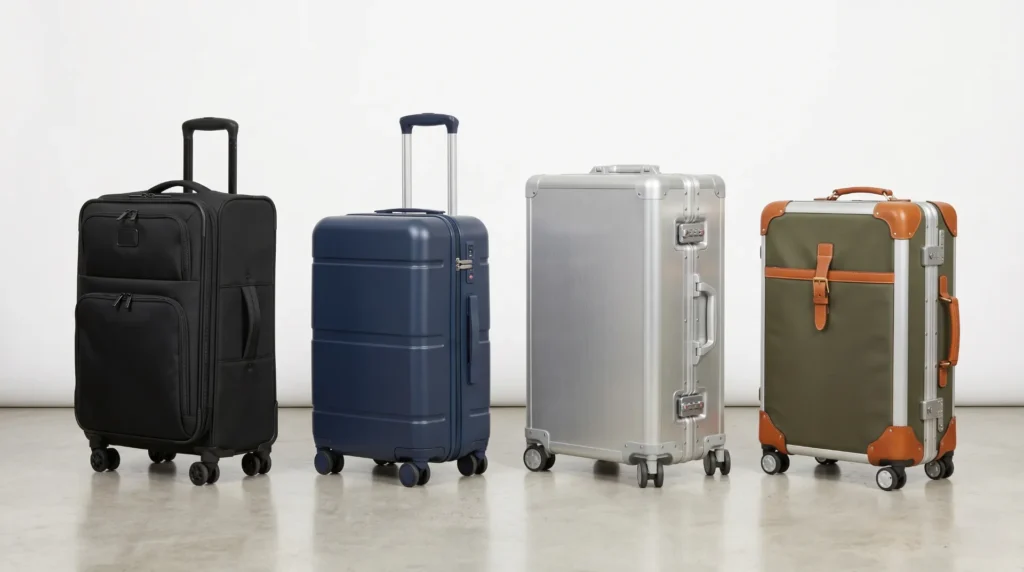
The first source of confusion is that “suitcase manufacturer” covers four distinct production models, each suited to a different product. Matching your product to the right type is the first evaluation step — a soft-side specialist will struggle with a hardside shell, and an injection molder is the wrong partner for a ballistic-nylon duffel.
Cut-and-sew soft-side producers. These factories specialize in fabric luggage — polyester, ballistic nylon, Cordura, canvas. Their expertise is in textile selection, precise cut-and-sew technique, and fabric treatments. If your product is a soft-shell roller, a duffel, or a garment bag, this is your supplier type.
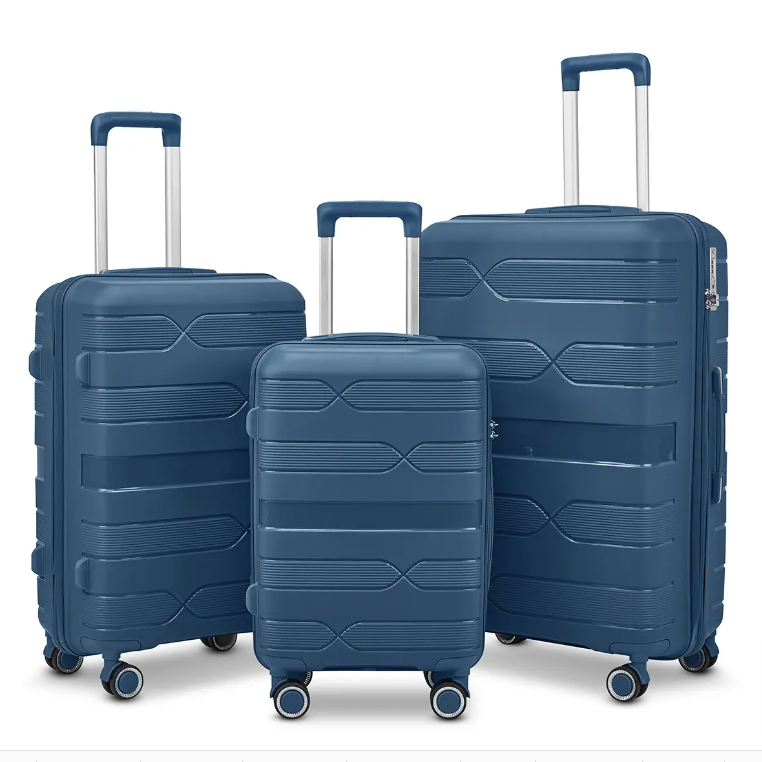
Hardside injection molders. These factories run injection-molding lines for ABS and polycarbonate shells. Their expertise is in mold development, controlled injection for uniform shell thickness, and shell structural performance. If your product is a hardside spinner in ABS or PC, this is the type to evaluate.
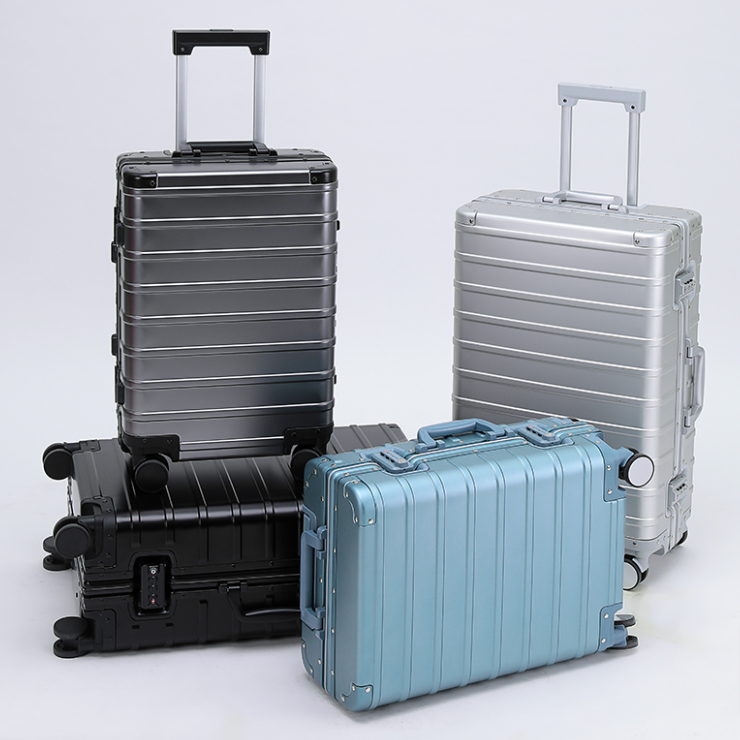
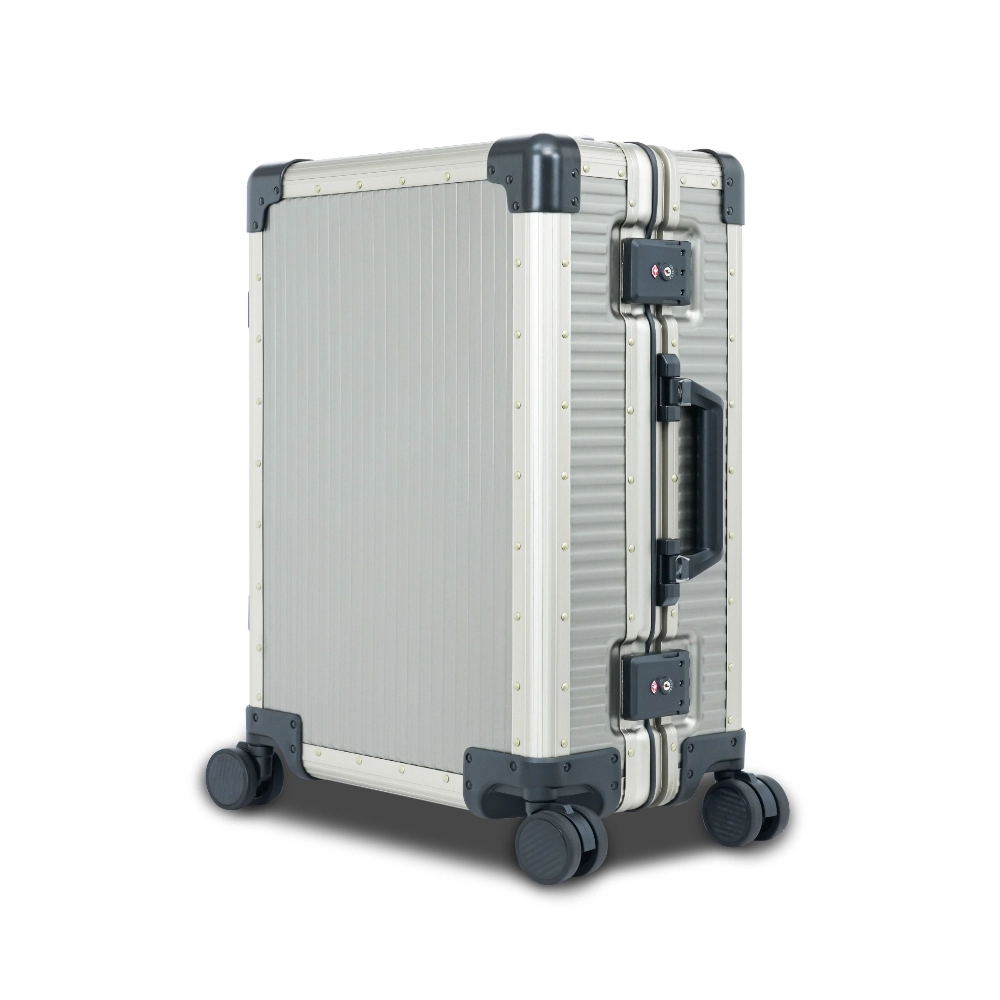
Hardside thermoformers / aluminum specialists. A related but distinct hardside group works in thermoforming or aluminum-frame construction rather than pure injection molding. Aluminum and aluminum-frame suitcases sit here — the expertise is in metal forming, frame assembly, and the hinge and latch systems that zipperless frames require.
Full-service manufacturers. These factories offer capabilities across both soft and hardside construction, often providing more comprehensive solutions for brands with diverse product lines and complex component-integration needs. A brand planning a range that spans hardside spinners and soft duffels benefits from a full-service partner that can build the whole line under one roof.
Knowing your type narrows the field immediately and prevents the most basic mismatch: asking a specialist to build outside its core competence. For a directory-style view of established manufacturers across these types, see: Top OEM Luggage Manufacturers in China →
The Metrics That Actually Signal Reliability
Once you have the right supplier type, the question is which factory within that type to trust. Marketing copy will not tell you — but several verifiable metrics will. These are the numbers worth requesting and comparing.
Reorder rate. The single most telling quality signal. A factory’s reorder rate reflects whether its buyers come back, and the spread between good and poor suppliers is wide — strong manufacturers show reorder rates in the 30–60% range, while weak ones sit below 15%. A high reorder rate is hard to fake: it means real buyers placed a second order after living with the first. Treat sub-15% reorder rates as a flag warranting deeper due diligence, and reorder rates above 30% as a positive signal.
Response time. Response speed during the quoting phase is a reliable preview of communication during production. The best suppliers respond in two hours or less; slow or vague pre-sale communication rarely improves after the deposit is paid. This is easy to measure yourself — simply track how a supplier handles your initial inquiries.
On-time delivery rate. A factory that publishes or will state its on-time delivery percentage is giving you a measurable reliability indicator. Combined with capacity (below), it tells you whether the supplier can hit your delivery commitments during peak demand.
Production capacity. Capacity determines whether a supplier can scale with you without bottlenecking your inventory before a peak season. Ask for monthly output capacity, the number of active production lines, and true annual capacity — not just floor area. A factory’s footprint and staff count are context; the capacity number is what protects your supply chain when demand rises.
These metrics are concrete, comparable, and far more useful than any self-description. A supplier that can state its reorder rate, response benchmark, on-time rate, and capacity is a supplier operating with the transparency you want; one that deflects these questions is telling you something too.
For the broader supplier vetting process behind these metrics, see: How to Vet Industrial Luggage Suppliers →
Quality Systems: What Separates a Factory From a Trader
A critical distinction many first-time buyers miss is between a genuine manufacturer and a trading company that resells factory output. The difference shows up in the quality systems a supplier can document.
Vertical integration. A genuine manufacturer controls its core production — shells, wheels, and handles produced or closely controlled in-house rather than outsourced. Vertical integration matters for two reasons: it stabilizes your cost (the factory controls its own raw-material sourcing) and it prevents the third-party delays and quality drops that come from outsourced components. Ask specifically whether the factory makes its own shells, wheels, and handles, or sources them from other suppliers.
Documented QC standards. Reliable manufacturers run structured quality control — incoming quality control on raw materials, in-process control during production, and pre-shipment inspection against a defined acceptance standard (AQL 2.5 is the common benchmark for this category). These systems are what catch the silent profit-killers of travel retail: jammed telescopic handles, broken spinner wheels, and cracked shells that drive returns and erode margin.
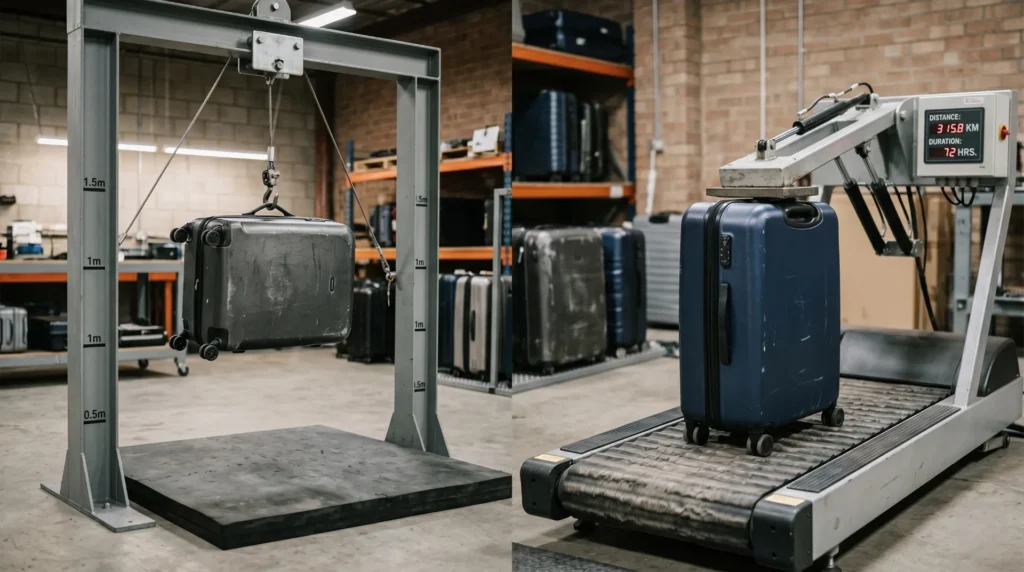
In-house testing. A serious suitcase manufacturer puts prototypes through its own lab testing before production — loaded drop tests for impact resistance, wheel mileage runs for mobility durability, and handle jerk tests for structural integrity under load. Ask whether testing is in-house and whether you can receive the test reports. Third-party verification (SGS, Bureau Veritas, Intertek) adds an independent layer.
Certification readiness. Export-ready manufacturers understand destination-market compliance — REACH for the EU, CPC for children’s products in the US, and textile labeling requirements for fabric-heavy goods. A factory familiar with your target market’s certifications removes a significant compliance burden from your side.
The pattern is consistent: a real factory can document its integration, QC, testing, and certifications; a trader points you to the factory’s documents without controlling any of it. For a deeper comparison of OEM cost and reliability mechanics, see: OEM Luggage Manufacturer Selection & Cost Guide →
What to Verify Before Your First Order
Even with the right supplier type, strong metrics, and documented quality systems, a first order goes wrong in predictable ways. These are the items to confirm in writing before you commit — each is a recoverable mistake on a first order and an expensive one on a reorder.
How the MOQ applies — per color or total. The most common and most expensive MOQ misunderstanding. A factory requiring 300 pieces per color forces a three-color launch to 900 units; a factory supporting total-order MOQ reaches the same 300-piece threshold across three colors at 100 units each. The distinction is the difference between a market test and an inventory bet. Always confirm whether the MOQ is per style, per color, or total.
Material grade in writing. Do not accept vague quotations that fail to specify material grade or hardware sourcing. “Polycarbonate” is not a specification; the grade, the source, and whether it is virgin or recycled are. A quote that does not name the material grade is a quote you cannot hold the factory to.
Written sample approval. Demand a pre-production (golden) sample and approve it in writing before mass production. This is your baseline confirming custom colors, lining, hardware, and dimensions are accurate. Skipping written sample approval is one of the most frequent first-order mistakes — and the hardest to dispute later.
Mold ownership terms. For any custom tooling, confirm who owns the mold before paying a tooling deposit. Mold ownership determines whether you can move production elsewhere later. This is a term to settle upfront, not after the deposit.
Sample vs bulk lead time. Confirm sample lead time and bulk production lead time separately, and do not conflate them. Underestimating the gap between the two is a classic scheduling error. Bulk lead time should be quoted from sample approval, not from order placement.
Tech pack readiness on your side. Come prepared with a detailed tech pack — material specifications, functional requirements (trolley cycle testing, wheel durability), and any required certifications. A clear tech pack gets you accurate, comparable quotes; a vague brief gets you vague quotes you cannot evaluate against each other.
For the full MOQ and color-splitting structure, see: Custom Luggage MOQ Guide →
Request a manufacturer evaluation — send us your product type, target volume, and tech pack, and we will return a transparent quote with material grade, MOQ structure, lead times, and capacity stated upfront. Request Quote
Aluvox as a Suitcase Manufacturer
Applying the framework above to ourselves, here is how Aluvox maps against the evaluation criteria — the same criteria you should apply to any supplier.
Supplier type: Hardside specialist with full-service capability — aluminum and aluminum-frame construction, PC and ABS injection, plus PP and titanium. We build hardside spinners, zipperless frame cases, and aluminum suitcases, and support brands across a multi-material range.
Production parameters:
| Parameter | Specification |
|---|---|
| MOQ | 300 pcs / style |
| MOQ structure | Total-order — color splitting supported across colors |
| Materials | Aluminum, PC, ABS, PP, titanium |
| Vertical integration | In-house mold workshop and core component control |
| QC standard | IQC, in-process control, pre-shipment inspection (AQL 2.5) |
| In-house testing | ISTA-style loaded drop, wheel mileage, handle jerk tests |
| Sample lead time (existing tooling) | 20 working days |
| New mold development | 30–45 working days |
| Bulk production | 45 days from sample approval |
| Payment terms | 30% deposit + 70% against B/L |
| Export ports | Huangpu, Nansha, Shekou, Yantian |
On the metrics that matter: Aluvox states material grade, MOQ structure, lead times, and capacity upfront in every quote — and provides mill certificates for metal, virgin-material confirmation for PC/ABS, and third-party test verification on request. Pre-production samples are provided for written sign-off before mass production, with photo or video confirmation of the finished sample.
Browse the Aluvox aluminum luggage collection →
Visit the Aluvox private label luggage manufacturer page →
A Practical Evaluation Scorecard
To compare suitcase manufacturers side by side, score each candidate against these criteria. A strong supplier answers all of them clearly and in writing; gaps and deflections are the signal to look closer.
Supplier fit
- Does the factory specialize in your product type (soft-side, hardside injection, aluminum/thermoform, or full-service)?
- Can it support your full intended range, or only part of it?
Reliability metrics
- What is the reorder rate? (Above 30% is positive; below 15% warrants scrutiny.)
- What is the typical response time? (Two hours or less is the benchmark.)
- What is the on-time delivery rate and monthly capacity?
Quality systems
- Is the factory vertically integrated (own shells, wheels, handles)?
- What QC standard does it run (AQL 2.5)? Can it provide inspection reports?
- Does it perform in-house drop, wheel, and handle testing? Third-party verification?
- Is it familiar with your destination market’s certifications (REACH, CPC)?
First-order terms
- Is the MOQ per color or total-order? Is color splitting supported?
- Is material grade specified in writing?
- Is a pre-production sample provided for written approval?
- Who owns the tooling?
- Are sample and bulk lead times quoted separately?
A supplier that scores well across all four sections is one you can plan and budget around. One that scores well on price but poorly on transparency is the supplier whose first order goes wrong in the predictable ways above. The scorecard turns an impossible-looking comparison — every factory describing itself identically — into a structured decision.
If you would like to run this scorecard against Aluvox with your specific product and volume, our team will provide the figures and documentation for every line.
Contact our Sales Team — send your product type, target volume, and any tech pack you have. We will return a full evaluation against the scorecard above within 2 business days. Contact Sales Team