

How to Find a Reliable Luggage Supplier: A B2B Guide
“Luggage supplier” is one of the vaguest search terms in sourcing. Type it in and you get a chaotic mix: Chinese OEM factories, trading companies, wholesalers, local luggage stores, luggage shipping services, and consumer brands — all calling themselves, or being indexed as, “luggage suppliers.” For a B2B buyer trying to source product, most of those results are noise. The real challenge is cutting through it to find the right type of supplier for your needs, and then verifying that the supplier is actually what it claims to be.
That verification matters more than buyers expect, because in the global luggage industry, thousands of suppliers claim to be manufacturers when many are trading companies or factories with limited capability. Choosing the wrong type — or a supplier that misrepresents itself — affects your pricing, your quality control, your delivery reliability, and ultimately your brand. The supplier you choose influences far more than production.
This guide cuts through the ambiguity. It explains the three supplier types and which one fits your needs, how to tell a genuine factory from a trading company, how to verify a luggage supplier before you commit, and the sourcing process that protects you. At Aluvox, we are a direct luggage manufacturer — not a trading company — supplying brands from our Dongguan facility, so this guide will be specific about what a real factory looks like and how to confirm it.
The Three Types of Luggage Supplier
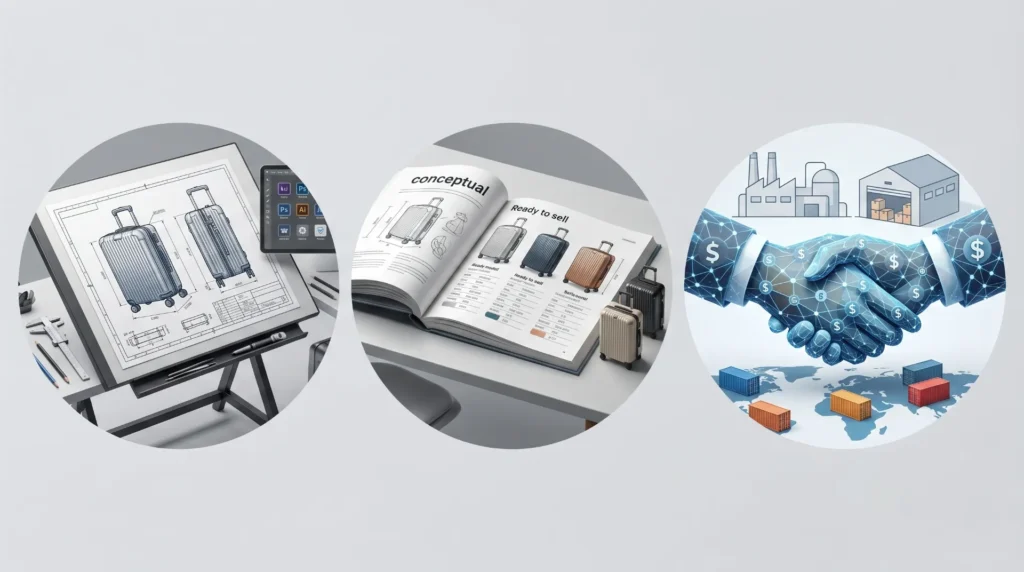
The first step in cutting through the noise is knowing that “luggage supplier” covers three distinct B2B types, each suited to a different buyer. (The local stores, shipping services, and consumer brands that also appear in search results are not B2B suppliers at all — set those aside.)
OEM factory — you bring the design. An OEM factory produces luggage to your specifications and designs. This suits established brands with their own product development teams who want a manufacturer to execute a specific vision. OEM factories give you full control over the product and direct factory pricing, in exchange for requiring more design input and typically higher minimums.
ODM factory — the factory’s design, your brand. An ODM factory offers ready-made designs you customize with your branding. This model is popular with startup brands and Amazon sellers who want to launch quickly without developing a product from scratch. It is faster and lower-risk than OEM, and the right entry point for most new luggage brands.
Trading company — an intermediary. A trading company acts as a middleman between you and the factory. It can be convenient for small or mixed orders and for buyers who want one contact across multiple product types — but it adds a markup over factory pricing and gives you limited visibility and control over the actual manufacturing. For some buyers the convenience is worth it; for most who are sourcing at volume, it is a cost and a risk.
The decision among these depends on your stage and needs: ODM for a fast, low-risk launch; OEM for a brand with its own design; a trading company only when the convenience genuinely outweighs the markup and reduced oversight. The mistake is using a trading company without knowing it — paying intermediary margins while believing you are dealing with a factory. For the broader manufacturer-selection framework, see: How to Choose a Luggage Manufacturer in China →
How to Tell a Real Factory From a Trading Company
Because so many trading companies present themselves as manufacturers, distinguishing the two is one of the most valuable skills in luggage sourcing. Direct manufacturers offer better pricing, tighter quality control, and greater transparency; trading companies add markup and act as intermediaries with limited oversight. Here is how to tell them apart.
Ask direct production questions. A real factory can answer detailed questions about its materials, processes, machinery, and capacity without deflecting. Ask what materials it uses, how it handles specific construction (telescopic handles and wheel structures — common luggage failure points), and what its production capacity is. A factory answers from direct knowledge; a trading company often cannot, or routes the question elsewhere.
Request unedited production-line video. Ask for unedited video of active production lines, not a polished marketing reel. A genuine factory can show its lines; a trading company cannot show what it does not own. Many real factories now also welcome video factory tours via Zoom or Teams with real-time Q&A — a practical verification for overseas buyers.
Verify the business license and operational data. Cross-check factory size, employee count, certifications, and transaction history. Verify the business license directly rather than trusting a profile. Be aware that “verified supplier” badges on sourcing platforms can be paid for — the badge confirms the platform checked some information, not that the supplier is a factory or is reliable. Treat the badge as a starting point, not proof.
Look for the manufacturing-and-trading distinction. Some suppliers are genuinely a “manufacturing and trading combo” — a real factory with an in-house trading arm. That can combine factory capability with sourcing convenience. The key is confirming the factory is real, which the steps above establish, rather than assuming a trading presence means no factory.
A supplier that answers production questions directly, shows its lines, and verifies its license is one you can treat as a real factory. One that deflects, shows only marketing material, or cannot verify its operation is one to approach with caution. For the full vetting framework, see: How to Vet Industrial Luggage Suppliers →
How to Verify a Luggage Supplier Before You Commit
Once you have identified the right type and confirmed it is a real factory, a structured verification protects you before you commit an order. These are the checks professional buyers run.
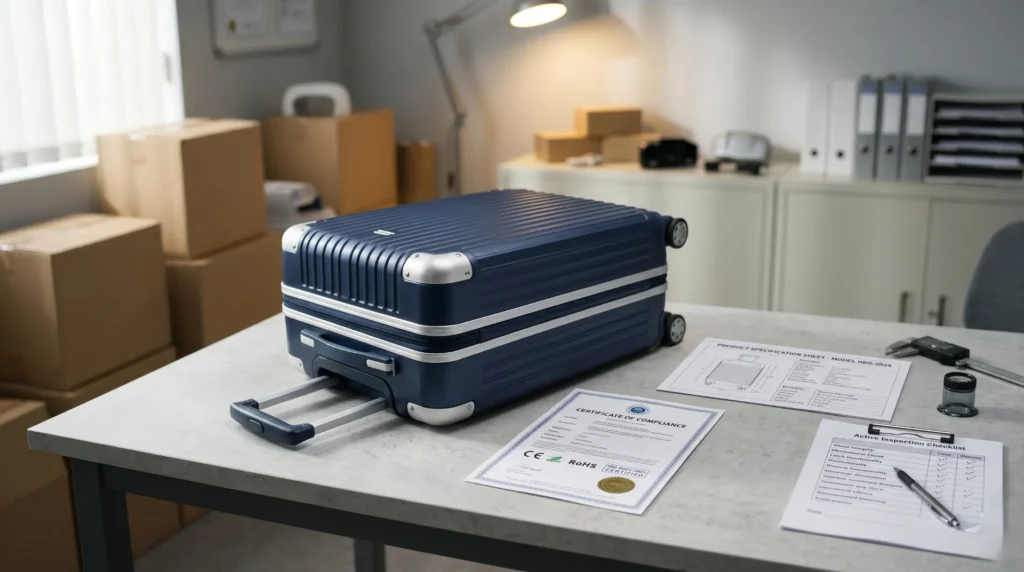
Operating history and certifications. Prioritize suppliers with at least three to five years of verified operation and recognized certifications — ISO 9001 for quality management, plus any market-specific compliance your destination requires. Verify certifications through the issuing bodies, not just the supplier’s claim.
Performance metrics. Request and compare verifiable metrics: reorder rate, on-time delivery rate, and response time. Strong suppliers show high reorder rates and consistent on-time delivery; a supplier with an inconsistent delivery record is a red flag for any time-sensitive order. These numbers reveal reliability that marketing copy cannot.
Physical samples. Always request a physical sample to assess material quality, craftsmanship, and packaging before a bulk order. Expect to pay a nominal sample fee — many reputable factories charge $15–$50 per sample, often credited toward the production order, precisely to filter serious buyers. Free samples are not a sign of a better supplier.
The sample-to-bulk gap. The most common sourcing failure is the “good sample, weak bulk order” gap — a perfect sample followed by inconsistent mass production. To prevent it, lock material specs, construction standards, and tolerances in writing before the PO, and require a pre-production sample sign-off tied to final QC criteria.
AQL inspection terms. Confirm AQL-based acceptance criteria before mass production — defect categories, inspection level, and pass/fail rules written into the contract. This makes quality objective and dispute resolution faster, lowering your financial exposure on a cross-border order.
Scalability. Confirm the supplier can grow with you — higher annual volume, more complex customization, and multi-market compliance as your brand expands. A scalable supplier reduces the cost and risk of switching later. For the full evaluation scorecard, see: Suitcase Manufacturers: A Buyer’s Evaluation Guide →
The Luggage Sourcing Process, Step by Step
A reliable luggage supplier relationship follows a structured process. Knowing the sequence helps you keep control and spot a supplier that tries to skip a critical step.
- Requirements — Define your product, materials, target price, volume, and timeline.
- Quotation — The supplier quotes against your requirements; clarify whether it is FOB and from which port.
- Sample development — The supplier produces a sample to your specification.
- Approval — You review and approve the sample in writing, locking specs and tolerances.
- Trial order — A smaller initial order tests real production quality and defect rates before full commitment.
- Mass production — Full production runs against the approved sample and locked specs.
Clear communication at each stage is what keeps production smooth. A supplier that wants to skip the sample or the trial order, or that is vague at the quotation stage, is showing you a risk before you have committed money. The trial order in particular — a smaller run before full volume — is one of the best protections a first-time buyer has.
Looking for a direct luggage factory? Request a quote — tell us your product, volume, and customization needs, and we will respond with factory pricing, MOQ, and lead times, plus documentation verifying we are a real manufacturer. Request Quote
Aluvox as a Direct Luggage Supplier
Aluvox is a direct luggage manufacturer — not a trading company — so a buyer dealing with us is dealing with the factory. Here is how we map to the verification criteria in this guide.
Verification at a glance:
| Criterion | Aluvox |
|---|---|
| Supplier type | Direct OEM/ODM factory (Dongguan) |
| Operating history | Established manufacturer with verifiable facility |
| Quality system | ISO 10012 measurement management |
| Production transparency | Factory video tour and production-line verification available |
| Performance | Documented QC, on-time delivery, reorder history |
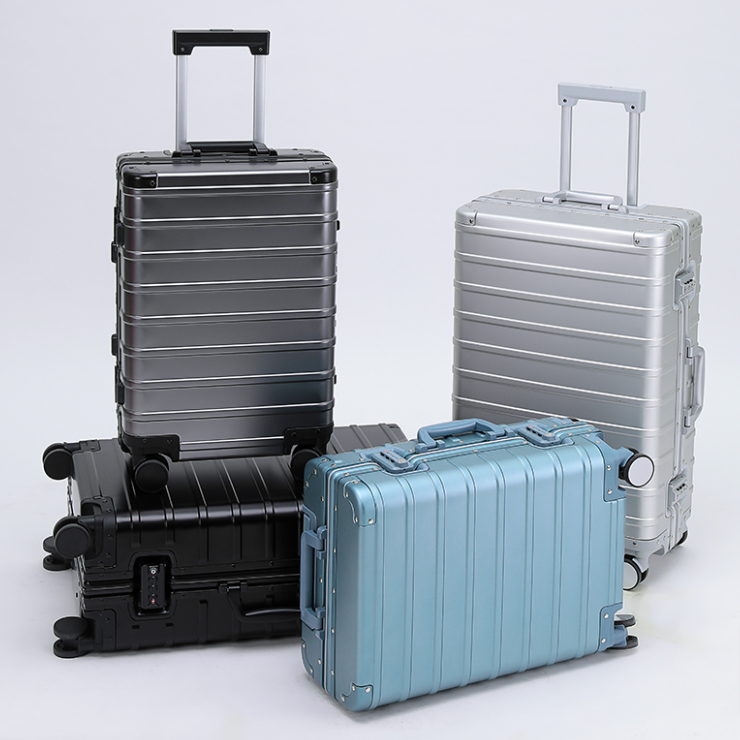
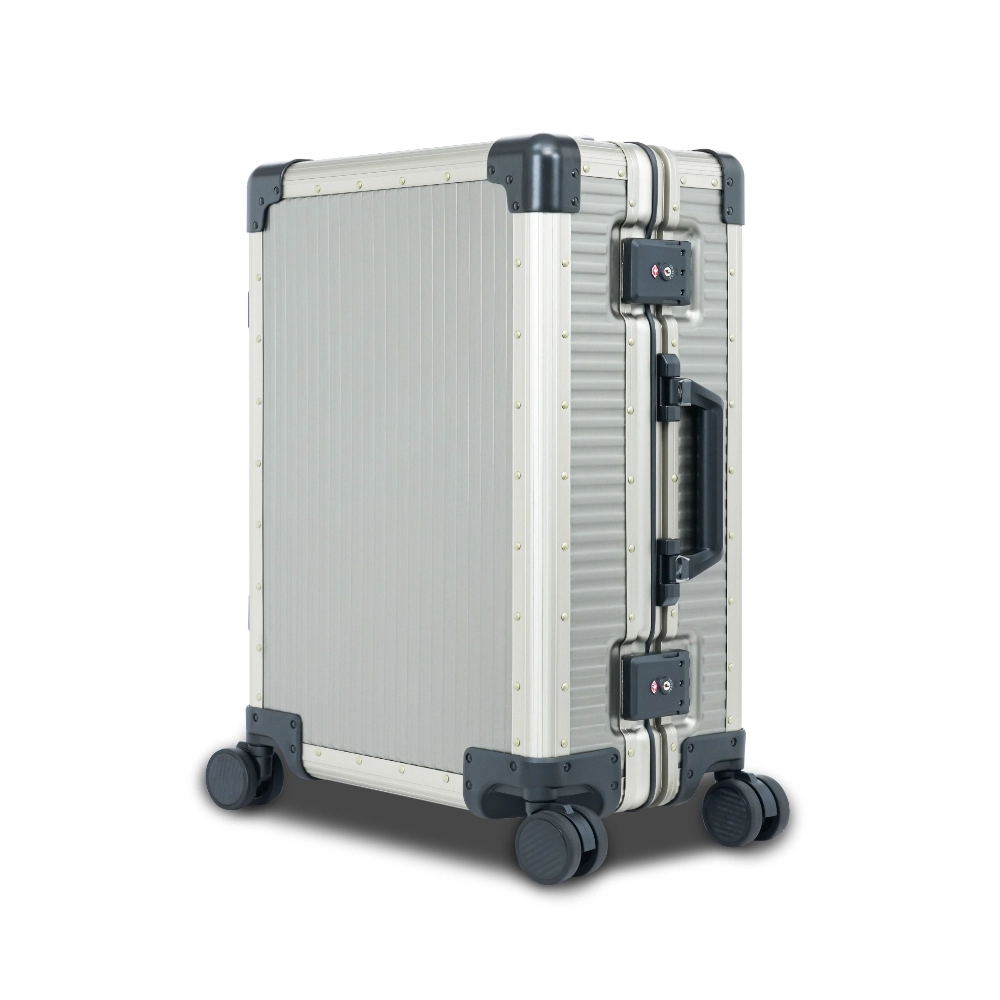
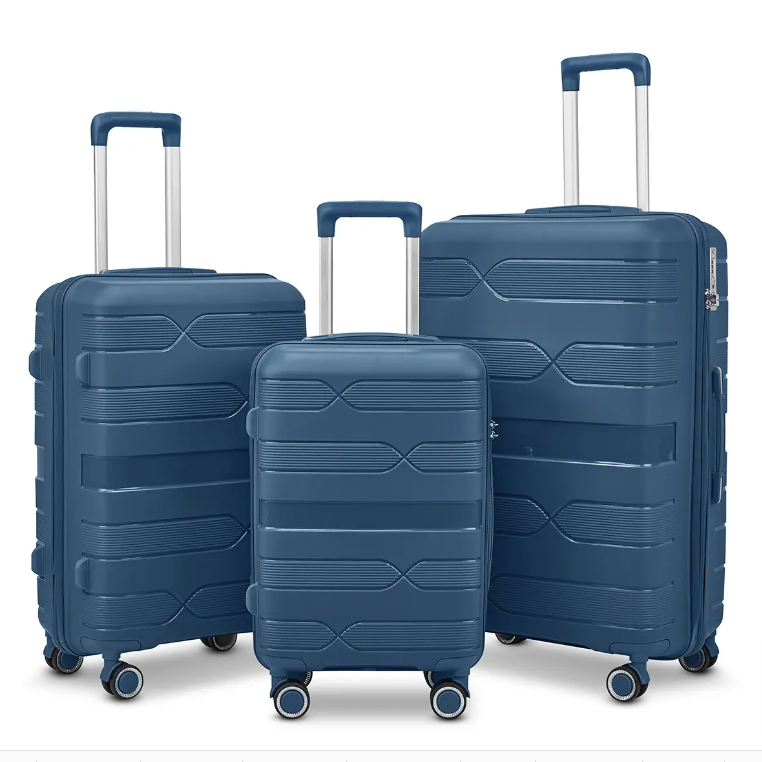
| Materials | Aluminum, PC, ABS, PP, titanium — with mill certificates and virgin-material confirmation |
Production parameters:
| Parameter | Specification |
|---|---|
| MOQ | 300 pcs / style |
| Color splitting | Supported — total order MOQ across colors |
| Models | OEM (your design) and ODM (our design, your brand) |
| Sample lead time (existing tooling) | 20 working days |
| New mold development | 30–45 working days |
| Bulk production | 45 days from deposit |
| QC standard | IQC, in-process, pre-shipment inspection (AQL 2.5) |
| Payment terms | 30% deposit + 70% against B/L |
| Export ports | Huangpu, Nansha, Shekou, Yantian |
What dealing with the factory means: Direct factory pricing with no intermediary markup, direct control and visibility over production, pre-production samples for sign-off, AQL 2.5 inspection, and material documentation on request. We welcome the verification this guide recommends — production questions, line video, and license checks — because a real factory has nothing to hide.
Browse the Aluvox luggage collection →
Visit the Aluvox private label luggage manufacturer page →
Find the Right Supplier, Then Verify It
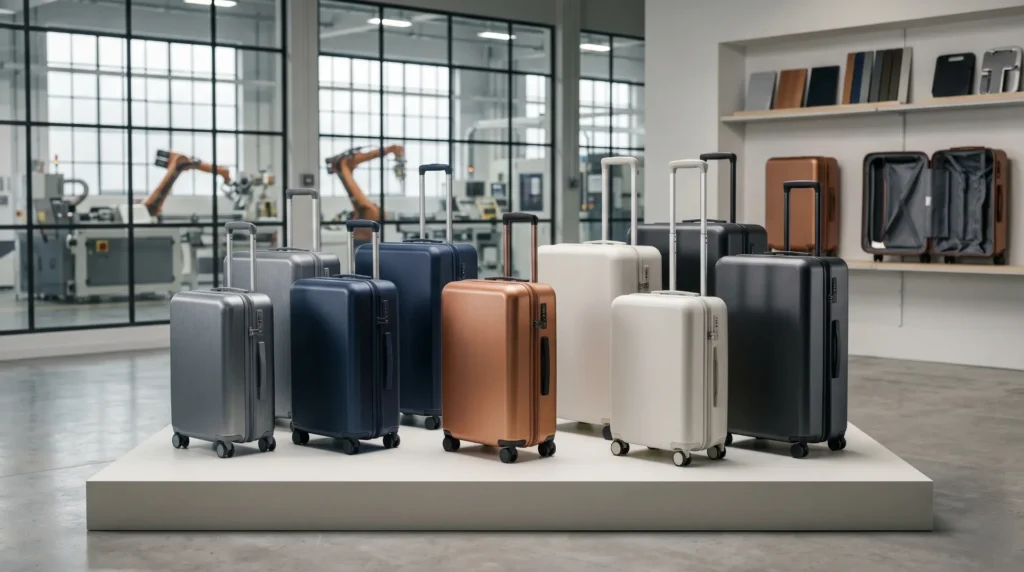
The chaos of the “luggage supplier” search resolves once you know what you are looking for: the right type of supplier for your stage — OEM, ODM, or, with eyes open, a trading company — and the verification that confirms a supplier is a real, reliable factory rather than an intermediary or an empty profile. Cutting through the noise is the first skill; verifying what remains is the second.
The verification is concrete: ask production questions, require line video, check the license, compare reorder and delivery metrics, sample before bulk, lock specs in writing, and confirm AQL terms. A supplier that passes these is one you can build a brand on; one that cannot is a risk no price discount offsets. The buyers who source luggage well are not the ones who find the cheapest supplier — they are the ones who verify the right one.
If you want to deal directly with a real luggage factory and verify it the way this guide recommends, Aluvox welcomes the scrutiny and can provide a quote with the documentation to back it.
Contact our Sales Team — tell us your product, volume, and customization needs. We will provide factory pricing and the documentation to verify we are a direct manufacturer, within 2 business days. Contact Sales Team