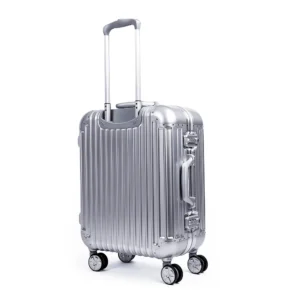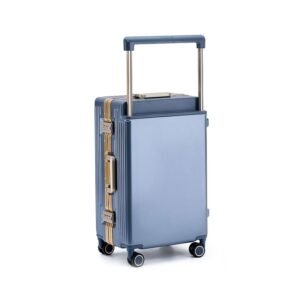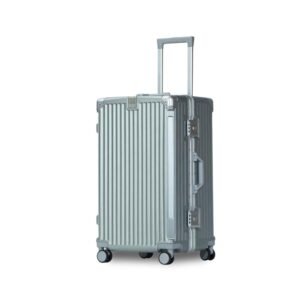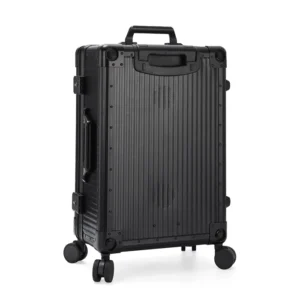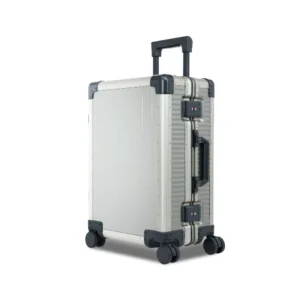

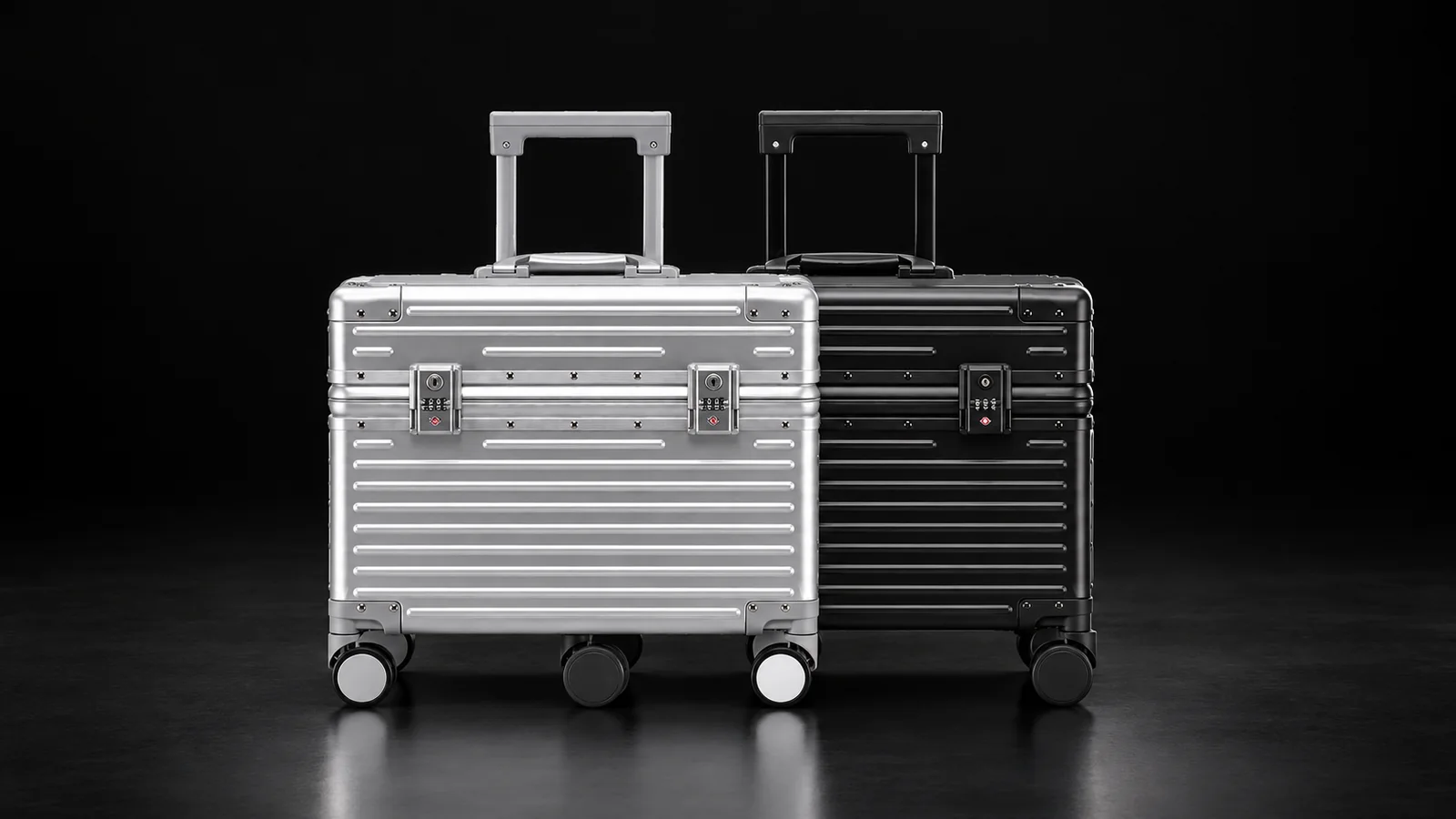
Aluminum carry-on luggage is the product where material specification and airline regulation intersect most directly. A checked bag has margin for error — a few millimeters of oversized dimension, a kilogram of extra weight. A carry-on does not. If it does not fit in the overhead bin or exceeds the weight limit at the gate, it gets checked — and the product has failed its primary use case.
For brands building an aluminum carry-on line, this means every design decision — shell thickness, corner construction, hardware weight, handle system — must be evaluated against airline compliance requirements that vary by carrier and region. Getting the balance right between structural performance and weight is what separates an aluminum carry-on that works in market from one that generates complaints.
This guide covers the airline size landscape, the material specifications that matter for aluminum carry-on production, and the OEM parameters for brands entering this category.
At Aluvox, we have manufactured aluminum carry-on luggage from our Dongguan facility since 1993. Our carry-on program uses aerospace-grade Series 5 aluminum-magnesium alloy at 1mm shell thickness — the industry standard for premium aluminum luggage production.
Airline Size Limits: What Carry-On Actually Means
There is no universal carry-on size standard. The dimensions that qualify as cabin luggage vary by airline, region, and — in practice — by how strictly the gate agent enforces the published limit on any given flight.
For brands designing aluminum carry-on luggage, the relevant question is not what fits on one airline — it is what fits on most airlines in your target market without creating a customer service problem.
Size limits by region:
| Region | Typical limit (including wheels and handles) | Weight limit |
|---|---|---|
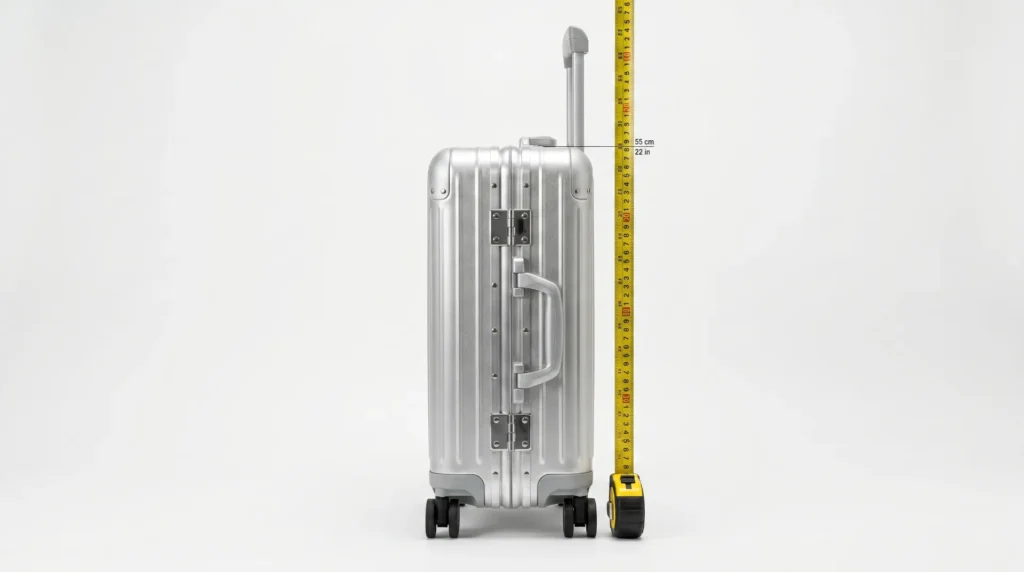
| US majors (AA, UA, DL) | 56 x 36 x 23 cm (22 x 14 x 9 in) | Generally none |
| European majors (LH, AF, BA) | 55 x 35 x 20 cm | 7–10 kg |
| Asian majors (ANA, JAL, CX) | 55 x 36 x 23 cm | 7–10 kg |
| Budget carriers (global) | Smaller, varies by carrier | Strictly enforced |
The IATA recommended guideline is 55 x 35 x 20 cm including all external components — wheels, handles, latches. Most premium aluminum carry-ons are designed to this specification as the lowest common denominator that provides the widest airline compatibility.
The weight problem for aluminum:
An aluminum carry-on built to premium specification — 1mm Series 5 alloy shell, aluminum frame, butterfly latches, telescopic handle, spinner wheels — typically weighs 3.5 to 4.5 kg empty. On US carriers with no weight limit, this is not an issue. On European and Asian carriers with 7–10 kg limits, it leaves the traveler with 2.5 to 6.5 kg for contents.
This is a product specification reality that brands must communicate clearly to consumers — and that product designers must account for by optimizing every non-structural component for weight. Handle tube material, wheel assembly weight, latch construction, and interior lining all contribute to the total and all offer optimization opportunities.
Why Aluminum for Carry-On: The Performance Case
A carry-on suitcase encounters more physical stress cycles than any other luggage format. It goes in and out of overhead compartments on every flight — lifted, compressed against other bags, removed at angles that stress corner joints and handle attachments. It rolls through airports on hard surfaces for extended distances. It passes through security screening conveyors. It is the luggage format where material performance matters most per use cycle.
Structural rigidity under compression. An aluminum shell does not flex when compressed against other bags in an overhead bin. The contents inside experience minimal movement and minimal compression force. For travelers carrying laptops, cameras, fragile items, or precisely organized business materials, this rigidity is a functional advantage that PC and ABS cannot match — those materials absorb impact by flexing, which means the contents inside also flex.
Zipperless frame closure. Aluminum carry-ons use frame latches or combination locks rather than zippers. This eliminates the zipper failure modes that are the most common carry-on complaint category: zipper separation under packing pressure, slider damage from overhead bin handling, and the pen-attack security vulnerability. For a product that opens and closes multiple times per trip, the durability advantage of a latched closure over a zipper compounds with every use cycle.
Surface durability. Brushed or anodized aluminum acquires character with use rather than degrading. Minor surface contact produces patina rather than scratches that look like damage. This is a brand positioning advantage — an aluminum carry-on that looks better after two years of use than a PC carry-on after the same period communicates the durability story the premium price point requires.
The weight tradeoff. Aluminum carry-ons weigh more than PC equivalents — typically 1.5 to 2 kg more at equivalent dimensions. This is the material’s primary commercial limitation and must be accounted for in product positioning, marketing communications, and target market selection. Brands selling into European and Asian markets with strict weight enforcement need to be explicit about empty weight in product specifications.
For a full comparison of aluminum versus polycarbonate from a manufacturing and brand positioning perspective, see: Aluminum vs Polycarbonate Luggage →
For more on the security advantages of frame closure systems, see: Metal Suitcase Guide →
Alloy Specification for Carry-On Production
The alloy grade used in an aluminum carry-on determines its structural performance, corrosion resistance, and surface treatment quality. Not all aluminum is equivalent — and the carry-on format, with its higher use frequency and more demanding stress cycles, is less forgiving of material shortcuts than larger checked luggage.
Series 5 aluminum-magnesium alloy (5052-H32) is the production standard for premium aluminum carry-on luggage. The magnesium content (2.2–2.8%) provides corrosion resistance without surface treatment dependency, structural integrity without brittleness, and consistent formability across production batches. Shell thickness for carry-on formats is typically 1.0 mm — sufficient for structural performance while managing total product weight.
Why carry-ons need better corner construction than checked bags:
A checked bag hits the ground during handling — primarily flat-face and edge impacts during conveyor transport. A carry-on hits overhead bin edges during insertion and removal — primarily corner impacts at angles that concentrate force on the corner joint. This means corner reinforcement design is proportionally more important for carry-on formats than for checked luggage.
Ask any aluminum luggage manufacturer how their corners are constructed — welded, riveted, or adhesive bonded — and request corner-specific drop test results. Corner impact at the angles a carry-on actually encounters (insertion angles into overhead bins, not vertical free-fall) is the relevant test condition.
Surface treatment selection for carry-ons:
Carry-ons experience more surface contact per trip than checked bags — overhead bin interaction, security conveyor contact, handling at cafes and lounges. Surface treatment selection should account for this higher contact frequency.
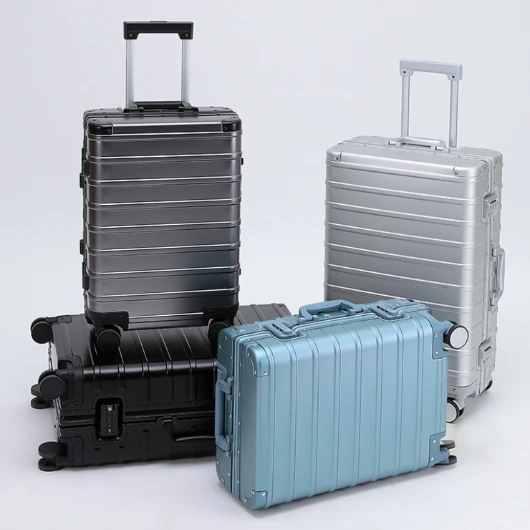
Brushed finish is the most wear-resistant option — micro-scratches from contact blend into the directional grain rather than showing as visible damage. Anodized finish provides color and scratch resistance but shows contact marks more visibly than brushed. Sandblasted finish is the least wear-resistant for high-contact applications.
For brands building a carry-on line, brushed finish is the safest default for customer satisfaction. Anodized color is appropriate for limited editions or fashion-forward positioning where some surface character is acceptable.
At Aluvox, all surface treatment — brushing, sandblasting, and anodizing — is completed in-house at our Dongguan facility, ensuring finish consistency across production runs.
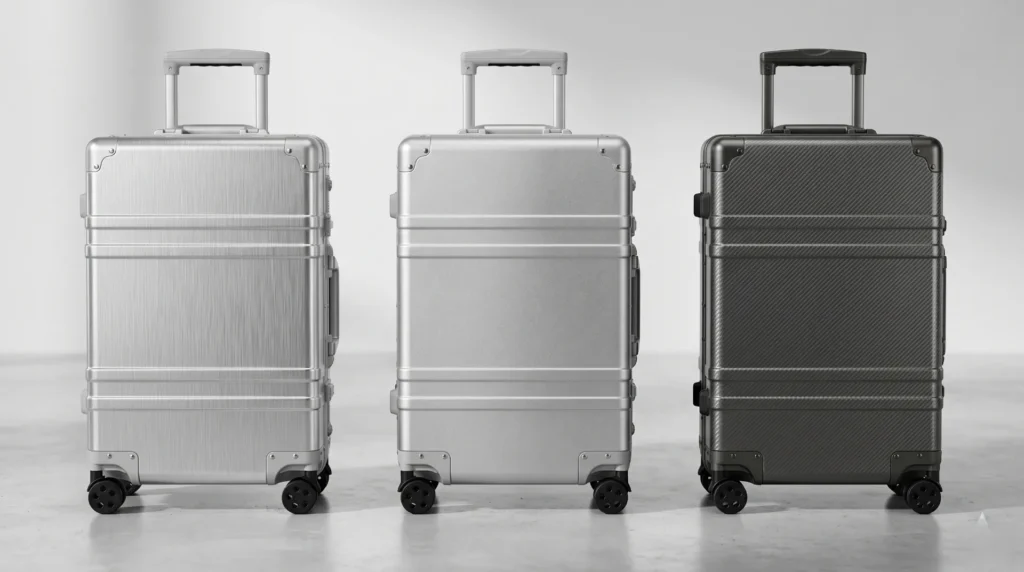
Aluvox Aluminum Carry-On OEM Program
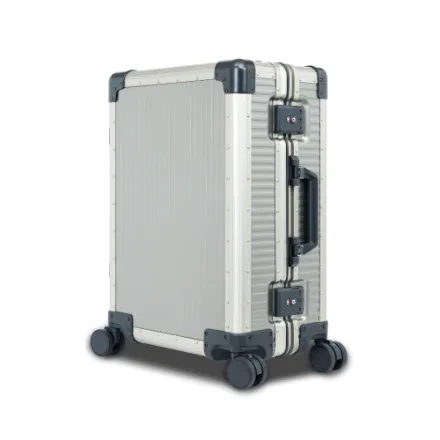
Material specification: Aerospace-grade Series 5 aluminum-magnesium alloy (5052-H32), 1mm shell thickness, stamped and finished in-house. Carry-on dimensions designed to IATA recommended guideline (55 x 35 x 20 cm) for maximum airline compatibility.
Production parameters:
| Parameter | Specification |
|---|---|
| MOQ | 300 pcs / style |
| Color splitting | Supported — total order MOQ across colors |
| Sample lead time (existing tooling) | 20 working days |
| Bulk production lead time | 45 days from deposit |
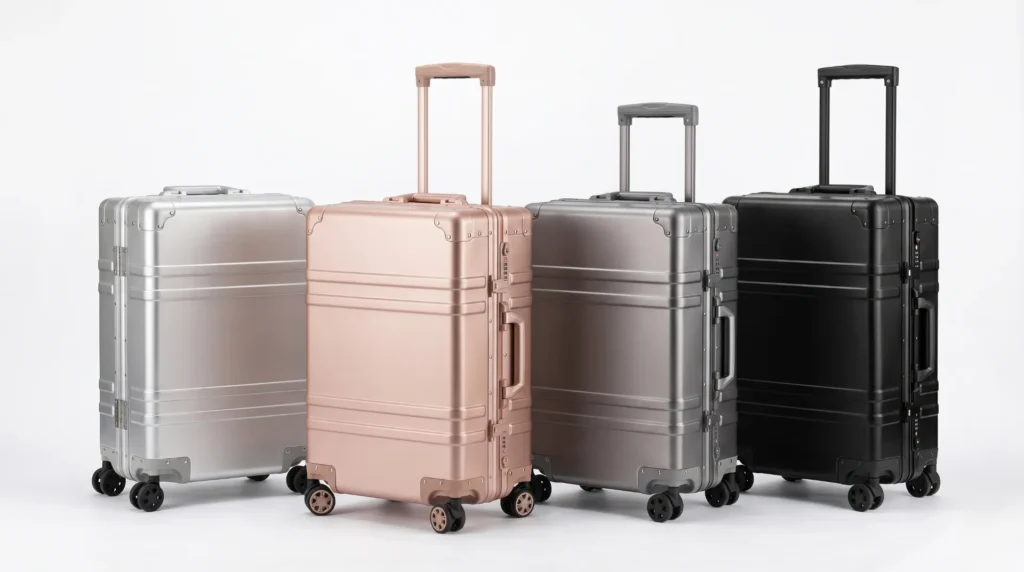
| Surface finish options | Brushed / Sandblasted / Anodized |
| Closure | Aluminum frame with latches or TSA combination lock |
| Customization scope | Shell color, finish, hardware, logo, lining |
| Export ports | Huangpu, Nansha, Shekou, Yantian |
ODM availability: Existing carry-on tooling is available for private label programs — brands can launch with proven shell geometry, applying their own color, hardware, logo, and interior customization at the 300-piece MOQ threshold.
Browse the Aluvox aluminum luggage collection →
For MOQ details and color splitting structure, see: Custom Luggage MOQ Guide →
Request an Aluvox aluminum carry-on sample — verify alloy specification, weight, airline dimension compliance, and surface finish quality before committing to production. Request Sample
Three Mistakes Brands Make with Aluminum Carry-Ons
Mistake 1: Ignoring airline weight limits in product design
An aluminum carry-on that weighs 4.5 kg empty leaves a European traveler with 2.5 kg of packing capacity under a 7 kg limit. That is not a carry-on — that is a briefcase. If your target market includes European or Asian carriers with weight enforcement, every component must be evaluated for weight optimization. Handle tube material, wheel assembly selection, latch weight, interior lining thickness — each contributes to total weight and each offers reduction opportunity without compromising structural performance.
Mistake 2: Insufficient corner reinforcement for carry-on use patterns
Carry-on luggage is inserted into and removed from overhead bins at angles that concentrate force on the top corners. A corner construction method that passes a standard vertical drop test may still fail under the angular impact conditions a carry-on actually encounters. Request corner drop test results at insertion angles — not just vertical free-fall — and inspect the corner reinforcement design on your sample before approving bulk production.
Mistake 3: Substituting Series 3 alloy for Series 5 to reduce cost
Series 3 aluminum-manganese alloy is cheaper than Series 5 aluminum-magnesium alloy. It is also less corrosion-resistant and less structurally stable under the repeated stress cycles a carry-on encounters. A factory quoting aluminum carry-on production at prices significantly below the Series 5 market rate may be using Series 3 without disclosure. Request the alloy mill certificate before approving production — the document specifies the alloy series, temper designation, and mechanical properties that determine your product’s real-world performance.
The Carry-On Is Your Brand’s Most Visible Product
A carry-on is the luggage product that consumers use most frequently, carry most visibly, and evaluate most critically. It is the product that goes through airports, into meetings, onto social media. For brands building a premium luggage line, the carry-on is the product that establishes — or undermines — brand credibility.
Aluminum carry-on production requires the tightest specification tolerances in the luggage category: airline dimension compliance, weight optimization, corner reinforcement for overhead bin use patterns, and surface treatment durability for high-contact applications. The factory that produces your carry-on needs to understand these requirements at the engineering level, not just at the catalog level.
If you are developing an aluminum carry-on for an upcoming product line, Aluvox engineers are available to review your dimension targets, weight requirements, and market-specific airline compliance needs.
Contact an Aluvox Engineer — submit your target airline markets, retail price point, and estimated order volume. We will provide a carry-on specification recommendation and indicative production quote within 2 business days. Contact Engineering Team