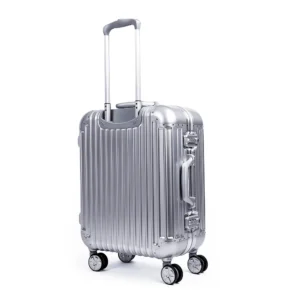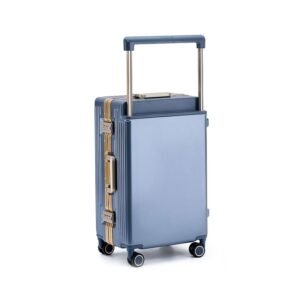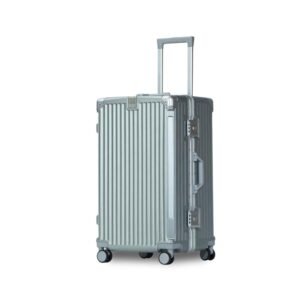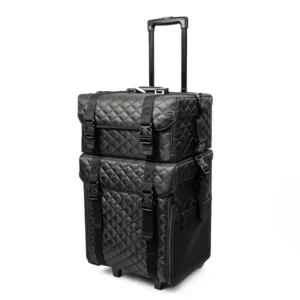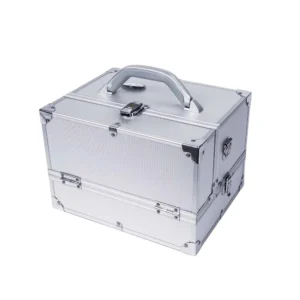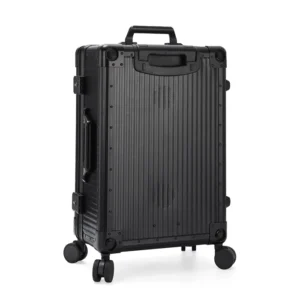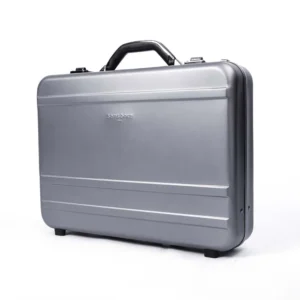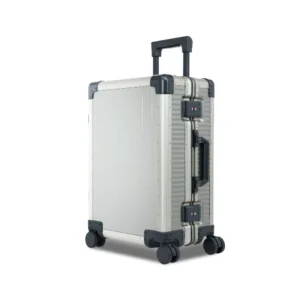

Aluminum defines the premium end of the hard-shell luggage market. It bends instead of cracking, takes surface finishes that polycarbonate and ABS cannot, and carries a perceived durability that lets a brand command a higher retail price — and it demands a manufacturing process most factories have never built.
For a brand, distributor, or private-label buyer entering the category, the sourcing problem is not finding factories that will quote aluminum. There are many. The problem is telling which ones have genuine in-house capability — in-house stamping, in-house surface treatment, verified raw-material sourcing — from those quietly outsourcing the critical steps to subcontractors they do not control. The sample looks identical either way. The bulk order does not.
This guide is the evaluation framework experienced aluminum buyers use before they commit tooling budgets and production deposits. Aluvox has manufactured aerospace-grade Series 5 aluminum-magnesium alloy luggage from its Dongguan, Guangdong facility since 1993; the framework below reflects three decades of production in this specific material category.
Why aluminum luggage is a specialist category
The properties that make aluminum commercially valuable — rigidity, finish range, premium appearance, and the way it dents rather than shatters — come from a process that differs fundamentally from PC or ABS moulding. Three things separate a real aluminum factory from one that assembles parts.
The forming process is the first. Aluminum shells are stamped from aerospace-grade alloy sheet using precision steel dies, typically four to six panels per case, each panel needing its own die set. The stamping controls shell geometry, wall thickness, and surface integrity at once, so a variation in die condition, pressure, or material batch produces a measurable change in how the shell performs. This is also why aluminum earns its place with travelers: where fabric tears and polycarbonate can crack, a stamped metal shell dents on a hard impact but holds its structure and protects the contents — the reason it is the default for frequent flyers, business travel, and buyers shipping valuable or fragile goods.
The alloy specification is the second. Aerospace-grade Series 5 aluminum-magnesium alloy is the production standard for premium luggage: the magnesium improves corrosion resistance and structural integrity without adding brittleness, which is why Series 5 survives the repeated impact of real use where Series 3 does not. A factory that cannot name the alloy series and temper of its sheet is either sourcing from unverified channels or has no direct control over its raw material. The third is surface treatment — anodizing, brushing, and sandblasting — each needing dedicated equipment and process control, covered in its own section below.
Six evaluation criteria for an aluminum luggage manufacturer
This is where sourcing lives, because “aluminum” alone guarantees nothing — cheaper brands use thinner sheet that dents on the first rough handling and, as buyers put it, looks good but fails on trip three. Score every candidate against the same six points.
1. In-house stamping capability. The single most important check. On a site visit, ask to see the stamping presses — model, rated tonnage, and the active die sets for current styles — and confirm the equipment is running and that staff can speak to the die maintenance schedule. A factory that outsources stamping has no direct control over the most critical variable in aluminum luggage: shell geometry and wall-thickness consistency. Your sample may come from a controlled environment; your bulk order may not.
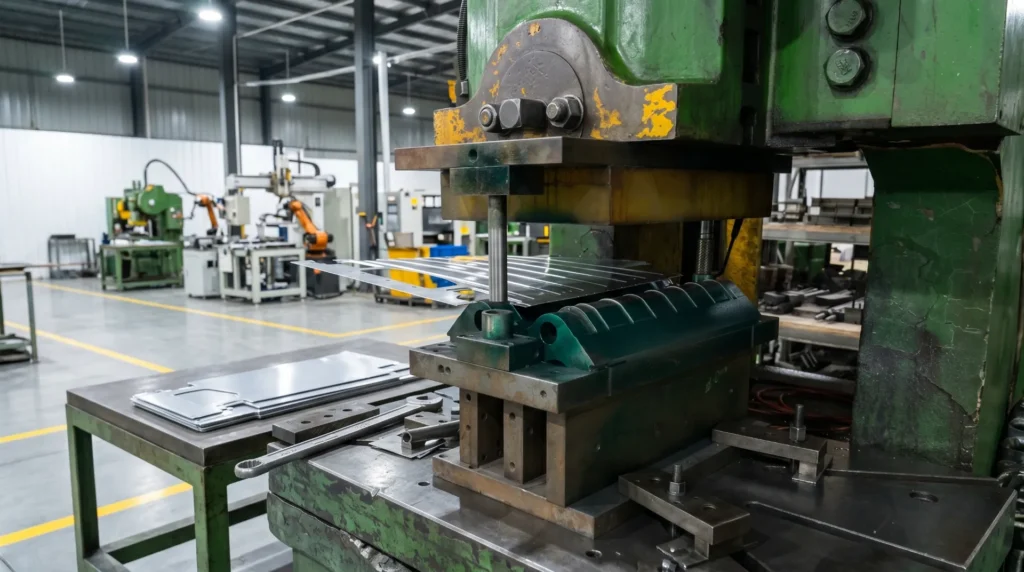
In-house aluminum stamping at the Aluvox Dongguan facility — shell geometry and wall thickness are controlled on our own presses, not outsourced.
2. Raw-material traceability. Request the alloy mill certificate for the sheet in production. It identifies the alloy series, temper, mechanical properties, and batch number — establishing traceability from source to finished shell. Aluvox sources aerospace-grade Series 5 aluminum-magnesium alloy and provides mill certificates on request for every production batch. A factory that cannot produce one is buying on spot markets without documented provenance, which means the specification of your finished product cannot be independently verified.
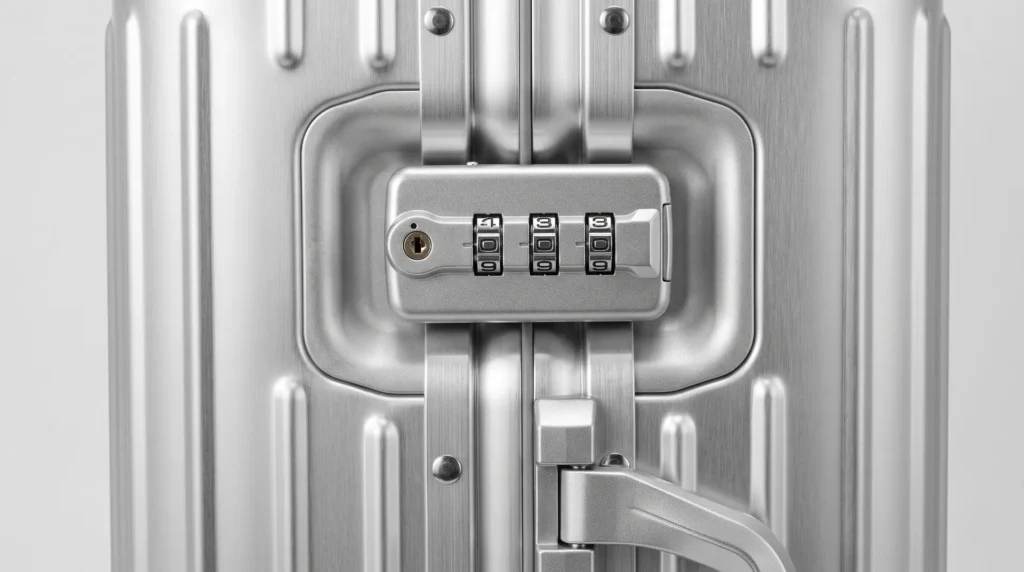
3. Surface-treatment control. Confirm whether anodizing, brushing, and sandblasting are done in-house or at a subcontractor. In-house is preferable because it keeps colour consistency and finish quality under the factory’s direct control. If treatment is outsourced, require the subcontractor’s name, location, and QC process — an auditable relationship is acceptable; an unnamed external provider is a consistency risk.
4. QC and testing documentation. Aluminum luggage should pass a defined test battery before export: drop testing to ISTA 2A or ASTM D5276 with corner-drop results specifically, compression at 100kg static load, handle-extension fatigue to at least 3,000 cycles, and wheel-drag testing. Request reports for a recent run, identifying the standard, pass/fail criteria, and date; third-party reports from SGS, Bureau Veritas, or Intertek are preferable to self-inspection for buyers who cannot attend production. Aluvox runs pre-shipment testing across seven categories — high temperature, compression, waterproofing, scratch resistance, load-bearing, handle fatigue, and wheel drag — with results retained per order.
5. Tooling ownership terms. Aluminum stamping dies are a real investment, typically $8,000 to $15,000 per style, and many factories retain ownership of dies a buyer paid for — change suppliers and your design stays behind. Before any tooling deposit, get in writing: who owns the die set after payment, on what terms it can be transferred or shipped, and the buyout price if ownership is not included. Aluvox offers tooling buyout agreements that transfer die ownership to the brand, protecting design IP and allowing a factory transition without losing the design.
6. Sample process and production parameters. Aluvox produces aluminum samples from existing tooling within 20 working days, with bulk starting 45 days from deposit and MOQ from 300 pieces per style — and colour splitting supported, so a 300-piece order can be divided across colours within one style without triggering a new MOQ. A manufacturer that can state these numbers plainly is one that runs a disciplined process; vagueness here usually shows up later as a slipped lead time.
Evaluating manufacturers for an upcoming aluminum line? Aluvox builds aerospace-grade Series 5 aluminum luggage with full material documentation — explore our aluminum luggage and send your specification.
The benchmark you are sourcing against
It helps to know the field, because aluminum is a category where reputations stick and a brand’s case is judged next to names buyers already own. At the premium brand end, RIMOWA has built aluminum in Germany since 1898 and prices it from roughly $1,550 to $2,500, with Zero Halliburton, TUMI’s 19 Degree, and Away’s aluminum edition setting the bar on finish, wheels, and the global repair networks buyers expect on a metal case. On the maker side, Sterling Pacific fabricates full-aluminum cases from 5052 and A380 alloy, and ALEON sells aircraft-grade aluminum with a ten-year warranty — both signalling that warranty and repairability are part of the category, not extras. Direct OEM factories such as Fusheng offer aluminum on an OEM and ODM basis, the lane most brands actually source in.
The buyers in this market are unusually blunt, which is useful intelligence for a brand. The consensus among frequent flyers is that aluminum is worth it only from a well-built, well-regarded source, not a thin marketing-led one: travelers pan one heavily-marketed brand as a disappointment while praising a Lufthansa-edition Rimowa as “solid as a tank” on the frame, handle, and locks. The practical lesson is that the construction has to back the positioning — and that the dent question is manageable rather than disqualifying. One business traveler noted a dent on flight three, then more than forty flights of perfect function afterward; airlines treat aluminum like any other checked bag, and a well-built case keeps opening, rolling, and locking through it. That is exactly the standard the six criteria above are built to verify.
Surface treatment and brand positioning
Aluminum’s finish versatility is one of its strongest commercial advantages: the same alloy and shell geometry can produce very different brand aesthetics depending on the treatment.
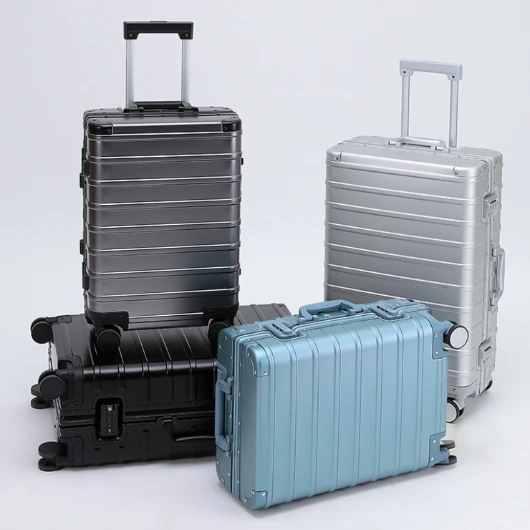
A brushed finish is a mechanical process that draws parallel micro-scratches across the surface for a directional satin texture — industrial, functional, engineered, the most common choice for business-travel positioning. A sandblasted finish uses a fine abrasive blast for a uniform matte texture — understated premium, softer than brushed, popular for brands sitting between industrial and luxury. An anodized finish is electrochemical: it builds a colour-impregnated oxide layer into the metal that cannot be scratched off the way paint can, the premium option, though the aluminum substrate limits the colour range against painted PC. A matte or textured finish carries a real field advantage too — in handling tests, glossy aluminum picks up heavy swirls from belt edges and metal carts while matte lets the same marks disappear into the surface, so finish is a durability decision as much as an aesthetic one.
For a line across several SKUs, finish also drives production economics: brushed and sandblasted can be varied within existing tooling at lower cost, while anodized colour changes require process re-qualification and carry higher per-batch costs. For the material decision behind the finish, see aluminum vs polycarbonate luggage and the titanium luggage alternative at the top of the metal tier.
Five red flags when sourcing aluminum luggage
- No alloy mill certificates. No certificate means no verified alloy specification, and a factory buying aluminum without documented provenance cannot guarantee the mechanical properties of your shells. Disqualify immediately.
- Stamping outsourced to a subcontractor. The most critical variable — shell geometry and wall thickness — is then controlled by a factory you have not audited and cannot inspect. Sample quality and bulk quality will diverge.
- Surface treatment unspecified or externally done with no audit trail. Unverified treatment subcontractors produce colour-consistency problems at scale. If anodizing is outsourced, require documented subcontractor information and QC process first.
- A quote well below the Series 5 market price. Series 5 alloy carries a commodity price floor that Series 3 does not. A quote under that rate is almost certainly a lower-grade alloy — or the factory does not know what alloy it is using, which is its own problem.
- Mould-ownership terms not available in writing. A factory that will not put ownership terms in writing before deposit intends to keep your tooling. That is a structural dependency that limits your ability to move production if quality or service slips.
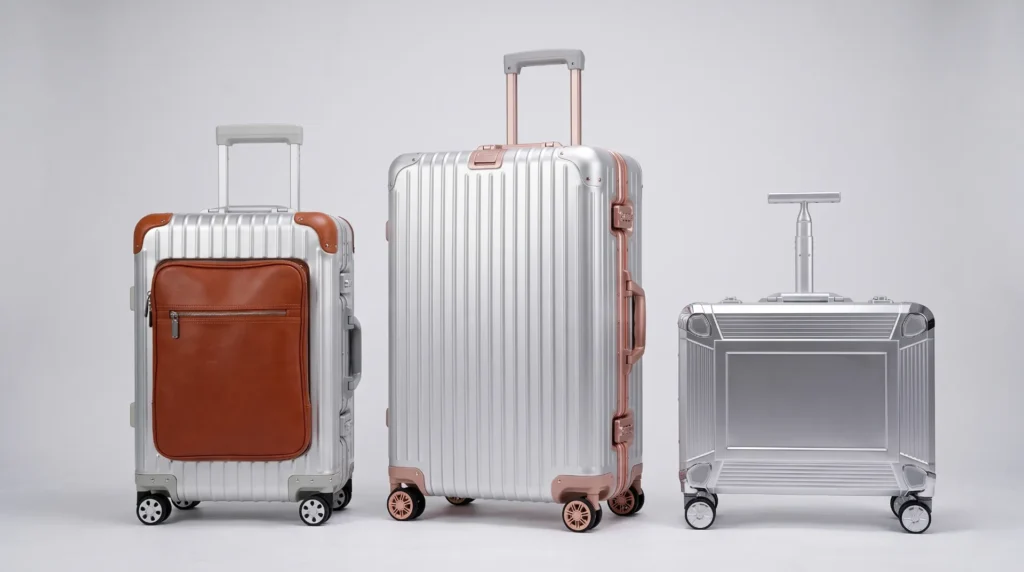
The Aluvox aluminum luggage OEM program
Material specification: aerospace-grade Series 5 aluminum-magnesium alloy, 1mm shell thickness, stamped and finished in-house in Dongguan, with ISO 10012 measurement management system certification and multiple utility-model and design patents for luggage construction methods.
| Parameter | Specification |
|---|---|
| MOQ | 300 pcs / style |
| Colour splitting | Supported — total order MOQ across colours |
| Sample lead time (existing tooling) | 20 working days |
| Bulk production lead time | 45 days from deposit |
| Surface finishes | Brushed / sandblasted / anodized |
| Customization scope | Shell colour, texture, hardware, logo, lining |
| Export ports | Huangpu, Nansha, Shekou, Yantian |
| Shipment terms | FOB, EXW, CIF |
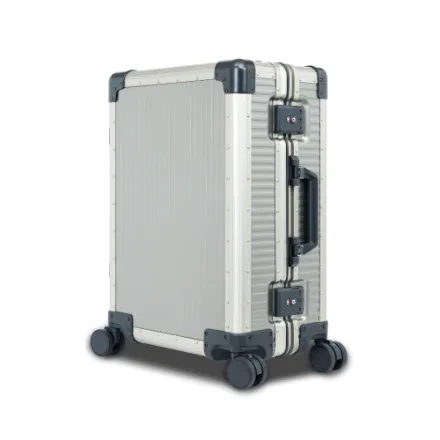
Facility: a 49,600 m² plant in Dongguan, Guangdong, with 10 production lines and a 250-person team across R&D, tooling, production, and QC — stamping, surface treatment, hardware assembly, and pre-shipment testing all in-house. Aluvox supplies internationally recognized brands across North America, Japan, Singapore, and the Middle East, and supports third-party factory audits on request. Real products you can quote today include the TS-003 premium all-aluminum carry-on (anodized aluminum, riveted frame, zipperless TSA closure), the TS-006 airline carry-on on spinner wheels, and the YCT-006 aluminum trolley.
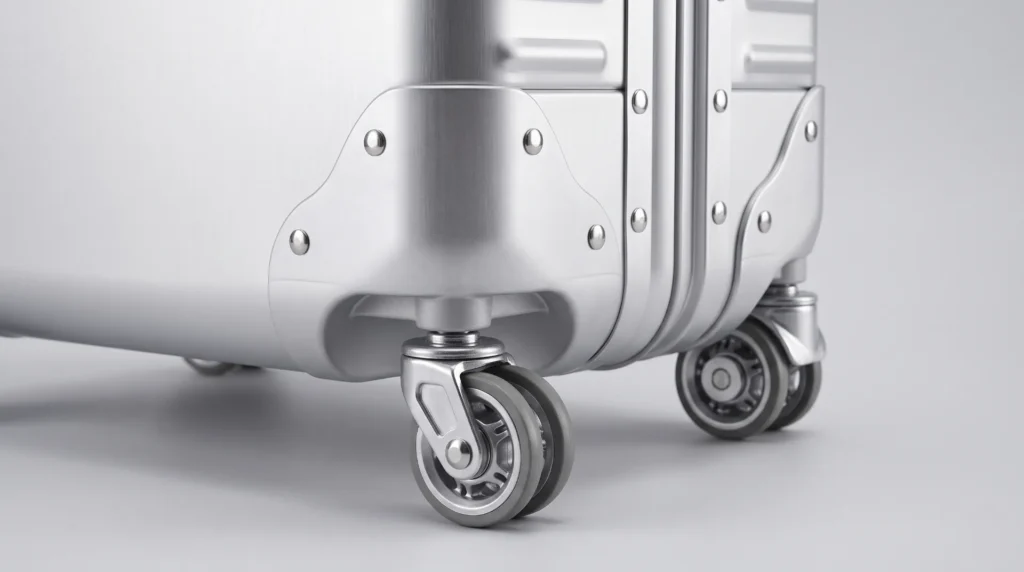
Choosing an aluminum luggage manufacturer is a long-term decision
Aluminum production involves tooling investment, alloy-sourcing relationships, and surface-treatment process knowledge that take time to establish and are costly to move. The factory you pick for your first aluminum order is likely the one you run your first several production cycles with — which makes the initial choice more consequential than in lower-complexity materials.
The framework above — stamping capability, alloy traceability, surface-treatment control, QC documentation, tooling ownership, and sample discipline — identifies factories that sustain quality across runs, not just deliver an acceptable first sample. If you are evaluating manufacturers for an upcoming line, Aluvox has produced aerospace-grade Series 5 aluminum luggage since 1993, and our engineering team can review your specification and return a production assessment with full material documentation.
Request a sample or a production assessment: send your brand positioning, target retail price, and estimated order volume, and Aluvox will return a material recommendation and indicative quote — start with our aluminum luggage.