

Search “aluminum tool case manufacturer” and you are in the world of technicians, tradespeople, and field service: lockable aluminum cases with a tool panel in the lid, adjustable dividers in the base, and foam cut to the kit. They sit between a soft tool bag and a truck box — portable, organized, and tough enough for daily work. And for a B2B buyer, they are a deceptively detailed thing to source.
If you are a tool brand, an industrial distributor, a field-service company, or an OEM assembling a kit into a case, this guide walks the sourcing side: what an aluminum tool case actually is under the panels, the interior system that makes or breaks it, and how to evaluate a manufacturer so the case organizes and protects the specific tools your buyer carries.
What an aluminum tool case actually is
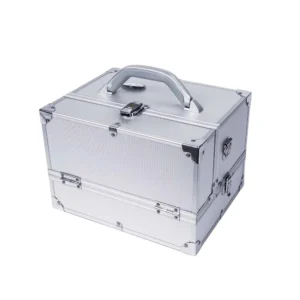
Start with the honest construction, because it sets expectations. Most aluminum tool cases are not a solid aluminum shell. The standard build is an aluminum frame around MDF or plywood panels, usually with a PVC or diamond-textured ABS outer layer, and reinforced metal or ABS corners. Specialists describe it plainly — the case is an aluminum frame with MDF or plywood panels and reinforced corners, and a metal corner protects better than an ABS one. At the heavier end, some makers fabricate a welded full-aluminum shell from 5052 alloy for maximum ruggedness. Both are legitimate; what matters is that you know which you are buying and match it to the load.
Why aluminum at all? Because for daily professional use it beats the alternatives. Against a plastic case, aluminum is far more durable, rust-resistant, and stable across temperature — plastic can turn brittle in cold and warp in heat — which is why tradespeople, mechanics, and field professionals who rely on their tools every day favor aluminum, while plastic suits lighter DIY use. Against steel, aluminum gives most of the toughness at a fraction of the weight. The trade-off is cost and a shell that shows wear, but for a case carried to a job every day, that is an easy call.
There is a weather and worksite dimension too, and the specialists lean on it: a tool case works as hard as its owner, bracing wind, rain, and sun on a site where a soft bag soaks through and a plastic box cracks. For a buyer specifying a case for outdoor trades — electricians, surveyors, installers — that resilience, plus a lockable shell that protects expensive tools from theft and weather, is the core of the pitch. It is also why the aluminum tool case commands a price a soft bag never will, and why the buyer who needs it rarely flinches at that.
The interior system is the product
Here is the part buyers underrate: an aluminum tool case is judged on its interior, not its shell. Three elements do the work, and each is a spec decision.
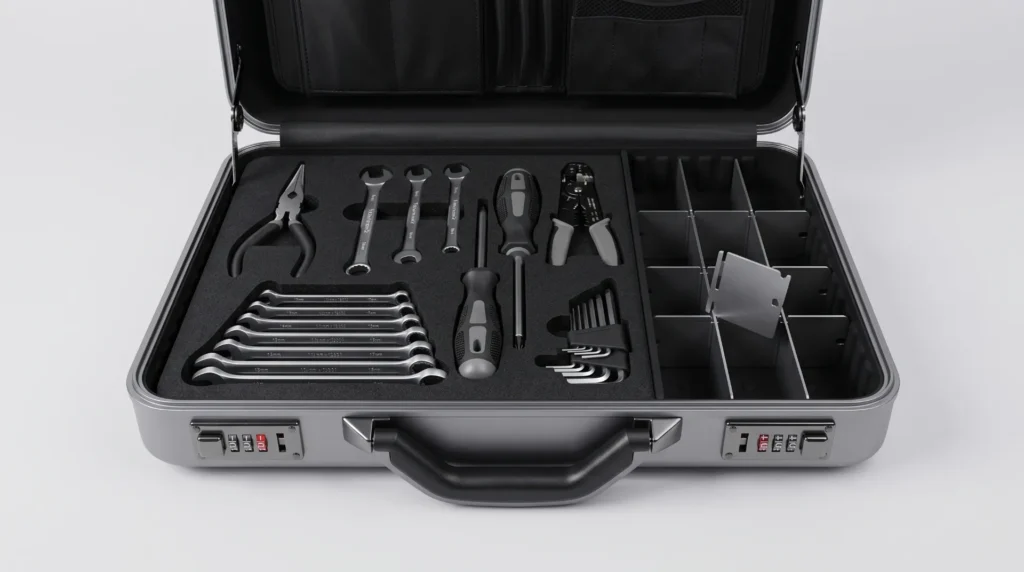
The first is the tool panel, or pallet — a removable rigid board in the lid fitted with pockets, sleeves, and elastic bands that hold screwdrivers, wrenches, and pliers in order and visible. One panel is often fixed in the lid and a second pallet sits removable in the base; a typical panel carries a dozen-plus pouches and several sleeves. The second is the divider system — removable segmented walls in the base that adjust, often in quarter-inch increments, so the buyer reconfigures compartments to their kit without tools. The third is foam, in three forms: wave foam in the lid that stops tools shifting and hitting the shell, pre-perforated diced foam the user plucks to shape, and high-density CNC-cut foam shaped exactly to a fixed tool set. Add a document pouch in the lid and you cover the manuals and paperwork that travel with a kit.
Spec the interior to how the tools are used. A reconfigurable kit wants a tool panel plus adjustable dividers; a fixed, high-value tool set wants CNC-cut foam that cradles each piece. The interior is what turns a metal box into a tool case, so brief it from the actual tools — a list or a sample — rather than from a catalog photo.
The reason this matters is protection, not just tidiness. Tools that shift in transit chip edges, bend tips, and hammer the shell from the inside; the wave foam in the lid and the cut foam in the base exist precisely to stop that movement. A well-fitted interior also speeds the job — a technician who can see every tool in its pocket works faster and notices instantly when one is missing at the end of a call, which is its own form of asset control for a fleet of field staff. When you brief the layout, think about both the protection and the workflow, because the buyer is paying for both.
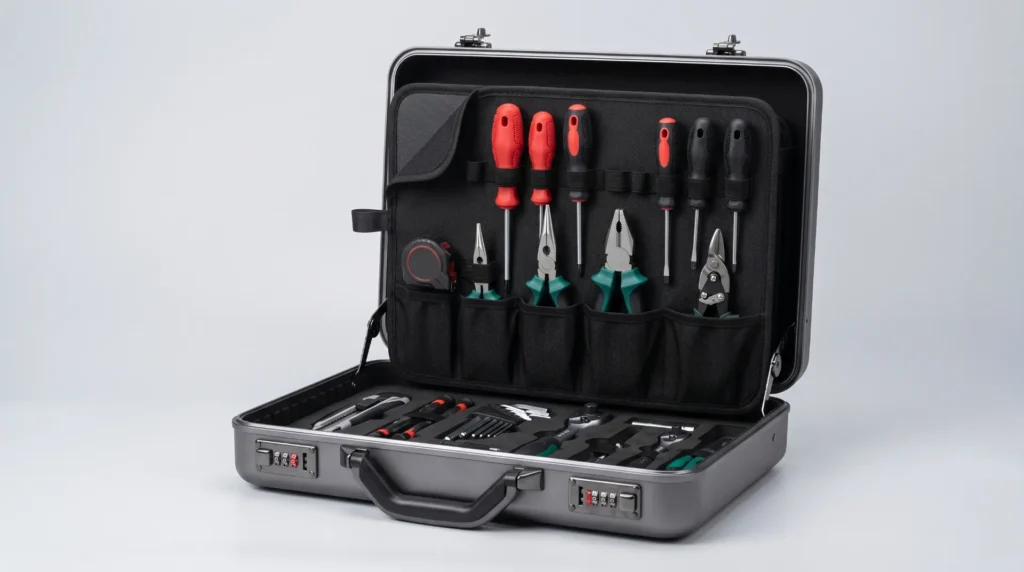
Sourcing aluminum tool cases for a technician or trade line? Aluvox builds aluminum cases with tool panels, adjustable dividers, and fitted foam — explore our aluminum cases and tell us the tools and the layout.
The benchmark you are sourcing against
Know the bar before you brief a factory. On the dedicated-specialist side, makers such as HQC build aluminum tool cases as a core line — aluminum frame on four-to-five-millimetre MDF glued to diamond ABS, removable pallets and dividers, wave and diced foam, two locks with keys, a comfort-grip handle, and a load rating around fifteen kilograms for a standard frame. On the full-aluminum side, Cases By Source fabricates from .063 and .080 5052 aluminum alloy and produces custom cases in quantities of 200-plus with no tooling charge, while German maker bwh Koffer and others build premium all-aluminum cases. General-line suppliers like Vestil and Global Industrial round out the stock end with panel-foam-divider cases off the shelf.
What the good ones share tells you what to expect: a genuine interior system rather than a bare box, honest construction you can specify, real hardware, and OEM customization that keeps minimums workable. A manufacturer that cannot detail the panel, the dividers, and the foam is selling a shell, not a tool case.
How to evaluate an aluminum tool case manufacturer
Score every candidate against the same checklist:
- Construction. Aluminum frame with MDF or plywood panels, or welded full aluminum — with reinforced corners (metal over ABS for hard use) and the panel and frame specs, not just a photo.
- Interior system. A removable tool panel with pockets, adjustable dividers in fine increments, and your choice of wave, diced, or CNC-cut foam built to the tools.
- Hardware. Two locks with keys, a comfort-grip handle, quality hinges and latches, and a shoulder strap where the case is carried far.
- Load and protection. A stated load rating and a shell that resists mar and impact, with rounded corners for safe handling.
- Customization and branding. Dimensions, panel finish, interior layout, and logo — built to your drawing for an OEM or private-label line.
- MOQ, sampling, and packaging. Confirm MOQ, sample cost and lead time, and export packing, since a dented case undermines the whole “rugged” pitch.
A manufacturer that answers all six can build a case around your tools. One that quotes only a price has not asked what goes inside.
A few red flags are worth naming. A “solid aluminum” claim on a case that is clearly aluminum-frame composite is a sign the supplier is hiding the real build rather than explaining it — the composite is fine, the dishonesty is not. ABS corners on a case sold for heavy daily use, stapled rather than glued-and-screwed panels, a tool panel with flimsy elastic that stretches out in a season, and foam too soft to hold a shape are the details that turn into complaints. Ask for the specifics, and where a buyer’s use is genuinely rugged, push for metal corners and a stated load rating rather than accepting reassurance.
Stock, custom, and the MOQ reality
Tool cases suit a stock-plus-customization model well. The shell sizes, the panel formats, and the divider systems are already engineered, so you rarely start from a blank mold: pick a base case close to your kit, then customize the dimensions, the tool panel, the divider layout, the foam, and the logo. Full-aluminum specialists often run custom work from a couple of hundred pieces with no tooling charge, and composite makers sample quickly from proven formats, so a tool-case line is reachable without a heavy upfront commitment.
Match the build to the kit and always sample with the real tools. With a tool case the sample test is concrete: load the actual tools, close the panel, latch it, and carry it as it will really be carried — then check that nothing shifts and the dividers hold. A case that lets tools rattle in your hand will let them rattle on a job site, so the sample, fitted with your kit, is the cheapest way to confirm the layout before a production run. Confirm MOQ, sample cost, and lead time early, since they vary between composite and full-aluminum builds. As a rule, a composite aluminum-frame case keeps cost and minimums lower, while a welded full-aluminum shell costs more but earns its place for the heaviest loads — so let the buyer’s real use, not the spec sheet’s biggest number, decide the build.
Sourcing aluminum tool cases with Aluvox
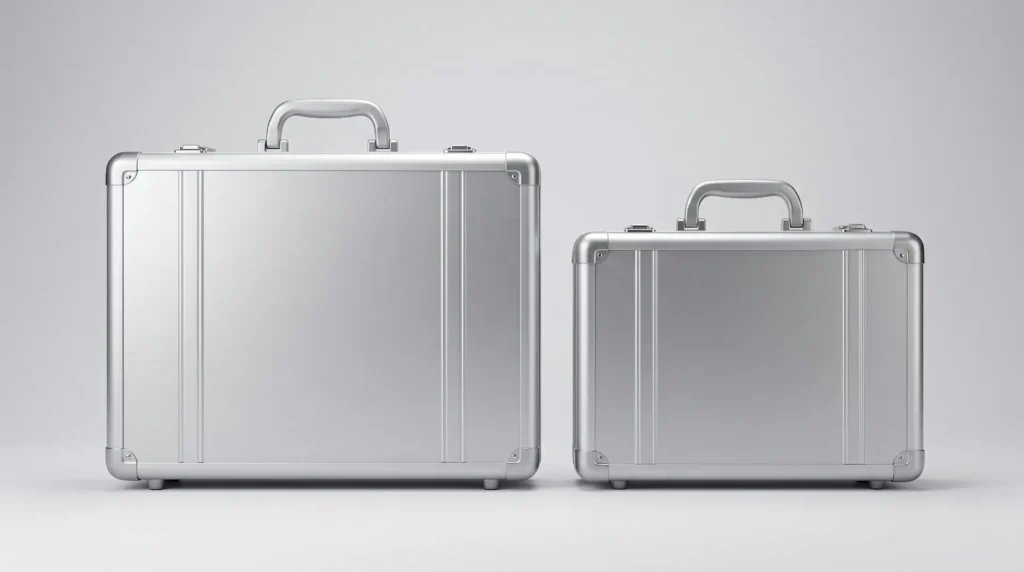
Aluvox is a full-metal aluminum case manufacturer, building aluminum cases to spec as an OEM/ODM partner rather than reselling a catalog box. For a tool-case program that means an aluminum case fitted with the interior your buyer needs — a removable tool panel in the lid, adjustable dividers in the base, and wave, diced, or CNC-cut foam shaped to the kit — with metal hardware, secure locks, and your logo. Tool cases sit in the same aluminum case manufacturer program as the carrying, flight, and instrument cases beside them, so one partner can cover a full range.
For tool brands, distributors, and field-service buyers that means OEM and private-label aluminum tool cases built to your tools and your logistics, with samples available before a bulk run so you can load the kit and confirm the fit first-hand. If your buyer carries a defined set of tools, start with that list, then bring your layout, your finish, and your volumes.
See the range and request a quote: Aluvox aluminum cases.