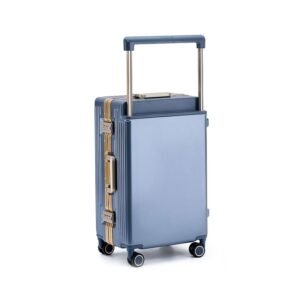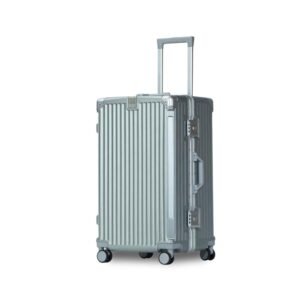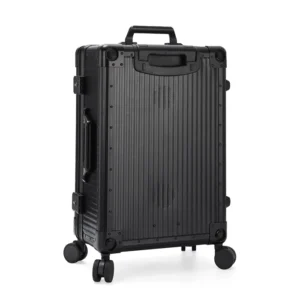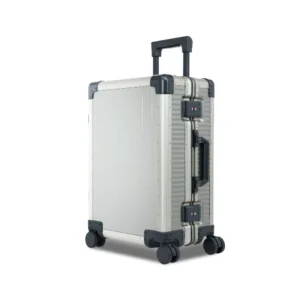

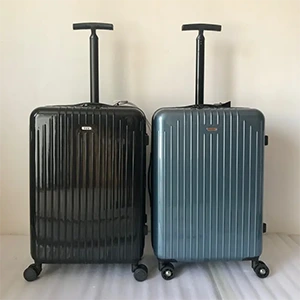
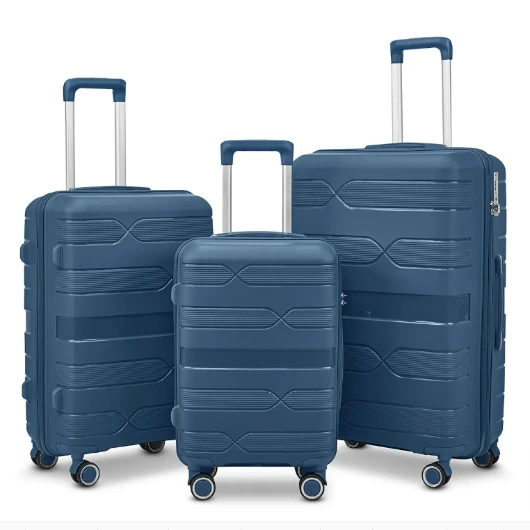
Polycarbonate is the material behind more than 40% of the world’s hard-shell luggage. It is also the material most frequently misrepresented in factory quotes — substituted with ABS blends, recycled resin, or substandard grades that look identical on paper but perform differently in the field.
For brand buyers sourcing PC luggage, the challenge is not finding a manufacturer. There are hundreds of polycarbonate luggage factories in China. The challenge is identifying which ones are producing genuine, consistent-grade PC and which ones are cutting material costs in ways that will eventually show up as your brand’s return rate problem.
This guide provides a sourcing framework for evaluating PC luggage manufacturers — covering material verification, factory capability checks, quality red flags, and the production parameters that determine whether a supplier can deliver what their quote implies.
Aluvox manufactures polycarbonate luggage alongside aluminum and titanium lines from our Dongguan, Guangdong facility. Our PC OEM program starts from 300 pieces with multi-color splitting supported. The framework below applies to evaluating any PC factory, including us.
Why PC Dominates Hard-Shell Luggage Production
Polycarbonate became the default material for premium hard-shell luggage for a specific set of physical reasons, not marketing ones.
PC’s molecular structure allows the shell to flex under impact and return to its original shape — a property called elastic recovery. Where an ABS shell reaches its stress threshold and cracks, a PC shell absorbs the same impact and rebounds. This is why PC luggage can survive the cargo hold environment that destroys lower-grade alternatives.
The material also processes well. PC can be vacuum thermoformed into complex geometries, takes texture and color treatments cleanly, and produces a surface finish that reads as premium at retail — a combination that makes it commercially viable across a wide price range.
The result is that PC now sits at the center of the hard-shell luggage market:
| Material | Typical retail range | Impact resistance | Weight | Cost index |
|---|---|---|---|---|
| ABS | $30–$80 | Low | Light | 1.0x |
| PP | $50–$120 | Medium | Lightest | 1.1x |
| PC | $80–$250 | High | Medium | 1.5x |
| PC+ABS blend | $60–$150 | Medium-high | Medium-light | 1.2x |
For brands targeting the $80–$250 retail segment — the largest volume tier in the global luggage market — PC is the material that delivers the performance-to-cost ratio their customers expect and their margin structure requires.
The Hidden Risk: ABS Blending and How to Detect It
This is the section most factory marketing guides do not include — because it describes something factories do.
ABS blending is the practice of mixing acrylonitrile-butadiene-styrene resin into a polycarbonate production run to reduce raw material costs. The resulting shell looks like PC, processes like PC, and photographs like PC. It does not perform like PC.
What changes when PC is blended with ABS:
- Impact resistance drops — the blend loses PC’s elastic recovery and begins to behave more like ABS under stress
- Low-temperature performance degrades — pure PC maintains impact resistance down to approximately -20°C; ABS-blended shells become brittle significantly earlier
- Surface finish changes subtly — blended shells tend toward a flatter, more opaque finish versus the slight translucency of pure PC at thin sections
- Long-term UV stability decreases — ABS degrades under ultraviolet exposure; blended shells yellow and become brittle over time in ways pure PC does not
How to detect ABS blending before bulk production:
Request the factory’s raw material documentation. A credible PC manufacturer should be able to provide the resin brand and grade for the specific production batch — Covestro and SABIC are the two industry-standard suppliers for luggage-grade polycarbonate. Factories sourcing from unspecified domestic suppliers or unable to identify their resin brand warrant follow-up questions before committing to an order.
Request a low-temperature impact test report specifically. Ask for results at -20°C per ASTM D256 or equivalent. Pure PC passes this test reliably. ABS-blended shells often fail or show significant degradation. Factories that cannot produce this test report have either not run it or do not want you to see the results.
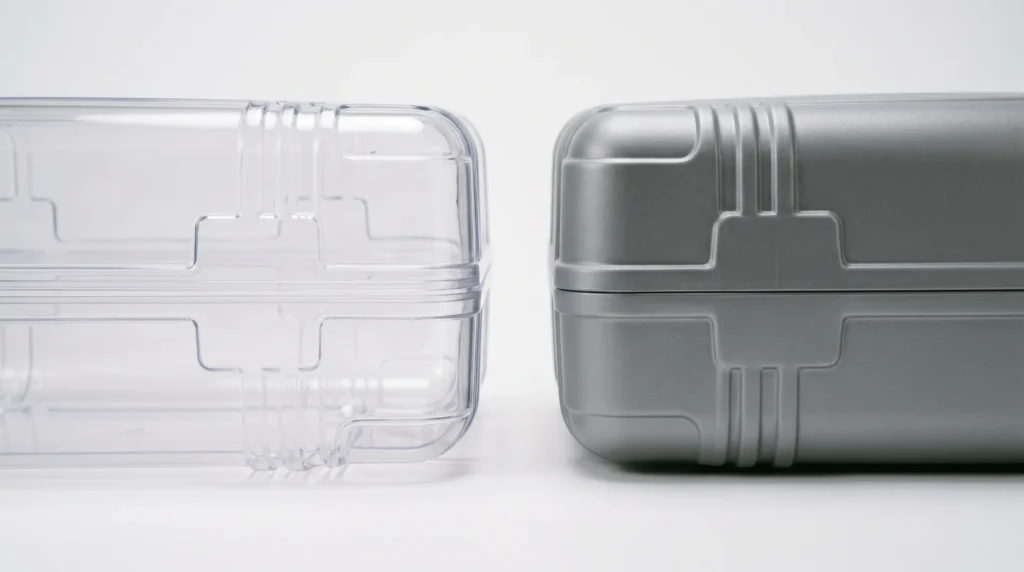
Inspect the sample at a thin section — typically the corner geometry or the shell edge. Pure PC has a slight amber translucency when held to light at 0.8–1.0mm thickness. Fully opaque white-casting shells at the same thickness frequently indicate ABS content.
A factory quoting PC luggage at more than 20% below market rate without a clear cost explanation is the most reliable signal that the material specification is not what the quote states.
PC Factory Evaluation: Six Capability Checks
These six checks apply to any polycarbonate luggage factory evaluation, whether conducted via site visit, sample review, or documentation request.
1. Forming Equipment and Process
PC luggage shells are produced via vacuum thermoforming or injection molding. Vacuum thermoforming is the standard for luggage-grade shells — it produces the wall thickness consistency and surface quality required for retail-grade product. Injection molding is used for specific components and lower-thickness applications.
Ask the factory to specify which process they use for their PC shells and to show the relevant equipment during a site visit. A factory that cannot clearly explain their forming process is worth scrutinizing further.
2. Raw Material Traceability
Every production batch of luggage-grade PC should have a corresponding material delivery record identifying the resin brand, grade, and batch number. Request to see this documentation for a recent production run. Factories with genuine traceability can produce this in minutes. Factories without it will redirect the conversation.
This check matters because raw material substitution — switching to a lower grade or blended resin after sample approval — is one of the most common quality failures in PC luggage production. Traceability documentation is the only paper trail that makes substitution detectable.
3. Color Consistency Management
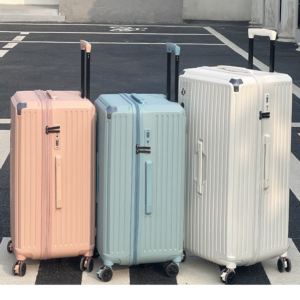
PC luggage’s commercial advantage is partly its color range — brands can run multiple colorways from the same tooling without new mold investment. The risk is color consistency across production batches.
Ask the factory how they manage inter-batch color consistency. A credible answer includes a delta-E tolerance specification — typically delta-E 1.5 or below for premium product — and a documented color approval process between pre-production sample and bulk production. Factories that describe color consistency in qualitative terms rather than quantitative ones have not systematized the process.
4. Mold Condition and Maintenance
Well-maintained PC molds can produce several hundred thousand cycles before requiring replacement. However, aging or poorly maintained molds produce shells with flash lines, wall thickness variation, and surface defects that become your brand’s quality problem.
During sample evaluation, examine the shell edges for flash — thin excess material at mold parting lines. Check wall thickness at multiple points if possible. Ask the factory when the mold was last serviced and what their maintenance interval is. Any credible factory will answer these questions directly.
5. Low-Temperature Impact Testing
If your distribution market includes Northern Europe, Canada, high-altitude regions, or any cold-climate geography, low-temperature impact performance is not optional. Polycarbonate maintains its impact resistance down to approximately -20°C. ABS-blended shells and lower-grade PC begin failing significantly above that threshold.
Request test results conducted at -20°C per ASTM D256 or equivalent standard. The absence of this test result from a factory’s documentation set tells you something specific about their QC capability — or their willingness to provide it.
6. Assembly Integration
PC shell production is only one part of luggage manufacturing. Zipper sourcing, wheel assembly, handle installation, and interior fitting are equally important quality variables. Ask directly: which components are assembled in-house and which are outsourced?
Outsourced assembly — particularly wheels and handles — is a common failure point in lower-tier factories. Aluvox assembles all components in-house at our Dongguan facility, with wheel and handle suppliers documented and subject to our incoming quality inspection process.
Aluvox PC Luggage OEM Program
For brand buyers evaluating Aluvox as a PC luggage manufacturing partner, the relevant production parameters are as follows.
Material and specification: PC shells produced to industry standard wall thickness (0.8–1.2mm depending on style and geometry). Surface finish options include matte, gloss, and textured variants. Color range is open — buyers submit Pantone reference or physical swatch for color matching.
Order parameters:
| Parameter | Specification |
|---|---|
| MOQ | 300 pcs total — color splitting supported |
| Color splitting | Multiple colors within same style, total quantity = MOQ |
| Sample lead time (existing tooling) | 20 working days |
| Bulk production lead time | 45 days from deposit |
| Customization scope | Shell color, texture, hardware, logo, interior lining |
| Export ports | Huangpu, Nansha, Shekou, Yantian |
| Shipment terms | FOB, EXW, CIF |
Brand fit: Aluvox’s PC program is structured for e-commerce brands, Amazon sellers, DTC luggage labels, and fashion brands adding a luggage line. The 300-piece MOQ with color splitting allows market testing across multiple colorways without committing full MOQ to a single color.
For detail on how MOQ works across color splits and order structures, see: Custom Luggage MOQ Guide →
Browse the Aluvox PC luggage collection →
For brands considering both PC and aluminum lines, see: private label luggage program →
For a full material comparison between PC and aluminum from an OEM perspective, see: Aluminum vs Polycarbonate Luggage →
Request an Aluvox PC luggage sample — confirm material quality, surface finish, and customization options before committing to bulk production. Request PC Sample
Five Red Flags When Sourcing PC Luggage
These signals each require a direct question and a satisfactory answer before proceeding with any factory.
Factory cannot provide raw material documentation
If a factory cannot identify the resin brand and grade for their PC production, they either do not know what they are using or do not want you to know. Neither situation is acceptable for a brand building a product with a warranty.
Quote is more than 20% below market with no cost explanation
PC resin has a commodity price floor. A quote significantly below market is either using a different material than quoted, sourcing from unverified channels, or pricing in a way that will not survive bulk production without quality compromise.
All test reports are factory self-inspection only
In-house QC is a baseline requirement, not a differentiator. For a buyer who cannot inspect production in person, third-party inspection documentation — SGS, Bureau Veritas, Intertek — is the only independent verification available. Factories operating without it are asking for trust without evidence.
Color changes require new tooling
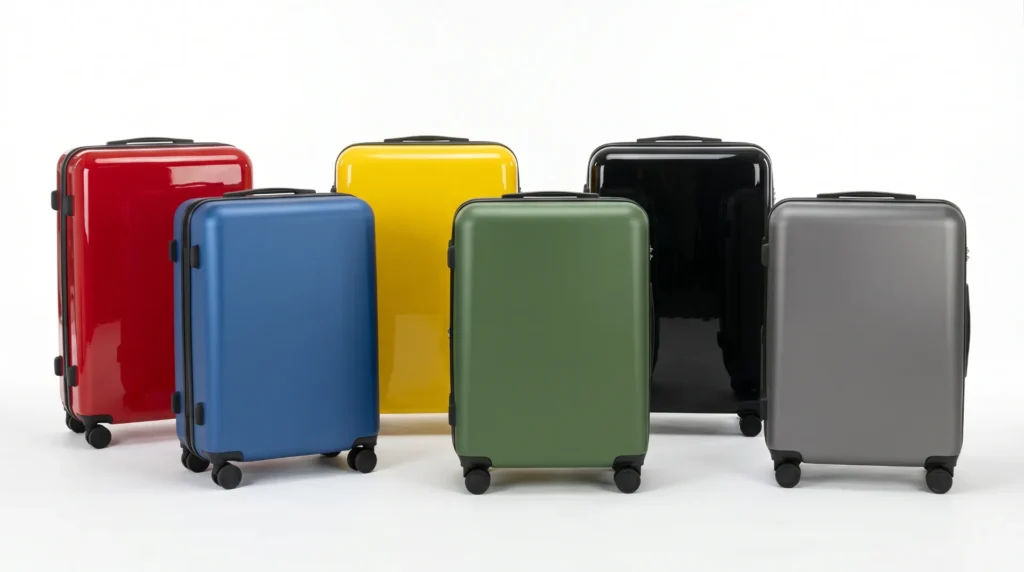
PC’s commercial advantage is that color changes do not require new molds — only a resin color change in the thermoforming process. A factory that quotes new tooling for a color change either does not understand PC processing or is using a production method inconsistent with their stated capability.
Sample and bulk production from different locations
Ask directly: will the production line that made my sample produce my bulk order? If the factory hesitates or redirects, they are likely a trading company managing production through subcontractors — meaning your sample quality is not a reliable indicator of bulk quality.
For a complete factory evaluation framework covering PC, aluminum, and mixed-material suppliers, see: How to Choose an OEM Luggage Manufacturer in China →
Choosing a PC Manufacturer Is a Material Decision, Not Just a Price Decision
The PC luggage market is competitive at the factory level precisely because the material is accessible. Low tooling costs, widely available resin, and straightforward processing means there are many factories that can produce PC luggage — and significant variation in how they do it.
The evaluation framework above — material traceability, forming process verification, color consistency management, mold condition, low-temperature testing, and assembly integration — distinguishes factories that produce PC luggage from factories that produce it consistently, to specification, across production runs.
Price is not a reliable proxy for any of these variables. A factory quoting $2 per unit more than the market rate may be using verified resin and documented QC. A factory quoting at the bottom of the market may be using blended material and no third-party testing. The only way to know is to ask the right questions before the deposit is paid.
If you are evaluating PC luggage suppliers for an upcoming product line, Aluvox engineers are available to discuss your specifications and provide a detailed quote with full material and process transparency.
Contact an Aluvox Engineer — submit your target colorway, order quantity, and distribution market. We will provide a PC material recommendation and indicative production quote within 2 business days. Contact Engineering Team