

2026 Top OEM Luggage Manufacturers in China: The Ultimate Sourcing & Profit Guide
China manufactures the majority of the world’s hard-shell luggage. The challenge for brand buyers is not finding a factory — it is identifying the right one before committing tooling budgets, sample costs, and brand reputation to a supplier that cannot actually deliver what it quotes.
Most sourcing failures in the luggage category are not caused by bad luck. They are caused by applying the wrong evaluation criteria: prioritizing unit price over production capability, skipping material verification, or misreading a trading company as a factory. The result is delayed bulk orders, inconsistent quality between samples and production, and in some cases, mold ownership disputes that lock your designs inside a factory you are trying to leave.
This guide provides a practical evaluation framework developed from the factory floor — not a ranked list of suppliers, but a structured method for assessing any OEM luggage manufacturer in China against the criteria that actually determine whether a partnership will succeed.
At Aluvox, we have manufactured aluminum and polycarbonate luggage from our Guangdong facility since 1995, supplying international brands across North America, Japan, Singapore, and the Middle East. The framework below reflects what experienced buyers ask us — and what they should be asking every factory they evaluate.
China’s Luggage Manufacturing Geography: Where to Start
Before evaluating individual factories, understanding China’s manufacturing clusters helps buyers narrow the right sourcing region for their product category.
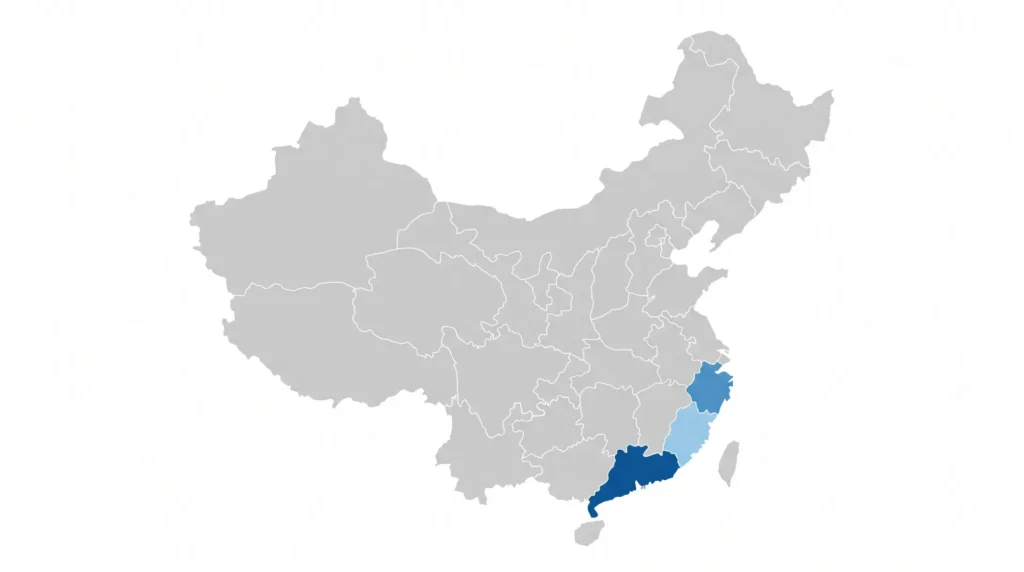
Guangdong Province — Premium hard-shell and aluminum
The Pearl River Delta — Dongguan, Guangzhou, Shenzhen — is the primary hub for high-end hard-shell luggage production, including aluminum and premium polycarbonate. The region supports a dense ecosystem of raw material suppliers, precision tooling facilities, and experienced assembly labor. Export logistics are mature, with direct access to Huangpu Port, Nansha Port, Shekou Port, Yantian Harbor, and New Port — among the highest-volume container terminals in the world.
Zhejiang Province — Mid-range volume PC and ABS
Pinghu and Haining are major production centers for mid-range polycarbonate and ABS luggage, oriented toward high-volume retail and e-commerce fulfillment. Strong on throughput and cost efficiency; less developed for premium material processing.
Fujian Province — Mixed hard and soft luggage
A diversified manufacturing base producing both hard-shell and soft-sided luggage, with strengths in blended OEM/ODM capability and multi-category orders.
Why geography matters for material sourcing:
If your target product is aluminum luggage, Guangdong is the only cluster with sufficient specialist capacity — in-house stamping workshops, anodizing lines, and hardware assembly infrastructure. Factories in Zhejiang or Fujian quoting aluminum luggage production typically outsource stamping to Guangdong subcontractors, which introduces quality consistency risk and extends lead times without reducing cost.
Aluvox operates from Dongguan, Guangdong, with direct port access to the Pearl River Delta terminal network — supporting FOB, EXW, and CIF shipment terms in partnership with carriers including Maersk Line and MSC.
Know Who You Are Talking To: Four Factory Types in China
Not every entity that quotes OEM luggage production is a factory. Misidentifying your counterpart is one of the most common and costly sourcing errors in the category.
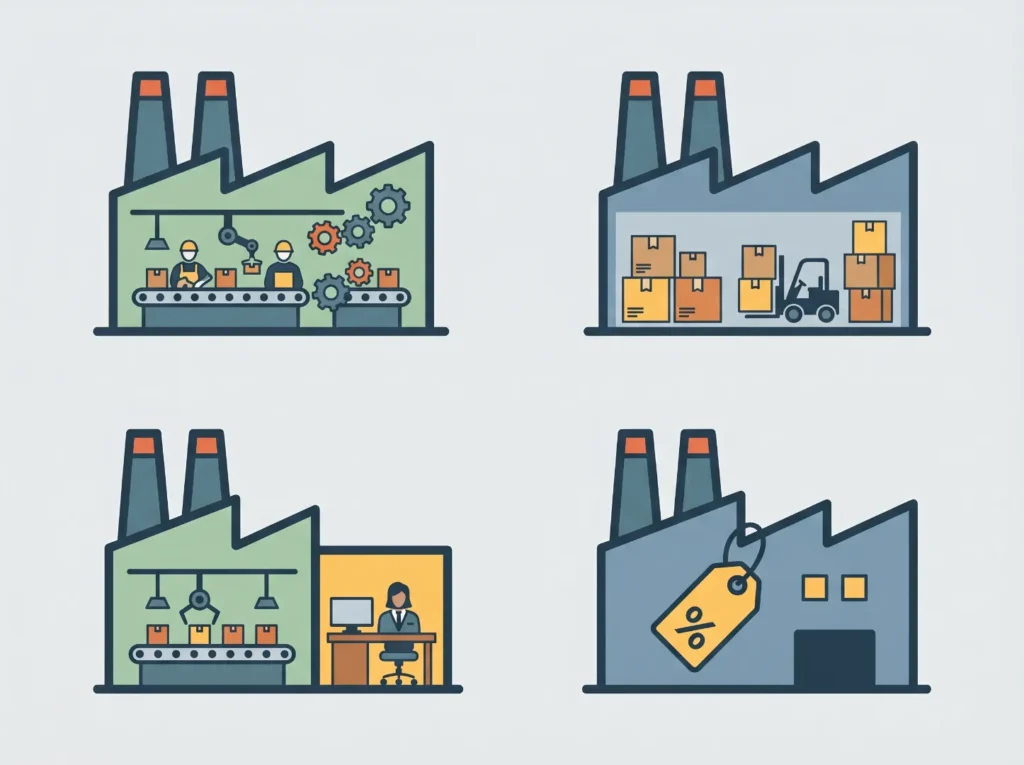
Pure Manufacturer
Owns and operates production lines directly. Quotes come from actual production cost structures. Communication may require more technical specificity, but pricing is transparent and quality control is direct.
Trading Company
No owned production infrastructure. Orders are subcontracted to one or more factories, often without the buyer’s knowledge. The risk: your sample is produced by Factory A under controlled conditions; your bulk order goes to Factory B under cost pressure. Quality consistency breaks down between sample and production.
Manufacturer with Trading Capability
Operates owned production lines and maintains a dedicated sales and trade team. This model combines factory-level cost transparency with commercial communication efficiency. Buyers get direct production access without the logistical overhead of engaging a pure manufacturer directly. Aluvox operates under this model — owned Dongguan facility, dedicated R&D and export teams, direct client communication.
Brand-Owning Manufacturer
Runs its own retail brand alongside OEM services. Production capacity may be prioritized toward proprietary lines during peak seasons, creating delivery risk for OEM clients during Q3–Q4.
How to verify factory type in one site visit:
Request to see the stamping or injection equipment serial numbers and ownership documentation. Ask to review employee social insurance records for production staff. Examine mold storage areas for mold ID tags — trading companies either have none or cannot explain the numbering system. A genuine factory can answer all three requests within the same visit.
Six Evaluation Criteria That Actually Matter
1. Material Specialization
Not all factories can produce all materials to the same standard. Evaluate material capability before evaluating price.
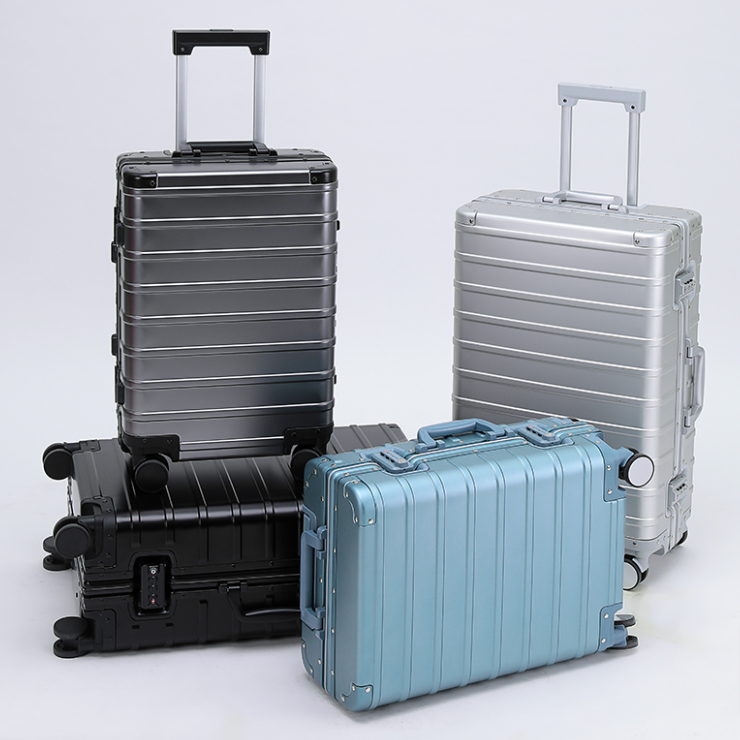
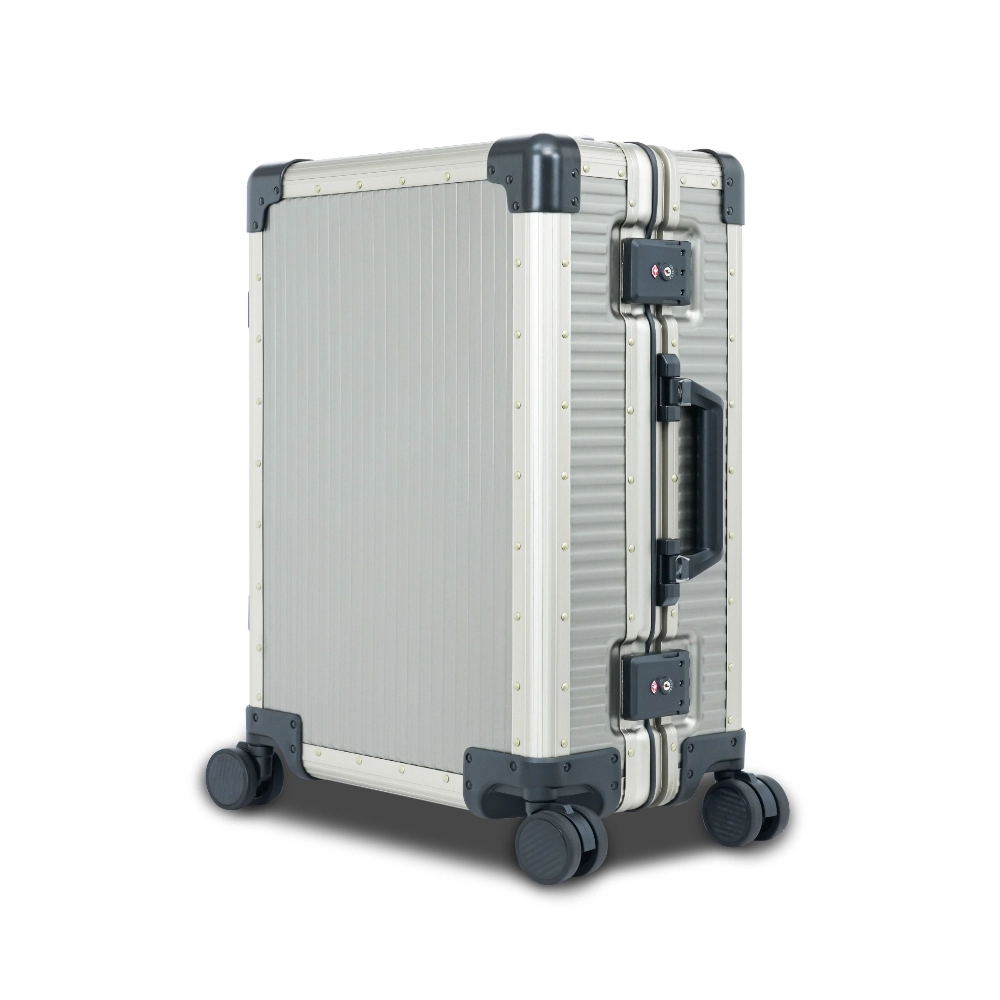
For aluminum luggage: confirm the factory operates an in-house stamping workshop. Outsourced stamping means your shell geometry, wall thickness, and surface consistency are controlled by a subcontractor you have never audited. Request the raw material mill certificate — this document verifies alloy grade and batch traceability. Series 5 aluminum-magnesium alloy is the production standard for luggage-grade hard shells; factories unable to provide mill certificates for the specific alloy grade they quote should be disqualified.
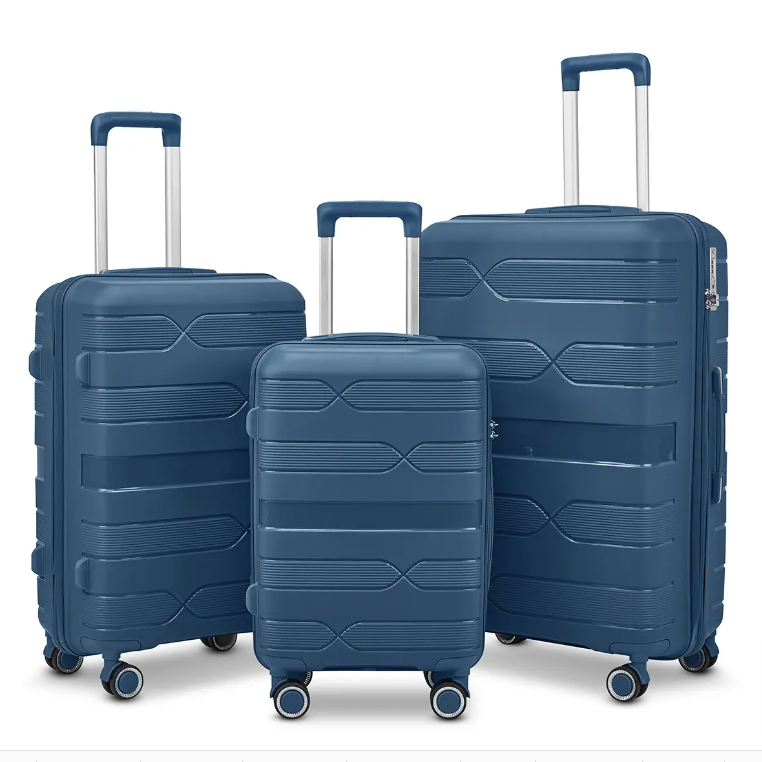
For polycarbonate luggage: verify PC resin sourcing. Covestro and SABIC are the industry-standard suppliers. Unspecified “imported PC” in a quote is a flag for potential ABS blending — a cost-reduction practice where ABS is mixed into PC shells without disclosure, reducing impact resistance without changing the quoted specification.
For a detailed material comparison from an OEM perspective, see: Aluminum vs Polycarbonate Luggage: OEM Material Selection Guide →
2. Production Capacity vs. Actual Order Load
A factory’s stated capacity and its available capacity in your delivery window are different numbers. Ask directly: how many active production lines are running, what is the current order backlog, and what is the Q3–Q4 peak season policy for new client orders. A factory that cannot answer these questions with specifics is either a trading company or is operating at capacity that will not accommodate your order without pushing lead times.
3. Mold Ownership Terms
This is the single most overlooked contractual risk in OEM luggage sourcing. Many factories charge buyers a tooling development fee — $3,000 to $15,000 depending on material and complexity — and retain ownership of the mold. If you change suppliers, your design stays behind.
Before paying any tooling deposit, confirm in writing: who owns the mold after payment, under what conditions can it be transferred, and what is the buyout price if ownership is not included in the initial agreement. Factories that refuse to discuss mold ownership in writing before deposit payment should not receive your tooling budget.
4. QC Process Transparency
Request the factory’s pre-shipment testing protocol in writing. A credible QC process includes documented test categories, pass/fail criteria, and inspection records retained per order. For luggage specifically, the minimum test battery should cover: drop testing (ISTA 2A / ASTM D5276), compression, handle fatigue (3,000 cycles minimum), wheel drag, and waterproofing.
Ask whether testing is conducted in-house or by a third-party inspection body such as SGS, Bureau Veritas, or Intertek. In-house testing is acceptable if the factory maintains a documented lab with calibrated equipment — not acceptable if QC means a visual check before loading. Aluvox operates an in-house testing laboratory covering all seven pre-shipment categories, with inspection records available on request.
5. Export and Logistics Capability
Confirm the factory’s export documentation capability directly: can they issue a commercial invoice, packing list, and bill of lading that meet your import country requirements? Can they support FOB, EXW, and CIF terms? Which freight forwarders or carriers do they work with regularly?
For Guangdong-based factories, proximity to Pearl River Delta ports — Huangpu, Nansha, Shekou, Yantian — provides access to frequent sailings on major lanes to North America, Europe, Japan, and the Middle East.
6. Sample Process Clarity
A factory’s sample process reveals how it handles production discipline. For existing tooling, the industry standard sample lead time is 15–25 working days. For new mold development, 30–45 working days. Request the sample confirmation process in writing — what constitutes approval, how deviations are documented, and what triggers a re-sample versus a bulk production release.
Aluvox produces samples from existing tooling within 20 working days, with bulk production commencing within 45 days of sample approval.
Aluminum Luggage: Specialist Evaluation Criteria
Aluminum luggage production requires a different evaluation framework than standard PC or ABS. The manufacturing process is more capital-intensive, the raw material supply chain is more complex, and the failure modes are different — making supplier qualification more rigorous.
Five Aluminum-Specific Checks Before Committing to a Supplier
Mill certificate availability
Every batch of aerospace-grade aluminum alloy should come with a manufacturer’s mill certificate documenting alloy composition, temper designation, and mechanical properties. Series 5 alloy (5052-H32 or equivalent) is the standard for luggage-grade production. A supplier that cannot produce mill certificates on request is either sourcing from unverified channels or has no traceability system — both are disqualifying conditions.
In-house stamping vs. outsourced
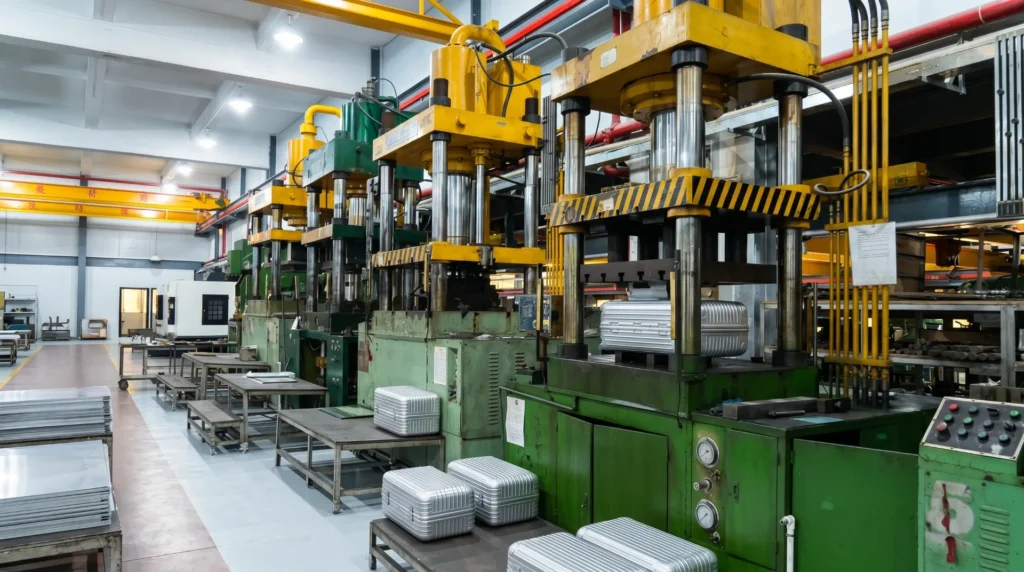
Stamping die ownership and operation should be confirmed in-house. Ask to see the stamping presses during the factory visit and verify they are operating, not staged. Outsourced stamping is the single most common reason aluminum luggage quality varies between sample and bulk production.
Surface treatment capability
Anodizing, brushing, and sandblasting should be completed in-house or at a documented, auditable subcontractor. Surface treatment quality directly affects your product’s visual consistency across a production run — color variance and finish inconsistency are the most frequent post-delivery complaints for aluminum luggage.
Drop test documentation
Request corner drop test results specifically — this is where aluminum luggage either passes or fails structural integrity requirements. Results should reference ISTA 2A or ASTM D5276 and be issued by a qualified testing source.
Corner construction method
Corner guards and reinforcement design are the highest-risk structural element in aluminum luggage. Ask the factory to explain their corner joining method — welded, riveted, or bonded — and the corresponding failure rate in their QC data.
Aluvox has manufactured aerospace-grade Series 5 aluminum-magnesium alloy luggage since 1995. Our Dongguan facility operates in-house stamping, surface treatment, and hardware assembly lines, supported by an internal testing laboratory and ISO 10012 measurement management system certification. We hold multiple utility model and design patents for luggage construction methods developed through our R&D program.
Browse the Aluvox aluminum luggage collection →
Your First OEM Order: From Inquiry to Shipment
Understanding the full process timeline helps brand buyers plan product launches without surprises.
Standard OEM Process Flow
Step 1 — Inquiry and NDA (Day 1–3)
Submit product specifications: material, dimensions, color, hardware requirements, target retail price, and order volume. A credible factory responds with a technical clarification request, not an immediate price. Sign a non-disclosure agreement before sharing proprietary design files.
Step 2 — Quotation and material confirmation (Day 3–7)
Review the quotation against your BOM expectations. Confirm material grade, hardware sourcing, surface treatment method, and packaging specification are explicitly stated — not implied. Vague quotations produce bulk orders that do not match samples.
Step 3 — Sample production (Day 7–27 for existing tooling)
For existing mold styles, Aluvox produces samples within 20 working days. New mold development adds 30–45 working days depending on complexity. Use the sample stage to verify: shell dimensions, hardware function, surface finish consistency, weight, and zipper or latch operation.
Step 4 — Sample approval and production PI (Day 27–35)
Issue written sample approval with documented deviations — any dimension, color, or hardware deviation accepted at sample stage becomes the production standard. Review and sign the proforma invoice before releasing production deposit.
Step 5 — Bulk production (Day 35–80)
Production lead time at Aluvox is 45 days from deposit receipt. Maintain communication checkpoints at 30% and 70% of production completion for photo updates and in-line QC confirmation.
Step 6 — Pre-shipment inspection and export (Day 80–90)
Pre-shipment inspection should occur before goods are loaded. Confirm port of loading, incoterm, and carrier booking. From Dongguan, export routes operate through Huangpu, Nansha, Shekou, and Yantian ports with connections to all major global trade lanes.
Standard payment structure:
A healthy first-order payment structure is 30% deposit against PI, with the remaining 70% payable against bill of lading. Factories requiring 100% prepayment on an initial order without an established relationship present a cash flow and delivery risk that is not standard practice in the industry.
Ready to start your first OEM order? Contact an Aluvox engineer — submit your product specification, target market, and order volume. We respond with a full process outline and initial material recommendation within 2 business days. Start Your Inquiry
Six Red Flags: Factory Behaviors That Signal Risk
Experience working with Chinese luggage factories produces a consistent pattern of warning signals. These do not guarantee a bad outcome — but each one warrants a direct question before proceeding.
Pricing more than 30% below market with no cost explanation
Aluminum alloy, PC resin, and quality hardware have commodity price floors. A quote significantly below market either reflects a material substitution you have not been told about, or a production model that cannot sustain the price through bulk delivery.
Unable to produce raw material certificates
For aluminum luggage specifically, the inability to provide alloy mill certificates means either the factory does not know what material it is using, or it is sourcing from channels with no traceability. Either condition disqualifies the supplier.
Sample and bulk production from different facilities
This is the trading company failure mode. Ask directly: will the same production line that made my sample produce my bulk order? Request the production line number and the name of the factory manager responsible for your order.
Mold fee collected without written ownership agreement
A tooling deposit paid without a signed mold ownership agreement is a deposit paid to a factory you cannot leave. This is not a negotiating tactic — it is standard IP protection practice that any credible manufacturer will agree to in writing.
All QC documentation is factory self-inspection only
Internal QC is acceptable as a first layer. It is not acceptable as the only layer for a buyer who cannot physically inspect production. Request at least one third-party inspection report from a previous order to verify the factory has experience operating under external audit conditions.
100% prepayment required on first order
Standard industry practice for a new client relationship is 30% deposit with balance against shipping documents. Full prepayment on an initial order with no relationship history transfers all delivery risk to the buyer with no leverage for resolution if production fails to meet specification.
For a complete supplier verification framework, see: How to Vet Industrial Luggage Suppliers →
Choosing the Right Factory Is a Brand Decision
The OEM manufacturer you select determines your product quality ceiling, your delivery reliability, and your ability to scale. A factory that works for a $50 retail ABS product will not work for a $300 retail aluminum line — and vice versa. Evaluating factories through the lens of your brand’s current stage and material requirements, rather than through price alone, is the single highest-leverage sourcing decision you will make.
The six criteria above — material specialization, capacity transparency, mold ownership, QC documentation, export capability, and sample process discipline — are not a checklist to complete once. They are the baseline expectations of any credible OEM partner.
If you are currently evaluating manufacturers for an upcoming product line, Aluvox engineers are available to walk through your requirements, provide a material recommendation, and outline the full production process with realistic timelines and costs.
Contact an Aluvox Engineer — Submit your brand positioning, target retail price, and estimated order volume. We will provide an initial recommendation and indicative quote within 2 business days. Contact Engineering Team