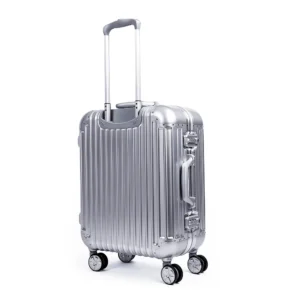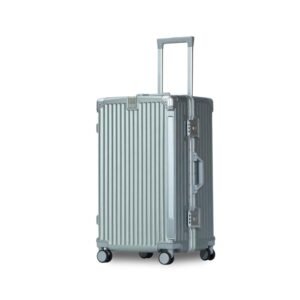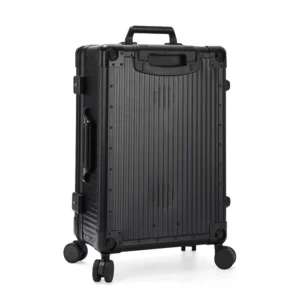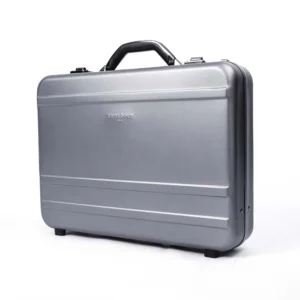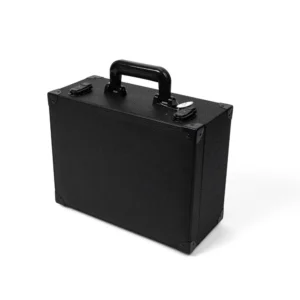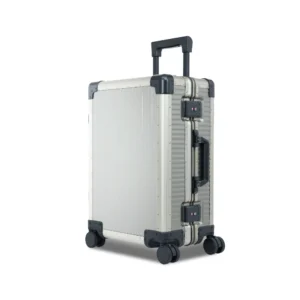

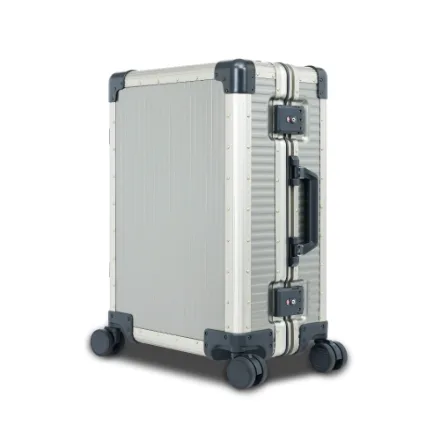
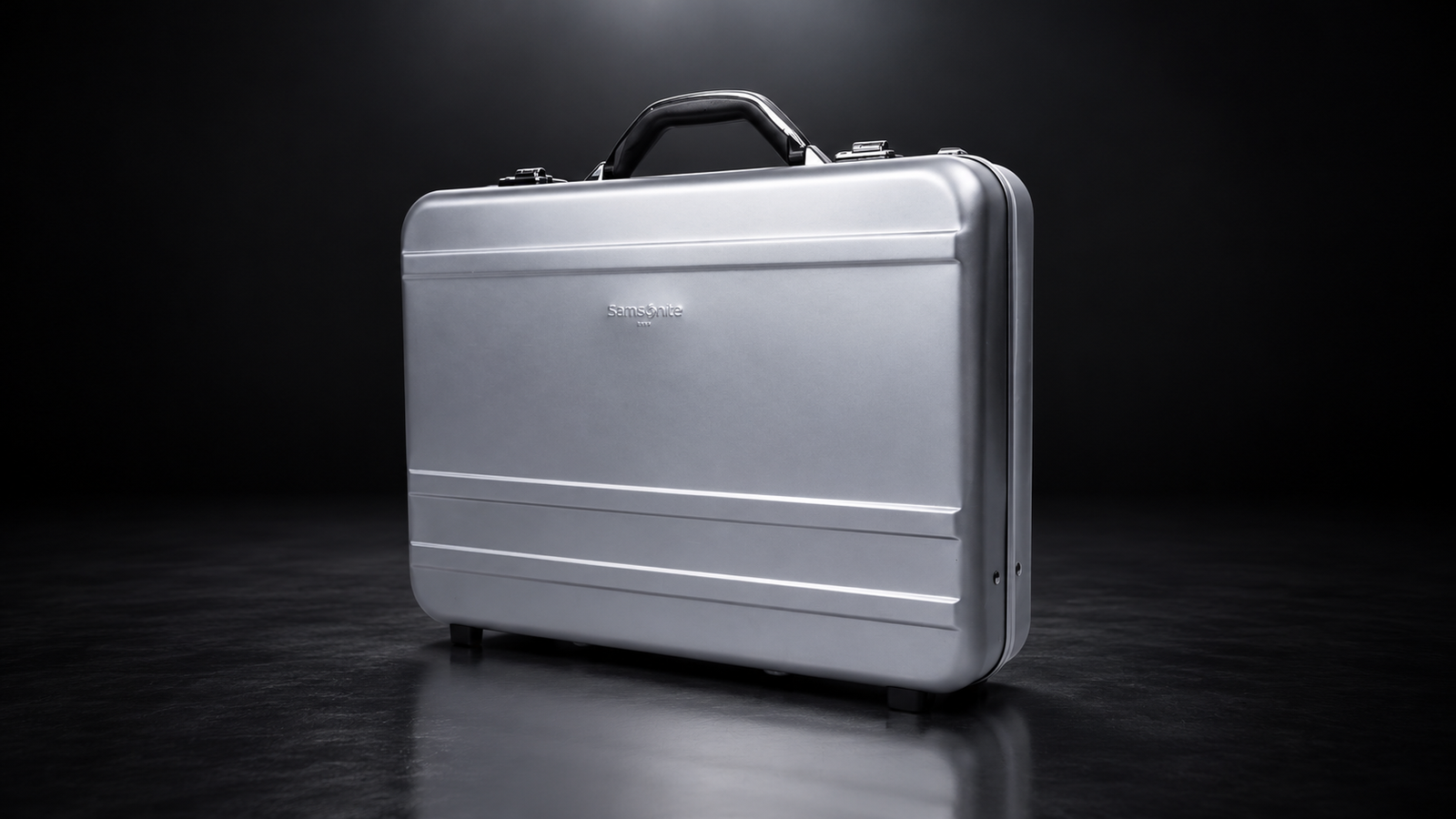
The BA0332 silver aluminum briefcase provides the exterior starting point for the interior layouts discussed below.
When developing a business briefcase, start with what the interior needs to carry. For laptop users, the device’s position and ease of removal come first. For document-focused use, folders need sufficient space. When both are carried together, the layout must balance these larger items with chargers and other accessories.
Our Aluvox BA0332 aluminum briefcase supports interior customization. Brands and wholesale buyers can use this model as a starting point and discuss a layout suited to their customers’ working habits, rather than simply adopting the displayed configuration.
What Does the BA0332 Interior Offer as a Starting Point?
The BA0332 has a silver aluminum hard shell and combination locks. Its product specifications include a removable document bag in the lid and an interior that supports customized divisions. These provide a starting point for organizing business essentials.
The lid’s document bag provides dedicated storage for paperwork. The base can then be planned around the other items the user carries, giving documents, a laptop, and accessories distinct places.

For brands developing a product, this offers a way to begin with the BA0332’s exterior design and explore how the inside should serve a particular use. The document bag, divided areas, and other interior components still need to work together: contents placed in the lid also affect the space available when the case closes.
Interior customization therefore involves more than adding compartments. It also means deciding which areas should remain open and where separation serves a useful purpose.
How Should Space Be Allocated for Different Uses?
The following are layout directions to discuss for the BA0332, rather than three ready-made configurations.
| Main use | Layout priority | Trade-off |
|---|---|---|
| Laptop-based work | Allocate space for the laptop first, use the lid for documents, and arrange chargers and accessories separately | Accessory storage must work around the laptop’s footprint; adding more pockets is not necessarily helpful |
| Document carrying | Leave a continuous area for the intended folders, with stationery and small accessories grouped separately | Too many divisions can restrict the space available for thicker folders or complete document sets |
| Mixed business use | Give the laptop and documents defined areas while allowing some flexibility for accessories | The layout needs a representative packing list; it cannot give every category its maximum possible space at once |
If your customers carry a consistent set of items, the layout can be developed around that specific combination. If the same product will serve people with different devices or working habits, a less restrictive arrangement may be more appropriate.
These approaches support different product positions. One focuses on a clearly defined set of contents; the other allows for more variation between users.
When Should You Use Document Storage, Dividers, or Fitted Inserts?
An interior does not have to use the same organizing method throughout. Documents, laptops, and small accessories have different shapes and are handled differently, so each area can serve a different purpose.
Document Storage: Keep Paperwork Together
The BA0332’s removable lid document bag provides an existing starting point for keeping paperwork together.
For users who carry contracts, meeting materials, or a notebook, the lid can be planned around those items. This leaves the base available for other contents and separates paperwork from chargers and cables.
Document storage also involves a space trade-off. A few sheets and a full folder have different requirements. For a heavier document load, one option is to place the main folder in the base and reserve the lid for thinner materials, rather than assigning all paperwork to the lid.
Divided Space: Separate Groups of Items
A divided layout is worth considering when a project calls for separate areas for a laptop, accessories, and other essentials without shaping every position around one specific object.
For example, an accessory area could accommodate a combination of a charger, mouse, and cables. Compared with individual shaped recesses, this approach leaves more flexibility in how that area is used.
The trade-off is that dividing an area does not individually secure every object within it. If a particular accessory needs to stay in a defined position, its storage arrangement needs further consideration.
Dividers also take up space. For a layout built around a large folder, leaving one continuous area may be more useful than splitting the base into several smaller compartments.
Fitted Inserts: Give a Fixed Set of Items Dedicated Positions
If the product will consistently carry a specific set of devices or accessories, a shaped insert is another direction to discuss.
Each item has a defined position, and the layout is developed around that particular combination. The trade-off is reduced flexibility: if the device or accessory changes shape, its original recess may no longer suit it.
An insert also needs to allow for removal. An object fitting into a recess does not necessarily mean there is enough room to grip and lift it out. Custom insert design guidance addresses item geometry, access space, and fit as parts of the design process.
For a business briefcase, an insert could be considered for only part of the interior—for example, a dedicated area for a fixed accessory set—while the remaining space serves documents or a laptop. Whether this approach suits the project depends on the layout; it is not a statement that the BA0332 includes such an insert as standard.
Why More Compartments Do Not Always Make a Better Interior
An interior can look organized when open yet feel awkward once packed. This can happen when the layout considers where items sit without also considering how they are removed and how the case closes.
Take a laptop, folder, and charger as an example. If the charger sits above the laptop, the user has to move it each time the computer is needed. Adding a charger pocket does not resolve that arrangement. Moving the charger changes the way the interior is used.
The lid and base have a similar relationship. Once the lid’s document bag is filled, a bulky accessory directly beneath it may compete for the same space when the case closes. Possible revisions include moving the accessory, changing the compartment arrangement, or reallocating contents between the lid and base.
For the BA0332, we recommend reserving sufficient uninterrupted space for the main items before adding secondary storage. Each additional component should have a clear job: separating documents, grouping accessories, or giving a particular object its own position.
If a divider makes the main contents harder to reach without providing useful organization, simplifying that part of the layout is worth considering.
How Can the Layout Become Part of Your Brand’s Product?
When developing from the BA0332, begin with the intended customer and translate that use into specific interior choices.
A laptop-focused version could retain document storage in the lid while concentrating development on the laptop position and accessory areas in the base. A document-focused version could use fewer small divisions in the base, leaving a continuous area for folders.
The intended customer also affects how broadly the layout should fit different contents. A company purchasing briefcases for a defined employee program can discuss the devices and items specified for that project. A wholesale product serving different end users should account for variation in what they carry, rather than being too closely shaped around one device.
Once the exterior model has been selected, the interior proposal should identify which components remain, which positions change, and which storage features require new design work. Changes to the case’s dimensions or structure should be discussed separately as part of the development scope.
The sample stage provides an opportunity to assess access and closure with the complete contents in place. The accepted layout, component arrangement, and revisions can then be brought together in a single configuration document. This gives the project a concrete product proposal to work from, rather than a broad request to “add more pockets.”
Discuss Your BA0332 Interior With Us
If you are developing an aluminum business briefcase for your brand, use the BA0332 product page to tell us about your target users, the main items they carry, and the layout you have in mind.
Photos of the contents, device models and dimensions, and a simple layout sketch can help explain your requirements. Together with your expected quantity and branding needs, these provide a starting point for discussing document storage, divided space, and other interior customization requirements for the BA0332.