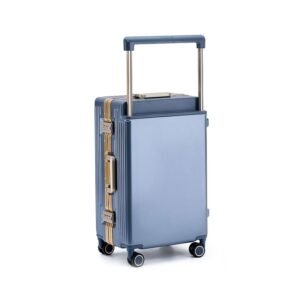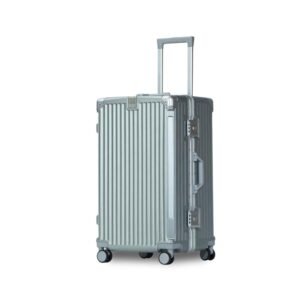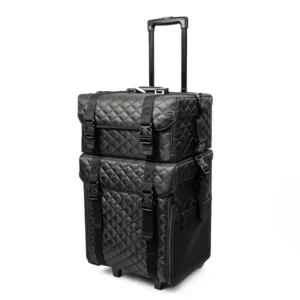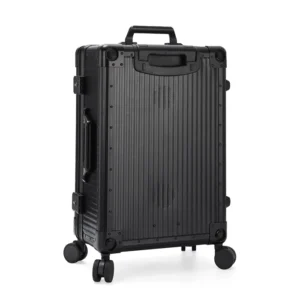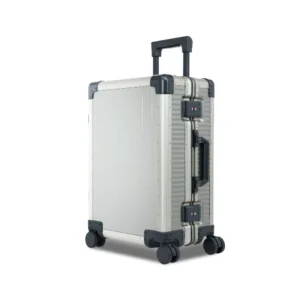

Suitcase wheels are the part a buyer specifies last and a traveller judges first. Five things vary from one wheel to the next: how many there are, whether each corner carries one wheel or two, what the tread is made of, what the wheel turns on, and how it is fixed to the case. This is how each one works, what it changes when the case is rolling, and which of them you will find on our own range.
The types of suitcase wheels at a glance
| Type | What it is | Where it works best | The trade-off |
|---|---|---|---|
| Inline (two wheels) | Two fixed wheels recessed into one edge. The case is tilted and pulled behind you. | Kerbs, cobbles, carpet, stairs | Loads the wrist on long walks; the case cannot roll upright beside you |
| Single spinner | Four wheels on the base, each turning 360° | Airport and hotel floors | Smaller wheels, more exposed to knocks |
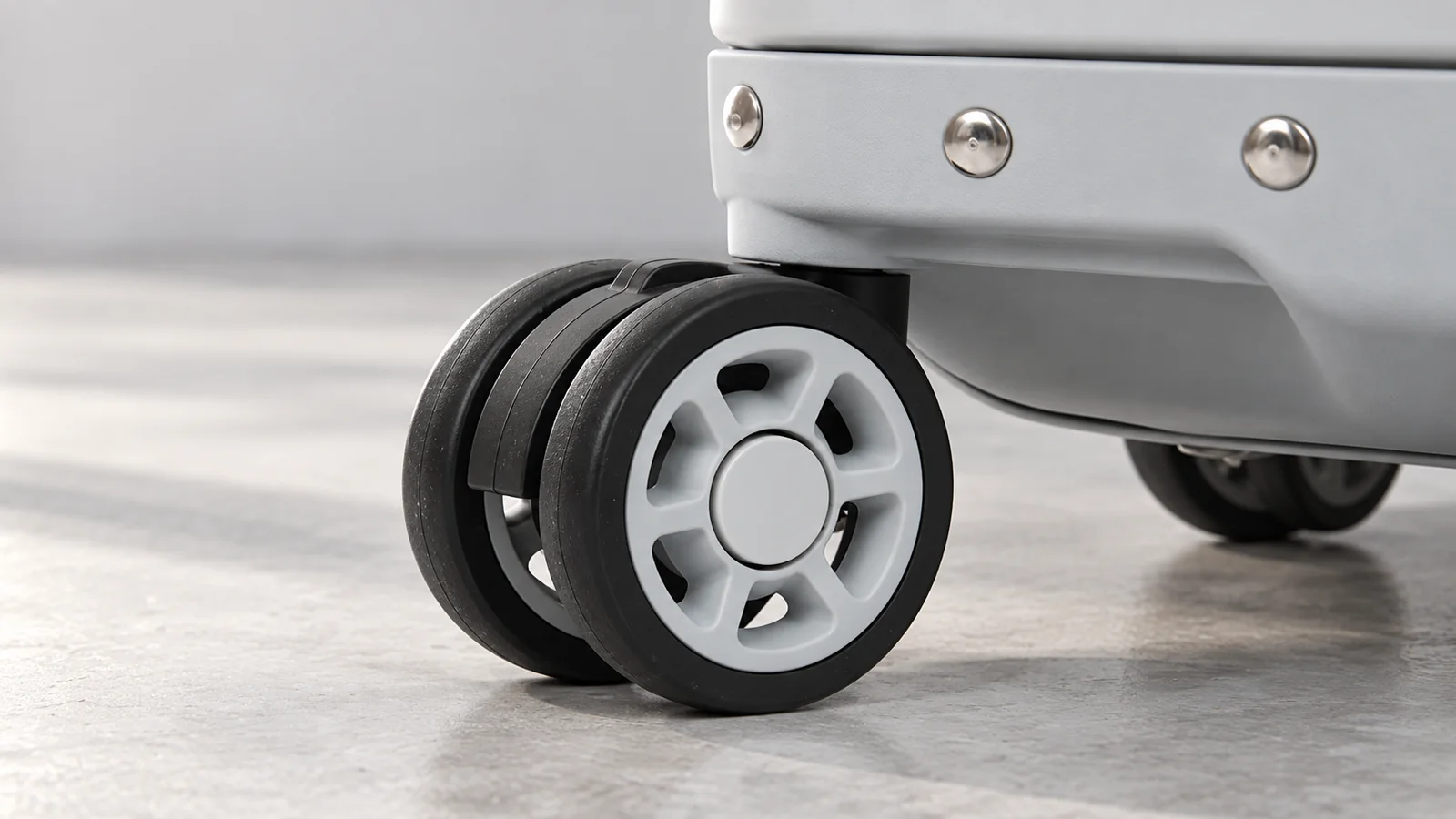
| Double spinner | Four corners, two wheels side by side at each | Heavier cases, longer walks on smooth ground | Heavier and more expensive than a single spinner |
| Spinner with brake | A spinner unit with a small lever that stops the wheel turning | Trains, slopes, cases used as a workstation | Another moving part to wear |
Inline or spinner: two wheels or four
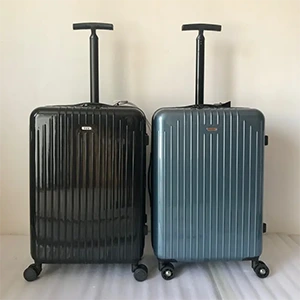
This is the oldest split. An inline case rolls on two fixed wheels set into one edge, so it is always pulled at an angle. Because the wheels are recessed into the body they are protected from knocks, and they cope better with kerbs and uneven paving. A spinner case stands on four wheels that each swivel through 360°, so it can be pushed upright beside you with almost no weight on your arm. It glides on terminal floors and is easier to steer down a train aisle, which is why nearly every hardside suitcase sold today is a spinner.
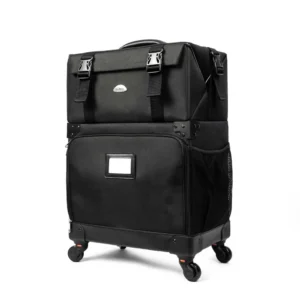
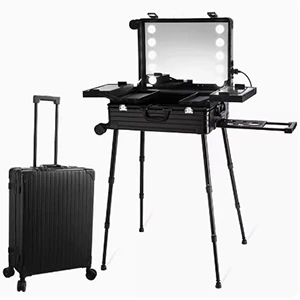
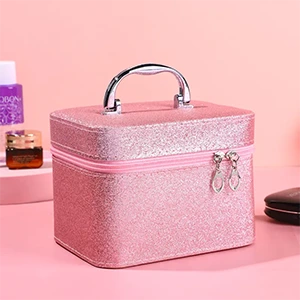
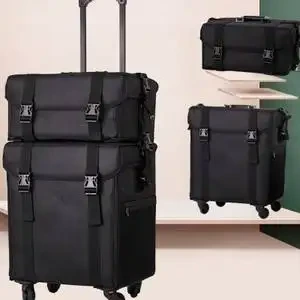
Almost every travel case we make is a four-wheel spinner. The exceptions are makeup cases that are parked and worked out of, where two fixed wheels keep the case where it is put: the HA007A and BH-0043T-B are two examples.
Suitcase spinner wheels: single or double
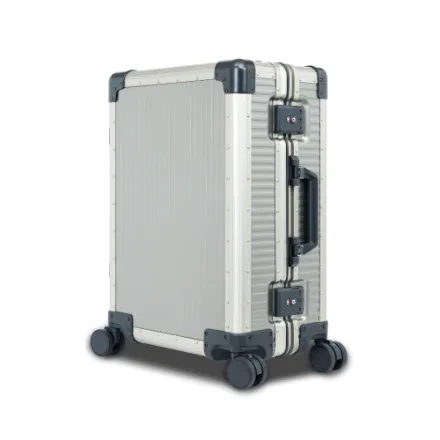
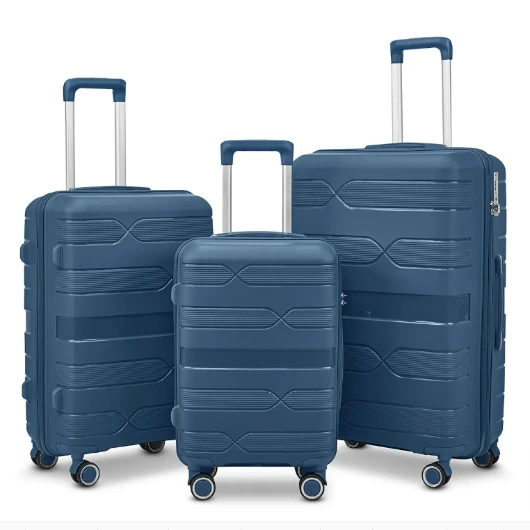
Within spinners, each corner can carry one wheel or a pair. A double spinner puts twice as much tread on the floor, so a loaded case tracks straighter, wobbles less over floor joints and is less inclined to tip on a slope. It also adds weight and cost, and because each of the pair is narrower, each one takes a little more wear on grit.
A single spinner is lighter and perfectly adequate on a carry-on that mostly lives on smooth floors. A double spinner earns its place on a heavy checked case and on anything sold as premium. On our range, the product pages list double spinners on models such as the TS-005 and TS-010 aluminum cases and the RM-027 and MB-020 polycarbonate cases.
What the tread is made of
The tread is the ring of softer material that actually touches the ground. It decides how loud the case is and how quickly the wheel wears. Four materials cover nearly everything on the market.
TPE (thermoplastic elastomer). A rubber-like material that grips well and runs quietly on hard floors. It is the tread named most often on our product pages; the RM-025, for example, uses thickened TPE wheels.
PU (polyurethane). Harder-wearing than TPE while still quiet, which is why it turns up on higher-priced wheels and on cases expected to see pavements rather than terminals. It costs more.
Rubber. Soft and quiet, with good grip on wet or uneven ground. The TB-032 on our range runs on double rubber wheels.
Hard plastic. PP or nylon with no soft tread. It is the cheapest option and the loudest, and it is common on entry-level cases. On our range, the MB-033 lists PP spinner wheels.
What the wheel turns on
Inside the hub, the difference between a cheap wheel and a good one is whether it turns on a steel ball bearing or on a plain plastic bushing. A ball bearing rolls with less push and stays smooth after grit gets in, and it is the main reason one wheel feels expensive in the hand and another does not. The swivel above the wheel, which lets it turn through 360°, has its own bearing or bushing for the same reason. On our range, the TB-032 lists stainless steel bearings, and the JL-3512T makeup case lists a metal core-bearing structure.
How the wheel is fixed to the case, and why it matters
The housing is the part that holds the wheel to the base. On some cases it is moulded into the shell, and a broken wheel means a broken case. On others the wheel unit is a separate part, and a damaged wheel can be taken off and replaced on its own. Ours are the second kind: the wheels on our cases can be replaced individually. Several product pages go further and describe the wheels as detachable, including the TS-004 aluminum carry-on, the MB-014 cabin case and many of our rolling makeup cases.
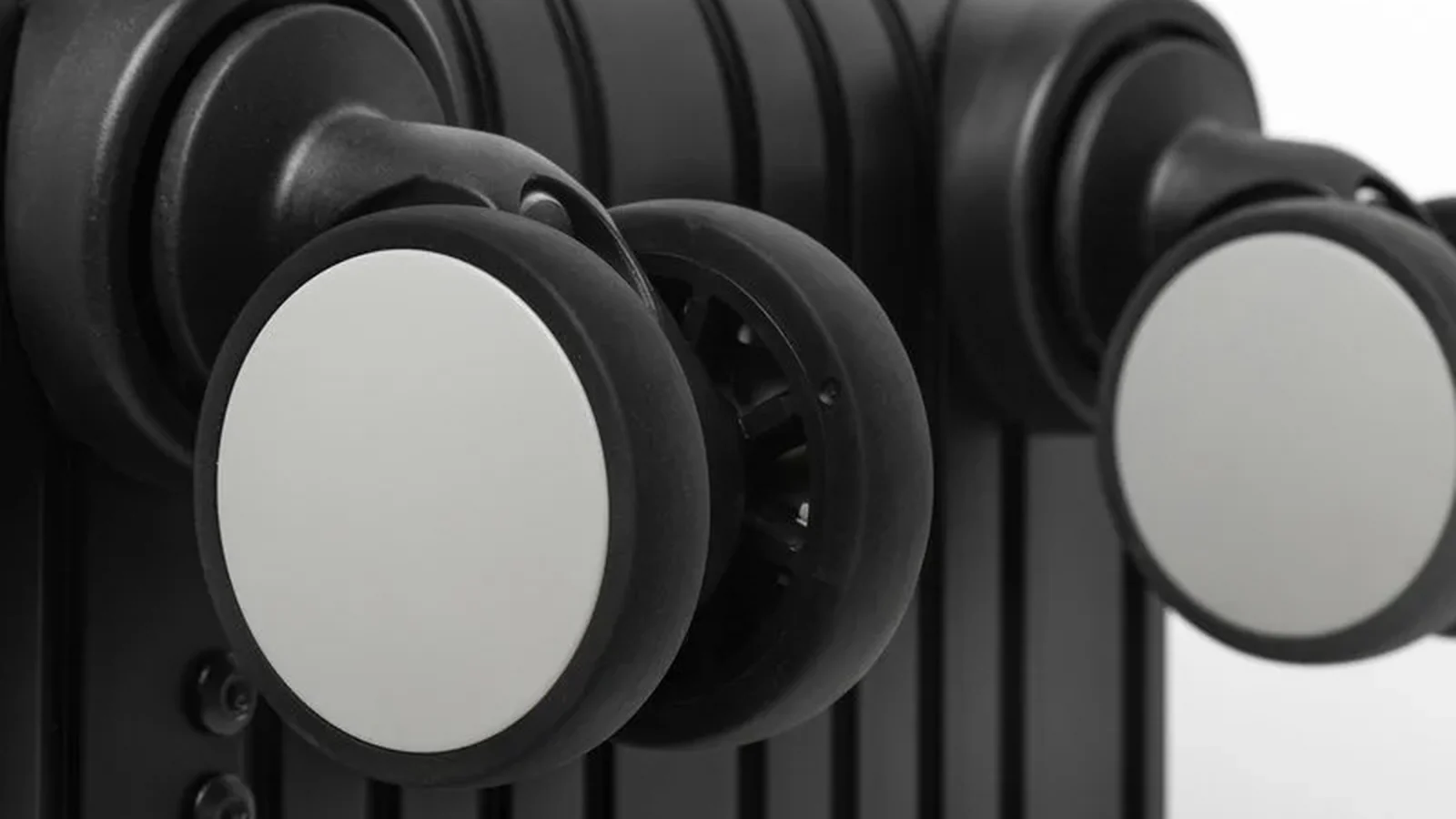
If you are comparing cases, this is the question that decides whether a broken wheel five years from now is a repair or a replacement suitcase.
What makes the best luggage wheels
There is no single best wheel, only the best wheel for where the case will roll. A few checks tell you more than a spec sheet:
Push it loaded. An empty case rolls well on almost any wheel. Put weight in it and push it across a floor joint or a doorway threshold. A good spinner tracks straight; a poor one shudders and pulls to one side.
Listen to it. On a hard floor, TPE, PU and rubber treads are quiet; hard plastic rattles. If “silent wheels” is a line on the listing, the tread material is what delivers it, so look for it by name.
Spin each wheel by hand. A wheel on a ball bearing keeps turning; one on a bushing stops almost at once.
Ask whether it can be replaced. A wheel that comes off as a part is worth more over the life of the case than a slightly better wheel that cannot.
Match the configuration to the case. A double spinner on a heavy checked case, a single spinner on a light carry-on, inline wheels if the case will spend its life on cobbles.
How we test wheels
Before samples or bulk orders leave the factory, our cases go through a set of common tests: high temperature, compression, waterproofing, scratch resistance, load bearing, handle extension lifespan and wheel drag. Wheel drag is the one aimed at the wheels.
Specifying wheels for your own brand
If you are putting your name on a case, the wheel is a line in the specification like the lock or the lining. Tell us three things: single or double spinner, the tread material, and whether the wheel must be replaceable. We will tell you which of our existing models already carry that wheel, and quote from there. The rest of a private label brief is covered on our private label luggage page.
Questions we get asked
Are double spinner wheels better than single? They are more stable and feel more premium, especially on a heavy case. They are also heavier and cost more. On a carry-on that mostly rolls through airports, a good single spinner is not a compromise.
Are spinner or inline wheels better on cobblestones? Inline wheels. They are larger, recessed into the case and pulled rather than pushed, so they ride over gaps that catch the smaller wheels of a spinner.
Which is quieter, TPE or PU? Both are quiet on hard floors. PU generally wears longer; TPE is the more common choice on travel cases. Either is far quieter than hard plastic.
Can suitcase wheels be replaced? On cases where the wheel unit is a separate part, yes. The wheels on our cases can be replaced individually.