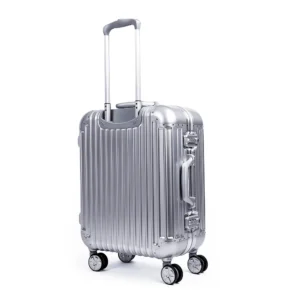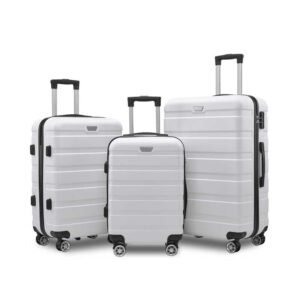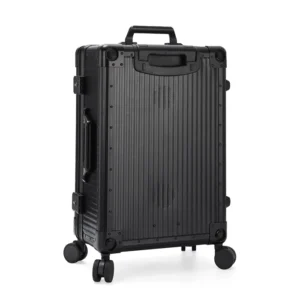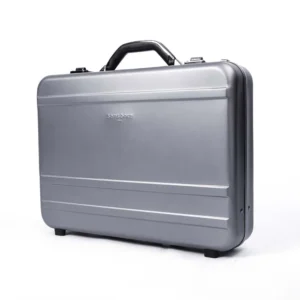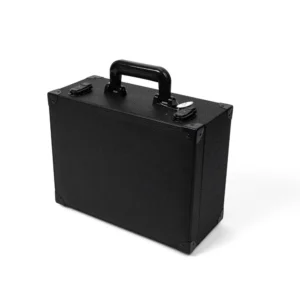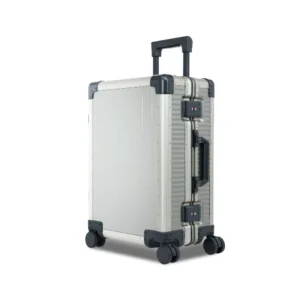

Half the findings on a first order are packaging findings. Not shells, not hardware. Cartons, marks, and counts.
It is also the only part of a luggage program where a wrong decision costs money on every single shipment forever, because the carton sets how many units fit in a container.
Luggage fills a container by volume, not by weight
Start here, because it inverts the usual instinct.
A suitcase is large and light. Stack enough of them and the container runs out of space long before it runs out of payload. Which means the freight cost per unit is set by how efficiently the cartons pack, and a carton that is 30 mm too large in one dimension can cost you a row.
The arithmetic is yours to do and worth doing before you approve a carton drawing. Take the carton dimensions, take the usable internal dimensions of the container you ship in, and work out how many fit. Then change the carton by a centimeter and do it again. The difference is often a number of units, not a rounding error.
Nesting is the other half. Two shells nested inside one carton, or telescopic handles retracted and wheels facing a particular way, can change the count materially. Ask what the factory’s standard nesting is before assuming one case equals one carton.
What has to be on the outside of the box
Three categories, and they come from three different places.
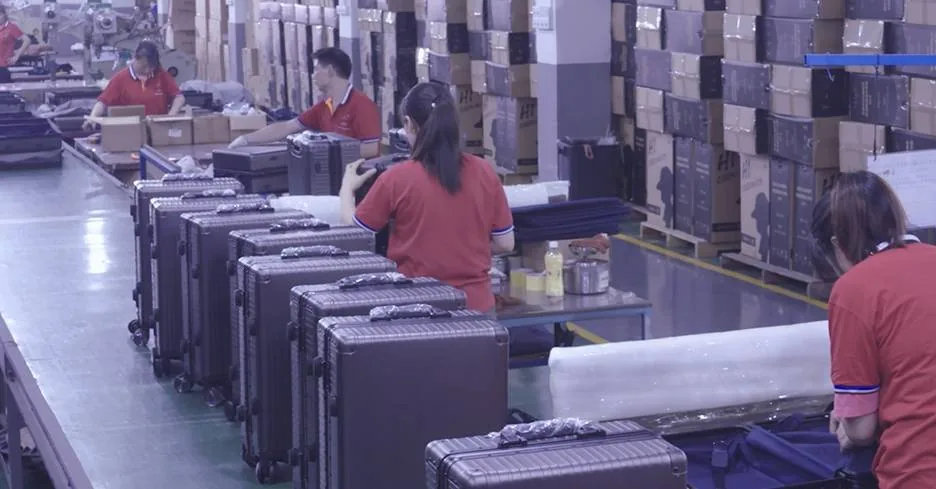
Commercial marks. Your item number, color, size, quantity per carton, net and gross weight, carton dimensions, and carton number in the series. This is the set the warehouse and the inspector both work from.
Regulatory marks. Country of origin, and whatever the destination market requires on the packaging where the product itself cannot carry it. For the United States that sits in our note on importing aluminum luggage into the US. For the EU and Northern Ireland the identification and contact requirements land here too, covered in what GPSR requires. What Canada requires on a prepackaged consumer product, and which parts of it have to be bilingual, is in luggage labelling in Canada.
Handling marks. The symbols and any stacking limit. These are the ones people copy from a previous supplier’s carton without checking whether they still apply.
The wood rule that stops shipments
This one is not negotiable and it is not the factory’s judgment call.
The US Department of Agriculture requires that all wood packaging material entering or transiting the United States is pest-free, debarked, heat-treated or fumigated, and marked with an ISPM 15 logo. The mark carries the IPPC logo, a two letter country code, a unique facility number, and the treatment, shown as HT for heat treatment or MB for methyl bromide.
The consequence is stated just as plainly. Shipments containing noncompliant wood packaging material will not be allowed to enter the country. The options after that are tarping, fumigation, destruction under supervision, or re-export.
Several materials sit outside the rule, including plywood, oriented strand board, hardboard, laminated veneer lumber, plastic pallets, metal frames, and synthetic foam. Source: USDA APHIS, importing ISPM 15-compliant wood packaging material, checked as of August 2026.
For a luggage program this usually comes down to one question. Are you shipping on wooden pallets or not. If yes, the mark has to be there and legible, and it is worth photographing at loading rather than discovering at the port.
What the packing spec should actually say
Eight lines. They belong in the tech pack alongside everything else, as set out in our note on what a luggage tech pack has to contain.
Inner packaging, meaning the bag or sleeve on the case and whether it is printed. Any corner or wheel protection. Accessories inside the case and where. Carton material and construction, given as a board grade rather than as strong. Units per carton and the nesting arrangement. Carton dimensions and weights. The full mark artwork, positioned. Pallet type, pattern, and whether wood is involved.
The line people leave out is the last one, and it is the one that stops a container.
Where packaging meets the inspection
An inspector counts cartons, scans barcodes, checks marks against the spec, and where you require it, drops a packed carton. All four of those need a document to check against.
Without a packing spec, a packaging finding becomes an argument about what was reasonable. With one, it is a measurement. That distinction is the whole subject of the defect classification list, and packaging deserves its own section in yours.
Timing matters too. If the inspection is scheduled before the goods are packed, packaging is not inspected at all, which is one of the reasons to state a packed percentage in the purchase order rather than leaving the visit date open. Our note on pre-shipment inspection covers that clause.
What we do and what we do not
We pack to the spec in the tech pack, and where there is not one we will send our standard and ask you to mark it up rather than treat silence as approval.
We will tell you what a carton change does to the unit count per container before you approve the drawing, because that is the cheapest moment to find out.
Our minimum is 300 units per design, and smaller test batches are negotiable rather than refused. Sampling runs 7 to 15 days per round and bulk is 45 days from a confirmed sample.
We do not reuse a previous customer’s carton artwork on your order. Marks carry item numbers, origin statements, and contact details, and inheriting somebody else’s is a compliance problem wearing a convenience costume.
Which regulatory marks belong on the carton depends on where the range is sold, and the United Kingdom now answers that differently from the EU, set out in UK product safety after the 2024 split.
Frequently asked questions
How many suitcases fit in a container?
It depends entirely on the carton, because luggage fills a container by volume rather than by weight. The way to get a real number is to take the approved carton dimensions and the usable internal dimensions of the container, then calculate the fit, and to repeat that if the carton changes size. Nesting matters as much as the carton, so ask what arrangement the count assumes.
Do we need ISPM 15 marked pallets for luggage shipments to the US?
If the shipment uses wood packaging material, yes. USDA APHIS requires all wood packaging entering or transiting the United States to be pest-free, debarked, heat-treated or fumigated, and marked with an ISPM 15 logo showing the IPPC symbol, country code, facility number, and treatment code. Noncompliant shipments are not allowed to enter. Plywood, oriented strand board, plastic pallets, and metal frames are among the materials outside the requirement.
What belongs on the master carton for a luggage order?
Commercial marks including item number, color, size, quantity, net and gross weight, dimensions, and carton number. Regulatory marks including country of origin and whatever the destination requires where the product cannot carry it. Handling symbols and any stacking limit. All of it should be supplied as positioned artwork rather than described in a sentence.
Written by James
James works at aluvox.com in Houjie, Dongguan. Regulatory references on this page were checked against the official sources linked above in August 2026. This is not legal advice and the current official text governs.