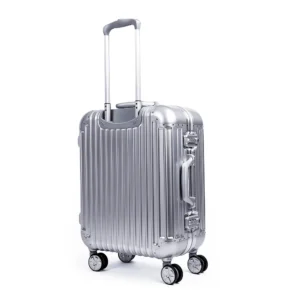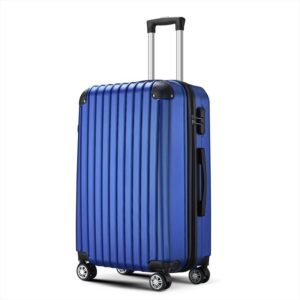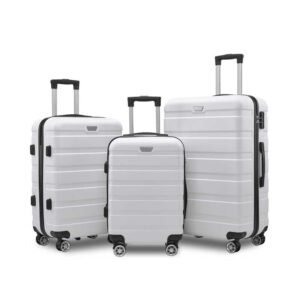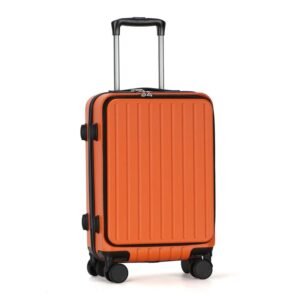

The AQL figure tells an inspector how many defects a lot may contain. The defect list tells them what counts as one. Almost every guide on this subject covers the first and stops.
This is the second half, written for a luggage program. It is a buyer’s document, and it has to exist before the first unit is packed rather than on the day the inspector calls.
The three tiers, and what each is for
Inspection bodies use the same three tiers. QIMA defines critical defects as safety or compliance failures, with an AQL typically set to 0. Major defects affect function or appearance significantly and would likely cause a return, commonly at AQL 1.0 or 2.5. Minor defects are small cosmetic issues that do not affect function, commonly at AQL 4.0.
Source: QIMA, acceptable quality limit, checked as of August 2026.
Note what that leaves open. The tiers are standard. Which mark on which panel lands in which tier is not, and no standard will tell you.

What makes a line usable
A defect line needs three things. A threshold, a location, and a viewing condition. Miss any one and the line will be argued about.
Unusable: no obvious scratches on the shell. Obvious to whom, at what distance, on which face.
Usable, in form: scratch on lid face, longer than 5 mm, visible at 60 cm under office lighting, equals major.
The 5 mm and the 60 cm in that example are yours to set. The structure is the part that has to be there. A number without a viewing condition is still an argument, because a mark you have to tilt the case to find is not the same defect as one you see walking past.
Six areas a luggage list has to cover
Shell surface. Scratch length and depth, dents, and how many are allowed per panel and per case. State which faces are graded strictly. The lid is seen. The base is not.
Finish. Color deviation against an approved physical sample rather than a screen value. Gloss variation. Coverage at edges and inside corners, which is where coating thins and where a list usually says nothing.
Hardware function. Lock operation, wheel rotation and noise, handle extension and retraction, latch engagement. Say whether the handle is tested empty or loaded, because those are different tests and only one of them resembles use.
Alignment and fit. Lid to base gap in millimeters, frame seating, hardware square to the panel. This is where a case looks wrong without anyone being able to say why.
Interior. Lining seams, divider fit, zipper operation, loose threads, adhesive marks.
Markings and packaging. Logo position and orientation, country of origin marking, barcode scan rate, carton count and carton marks. Put a wrong or missing origin mark in the critical tier, because it is a compliance failure rather than a cosmetic one.
Three ways these lists usually fail
Adjectives instead of thresholds. Slight, minimal, acceptable, and clean are not measurements. Every one of them transfers the decision to whoever is standing in the warehouse.
No location datum. A mark 3 mm from an edge and a mark in the middle of a panel are not the same defect, and a list that does not say so will be read the generous way.
Function tested in the wrong state. Wheels rolled on a bench with an empty case pass. Wheels rolled with the case loaded to its rated weight are a real test. Say which one you want.
Whose document this is
The buyer’s. It travels with the purchase order, it is referenced on the proforma invoice, and it is what the third party inspector is given.
A factory can and should send a starting draft, because a factory knows which failures actually occur on its line. What a factory should not do is set your thresholds. Where the line falls between acceptable and rejected is a commercial decision about your customer and your return rate, not a manufacturing one.

What we do and what we do not
We work to the defect classification list the buyer provides. Where there is not one we send ours and ask you to change it rather than assume our version is yours.
Our minimum is 300 units per design, and smaller test batches are negotiable rather than refused. Sampling runs 7 to 15 days per round and bulk is 45 days from a confirmed sample.
We do not argue classification after an inspection has started. If a line is ambiguous, that is a fault in the document, and we would rather fix the document than win the argument.
We also do not treat a stricter list as an insult. A list with real thresholds protects the factory as much as the buyer, because it is the only thing that makes a rejection reviewable.
Origin marking is one compliance line on the list. For EU shipments there are three more, set out in who has to be responsible for it inside the EU.
Closure operation appears in this list as a line item, and on a zippered case the specification behind that line is its own subject, covered in luggage zipper sourcing.
Frequently asked questions
Who is supposed to write the defect classification list?
The buyer. The factory can supply a starting draft because it knows which failures occur on its line, but the thresholds are a commercial decision about your customer and your return rate. Whoever sets them owns them.
What AQL values go with each defect tier?
Critical is typically set to 0 because those are safety or compliance failures. Major is commonly 1.0 or 2.5, and minor commonly 4.0. The values are conventions rather than rules, and they should follow your actual risk tolerance for the product.
Does a defect list replace an AQL sampling plan?
No, the two do different jobs. The sampling plan decides how many units are checked and how many failures are allowed. The defect list decides what a failure is. Without the second, the first is counting something nobody has defined.
Written by James
James works at aluvox.com in Houjie, Dongguan. Standards and test method references on this page were checked against the sources linked above in August 2026.