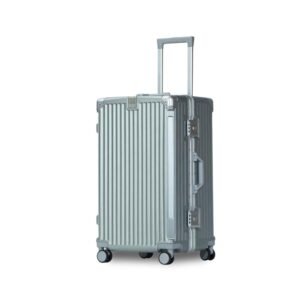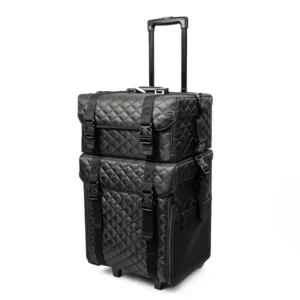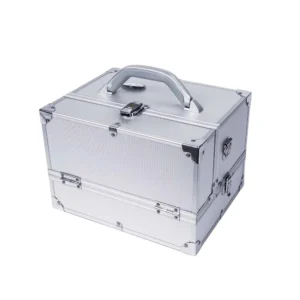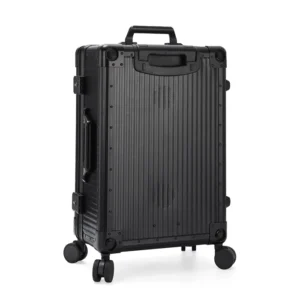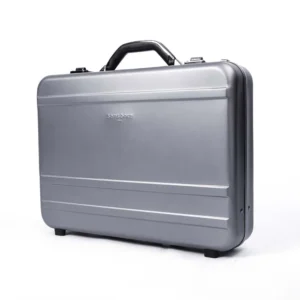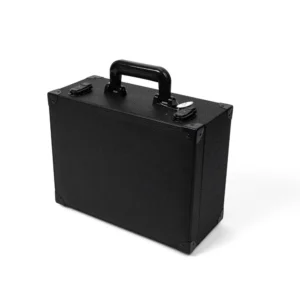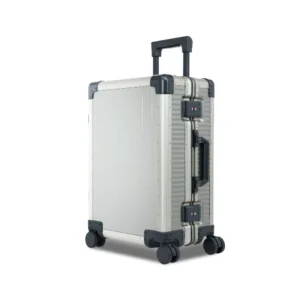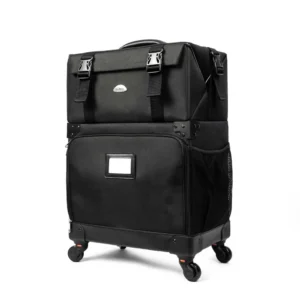


AQL decides how many defects a shipment may contain before it is rejected. It does not decide what counts as a defect, and that second question is the one that turns into an argument on the inspection floor.
Agree the defect list before production. The sampling plan is the easy half.
What the standard actually is
The sampling scheme behind almost every luggage inspection is ISO 2859-1, sampling procedures for inspection by attributes, part 1, sampling schemes indexed by acceptance quality limit for lot-by-lot inspection.
Worth knowing if you are reading older guidance: the standard was reissued. The third edition, ISO 2859-1:2026, was published on 2026-01-22 by ISO/TC 69/SC 5 and adds skip-lot sampling procedures along with updated application guidance. Source: ISO 2859-1:2026, checked as of August 2026.
Most buyer guides on this subject still describe the 1999 edition. If your inspection protocol names a revision year, check which one it names.
How the sample size gets decided
Two inputs. Lot size, and inspection level.
There are three general levels. Level I checks fewer units and suits a supplier with a settled record. Level II is the default for general consumer goods and visual checks. Level III checks more and is what you move to after a supplier has had a problem.
The effect is larger than most brands expect. On a 5,000 piece order the sample is 80 units at level I, 200 at level II, and 315 at level III. On 40,000 pieces it is 200, 500, and 800. Source: QualityInspection.org, AQL inspection levels, checked as of August 2026.
Then the AQL figure sets how many of those sampled units may fail. Common values in this category are 1.5, 2.5, and 4.0, usually applied as a tighter number for major defects and a looser one for minor.
All of which is arithmetic. None of it tells the inspector what a defect is.
The part AQL does not decide
Here is the situation that produces the phone call. An inspector finds a 3 mm mark on a brushed panel. Is that a major defect, a minor defect, or acceptable finish variation?
The standard has no opinion. Whoever wrote the defect classification list has the opinion, and if nobody wrote one then the opinion belongs to whoever is standing in the warehouse that day.
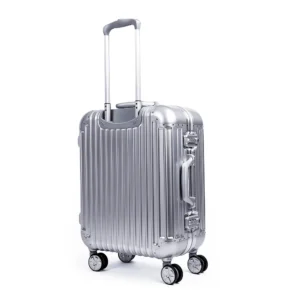
This matters more on metal than on plastic. A textured plastic shell absorbs the visual noise of handling. A brushed or anodized surface is a plain field, so the same handling produces marks that a person can see and therefore has to judge. The judgment is a specification decision, not an observation, and it has to exist in writing before the first unit is packed.
What a luggage defect list has to name
Six areas. Each needs a rule with a threshold, not an adjective.
Shell surface. Scratch length and depth that separates minor from major, per panel and per case. Say where you measure from, because a mark on the base is not a mark on the lid.
Finish. Color deviation against an approved physical sample rather than against a screen. Gloss variation. Coverage at edges and inside corners, which is where coating thins.
Hardware function. Lock operation, wheel rotation and noise, handle extension and retraction force, latch engagement. These are pass or fail, which makes them the easy ones.
Alignment and fit. Lid to base gap, frame seating, hardware seated square. Give a millimeter tolerance.
Interior. Lining seams, divider fit, zipper operation, loose threads.
Markings and packaging. Logo position and orientation, country of origin marking, barcode scans, carton count, drop of the packed carton if you require it.
A list like that fits on two pages. It removes most of what people argue about later.
What we do and what we do not
We work to the defect classification list the buyer provides, and where there is not one we will send ours and ask you to change it rather than assume our version is yours. Audit and test reports we hold are released on request at first inquiry.
Our minimum is 300 units per design, and smaller test batches are negotiable rather than refused. Sampling runs 7 to 15 days per round and bulk is 45 days from a confirmed sample.
We do not argue about classification after an inspection has started. If the list is ambiguous, that is a fault in the document and we would rather fix the document than win the argument.
We also do not treat a third party inspection as an inconvenience. A buyer who inspects is a buyer who reorders, and the report is a cheaper conversation than a return.
Inspection only protects you if it happens before the balance falls due. See which payment structure puts the risk where.
The sampling plan is the easy half. The document that decides what gets counted is what a defect list has to fix.
Sampling decides how many units get opened. When the inspector is called, and what the balance is conditional on, is the other half of the same arrangement, covered in pre-shipment inspection.
Frequently asked questions
Which AQL inspection level should I use for luggage?
General level II is the default for consumer goods and visual checks. Level I reduces the sample and suits a supplier with a settled record. Level III increases it and is the right response after a quality problem rather than a permanent setting.
What is your quality control process?
Incoming material and component checks, in process checks during forming and assembly, and a final check before packing, against the buyer’s defect classification list where one exists. We support third party inspection at any of those points and release the reports we hold on request.
Does AQL guarantee no defective units?
No, and it is not designed to. It is a statistical acceptance rule applied to a sample, so it controls the rate of defects a lot may contain rather than eliminating them. That is why the defect classification list matters more than the AQL figure. It decides what is being counted in the first place.
Written by James
James works at aluvox.com in Houjie, Dongguan. Standards and test method references on this page were checked against the sources linked above in August 2026.